A Penitent Blogger

Mindful of my imperfections, seeking to know Truth more deeply and to live Love more fully.

Quid sum miser tunc dicturus? Quem patronum rogaturus? Cum vix iustus sit securus?
Recordare, Iesu pie, Quod sum causa tuae viae: Ne me perdas illa die...

Thursday, May 31, 2007

Wonder and joy

In some respects, a relationship between God and human beings is something quite natural. As St. Augustine said: “For you have made us for yourself and our hearts are restless until they rest in you.”

Indeed, some people take it for granted that God has a relationship with us. After all, they might ask, why not?

But if you fully and carefully consider the reality, the reasons “why not” are overwhelming.

After all, we are finite beings with finite minds: scarcely able to figure out what we are going to do a year or a decade from now, let alone understand Infinity and Eternity.

Moreover, God is perfectly happy within himself: omnipotent, he needs nothing from anyone or anything, let alone a relationship with such insignificant and clueless creatures such as ourselves.

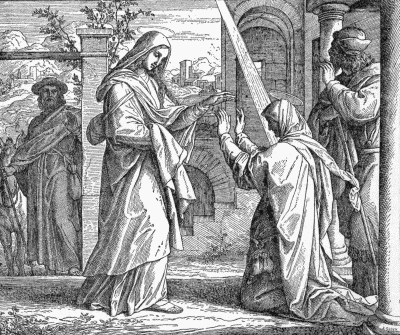
These are some of the facts underlying Elizabeth’s famous exclamation in today’s Gospel (Luke 1:39-56):

And how does this happen to me,
that the mother of my Lord should come to me?


Elizabeth, even having experienced miracles and having heard her husband’s account of seeing the Archangel Gabriel, is nonetheless struck with wonder that “the mother of my Lord should come to (her)” - that God is present and at work in her life, in the life of her family and indeed all of God’s people.

You and I need to recapture this kind of wonder: to be amazed yet again that the God of Infinite Power and Eternal wisdom freely and lovingly chooses to have a relationship with us - US!!!

Once we have recaptured this graced feeling of wonder, then joy will leap within us, as it did for Elizabeth and even for her unborn son John: joy that springs naturally from true wonder and the joy from God’s side of the relationship, as described in one of the two first readings provided for today’s feast (Zephaniah: 3:14-18a):

The LORD, your God, is in your midst,
a mighty savior;
He will rejoice over you with gladness,
and renew you in his love,
He will sing joyfully because of you....


May we always be open to the wonder and the joy of God by the grace of our Lord and Savior Jesus Christ.

Ut veniat mater Domini mei ad me

When Elizabeth heard Mary's greeting,
the infant leaped in her womb,
and Elizabeth, filled with the Holy Spirit,
cried out in a loud voice and said,
"Most blessed are you among women,
and blessed is the fruit of your womb.
And how does this happen to me,
that the mother of my Lord should come to me?"
(Luke 1:41-43)

Et factum est,
ut audivit salutationem Mariae Elisabeth,
exsultavit infans in utero eius,
et repleta est Spiritu Sancto Elisabeth
et exclamavit voce magna et dixit:
"Benedicta tu inter mulieres,
et benedictus fructus ventris tui.
Et unde hoc mihi,
ut veniat mater Domini mei ad me?"


Today the Church celebrates
the Feast of the Visitation of the Blessed Virgin Mary.


(from an earlier post)

Wednesday, May 30, 2007

We want you to do for us whatever we ask of you

This simple statement by James and John in today’s Gospel (Mark 10:32-45) expresses perfectly the attitude that many of us often have as we approach the Lord in prayer:

We want you to do for us whatever we ask of you.

It is easy to imagine our Lord smiling gently but gravely in response.

You do not know what you are asking.

Our attitude at prayer should not follow the example of James and John (as human as it is), but rather the example that Christ himself gives us near the end of this Gospel (14:36) as he speaks to the Father from his heart:

Not what I will
but what you will.

May this be our attitude in prayer
and in our daily lives may our attitude also be Christ’s,
as he tells us at the end of today’s Gospel.

Whoever wishes to be great among you
will be your servant;
whoever wishes to be first among you
will be the slave of all.
For the Son of Man did not come to be served
but to serve
and to give his life
as a ransom for many.

May we do what God asks of us.

Catholic Carnival

This week's Catholic Carnival - a collection of posts from various Catholic blogs - is online at just another day of Catholic pondering.

Tuesday, May 29, 2007

Give it up

Most of us like to have things of our own.

Today’s readings remind us that the greatest rewards are to be found in giving up the things that are our own.

The first reading (Sirach 35:1-12) begins by reminding us that this is more than giving up material possessions, but even giving up our own will and desires in order to obey the law of the Lord.

To keep the law
is a great oblation,
and he who observes the commandments
sacrifices a peace offering….

To refrain from evil
pleases the LORD,
and to avoid injustice
is an atonement….

The just one’s offering
enriches the altar
and rises as a sweet odor before the Most High.
The just one’s sacrifice is most pleasing,
nor will it ever be forgotten.

The religious actions of the unrepentant, on the other hand, are not so successful.

But offer no bribes (to the Lord),
these he does not accept!
Trust not in sacrifice of the fruits of extortion.
For he is a God of justice,
who knows no favorites.

Part of being righteous, of course, entails giving up material possessions for the aid of the poor.

In works of charity
one offers fine flour,
and when he gives alms
he presents his sacrifice of praise.


Yet righteous living and altruism are not enough. We must be also generous in the worship and thanksgiving we give to the Lord.

Appear not before the LORD empty-handed,
for all that you offer is in fulfillment of the precepts….

In a generous spirit pay homage to the LORD,
be not sparing of freewill gifts.

With each contribution show a cheerful countenance,
and pay your tithes in a spirit of joy.

Give to the Most High as he has given to you,
generously, according to your means.

For the LORD is one who always repays,
and he will give back to you sevenfold.

This promise is reaffirmed by our Lord himself in today’s Gospel (Mark 10:28-31):

Peter began to say to Jesus,
‘We have given up everything and followed you.”

Jesus said,
“Amen, I say to you,
there is no one who has given up
house or brothers or sisters
or mother or father or children or lands
for my sake
and for the sake of the Gospel
who will not receive a hundred times more
now in this present age:
houses and brothers and sisters
and mothers and children and lands,
(with persecutions),
and eternal life in the age to come.”

Monday, May 28, 2007

A way back

For some of us, at some point our lives became “complicated” – to put it diplomatically.

To put it bluntly, we took a wrong turn.

We probably had reasons. We probably thought it was the only thing we could do under the circumstances. We probably rationalized brilliantly.

But the truth remains that we had veered from the path God had lighted for us.

Today’s readings, as we begin again the Ordinary Time of the Church calendar, give us words of great hope, beginning with the first reading (Sirach 17:20-24):

To the penitent God provides a way back,
he encourages those who are losing hope
and has chosen for them the lot of truth.

Perhaps we cannot see a way back. Perhaps we feel we have gone too far astray and that the cost would be too high. Perhaps we feel that it is impossible for us to find a way back from the dark and complex morass into which we have wandered.

But in today’s Gospel (Mark 10:17-27) our Lord and Savior Jesus Christ gives us the ultimate words of hope:

For men it is impossible,
but not for God.
All things are possible for God.


In his way, in his time, by his grace, God extends to us a way back.

May we reach our hands to him and follow.

Sunday, May 27, 2007

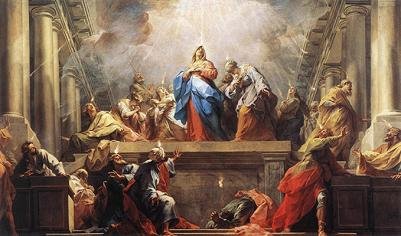
Pentecost

Veni, Sancte Spiritus
reple tuorum corda fidelium,
et tui amoris in eis accende.

V. Emitte Spiritum tuum et creabuntur.
R. Et renovabis faciem terrae.

Oremus

Deus,
qui corda fidelium
Sancti Spiritus illustratione docuisti.
Da nobis in eodem Spiritu recta sapere,
et de eius semper consolatione gaudere.
Per Christum Dominum nostrum.
Amen.


Come, Holy Spirit,
fill the hearts of Thy faithful
and enkindle in them the fire of Thy love.

V. Send forth Thy Spirit and they shall be created
R. And Thou shalt renew the face of the earth.

Let us pray:
O GOD,
Who didst instruct the hearts of the faithful
by the light of the Holy Spirit,
grant us in the same Spirit to be truly wise,
and ever rejoice in His consolation.
Through Christ our Lord.
Amen.

Saturday, May 26, 2007

Keep on teaching

Today’s first reading gives us the end of the Book of the Acts of the Apostles(28:16-20, 30-31): not with Paul’s death, but with his continuing to teach about Christ:

He received all who came to him,
and with complete assurance
and without hindrance
he proclaimed the Kingdom of God
and taught about the Lord Jesus Christ.


It is appropriate,
not only because that is what Paul’s life was all about
but also because that is what our lives should be all about:
being open to everyone,
being strong in our faith,
holding nothing back of what we believe,
proclaiming the Kingdom of God by our words and actions,
and teaching others the full truth
in and about our Lord and Savior Jesus Christ.

The teenager came to the city with no cash

Philip had left behind his family, his job, and a promising future.

He got a position as a tutor that included room and board. When he was not tutoring, he spent his time praying, reading, and sharing his faith with people on the street.

Many of those he met on the street would also dedicate themselves to the service of God. Some stayed with him, others entered religious orders. Philip sometimes thought about becoming a missionary or a hermit, but he was convinced that the city itself would be for him both mission territory and a hermitage.

In time, he became a priest and gathered a religious community around him that focused on prayer, preaching, and music. His community was known as the Congregation of the Oratory and would be associated with a form of musical presentation known as the "oratorio."

St. Philip Neri died in Rome 411 years ago tomorrow and his memory is celebrated on this day. Congregations of the Oratory can be found in many places, from Pittsburgh to South Africa and most famously the Oratory that Cardinal John Henry Newman founded at Birmingham, England.

(from an earlier post)

Friday, May 25, 2007

Where you do not want to go

Christ’s words to Peter in today’s Gospel (John 21:15-19) are spoken to us as well.

Someone else will dress you
and lead you where you do not want to go.


Christ was foretelling how Peter would die.

Christ is also telling us how we should live:
being prudent and taking care of ourselves as we can,
but remembering we need to seek the glorious robes of grace
rather than our own comfort or glory
and to follow where God leads
rather than the way of our own desires.

And when he had said this,
he said to him,
Follow me.”

They sent her to a convent

But her parents did not want Catherine to become a nun.

In fact, when she expressed interest in a religious vocation, they pulled her out of the convent.

In the end, her parents relented and she became a Carmelite at the age of 16, taking the name of Sister Mary Magdalen.

She would lead a very quiet life of prayer, away from the eyes of the world, but was an instrument of great grace for the entire Church.

Saint Mary Magdalen de Pazzi died 400 years ago today and would be canonized by the end of the century.

The Church was overflowing with scandal

Large numbers of clergy were guilty of financial and sexual corruption and they ridiculed those who sought to change the situation.

The Church was also feeling pressure in the political realm. One of the most powerful men in the world in particular seemed to enjoy bullying the Church.

Through it all, a Benedictine deacon was doing everything he could to turn back the tide.

There were many who listened to him, especially Popes. For twenty years, he was among the loudest and strongest voices promoting internal reform while defending the Church against external threats.

Then, during a papal funeral, after he had refused the position for many years, crowds loudly acclaimed that he must be the new Pope. The cardinals agreed. Despite his protests, he was ordained a priest and bishop. He was now Pope.

He took dramatic action: issuing decrees and dispatching legates to purge scandalous clergy and making authoritative declarations against the government figures that attacked the Church.

The most prominent of these figures, the famous Emperor Henry IV, ended up coming barefoot in the snow to ask the Holy Father’s pardon.

But the politics of the time were treacherous and Pope Gregory VII himself was betrayed by many sides and had to flee into exile where he soon died on this very day in 1085.

Born in poverty and known as Hildebrand, his personal piety and bold struggles for the freedom and purity of the faith would be long remembered and several centuries later he would be canonized as Pope St Gregory VII.

Thus wrote the humble monk

"From the time of my admission to the priesthood to my present fifty-ninth year, I have endeavored for my own use and that of my brethren, to make brief notes upon the holy Scripture, either out of the works of the venerable Fathers or in conformity with their meaning and interpretation."

Thus wrote the humble monk, who spent the whole of his life within the same monastery and who died a few years after he wrote these words on this very day.

This humble monk who made “brief notes” would be recognized as the most learned man of his day and one of the Church’s greatest historians.

Not long after his death, he was known as “the Venerable” and in 1899, more than a thousand years after his death (in 735), Bede the Venerable would be declared a Doctor of the Church.

(adapted from an earlier post)

Thursday, May 24, 2007

Allies

In the Gospels, the Pharisees almost always appear as villains.

In today’s first reading (Acts 22:30; 23:6-11), St. Paul effectively makes the Pharisees his allies in a particular situation.

Paul does this not by compromising the truth, but by focusing on a controversial area in which he and the Pharisees strongly agree.

This wisdom is especially important for us in today’s world.

I once heard a Catholic bishop, whose politics tend to be progressive, say that because abortion was so great an evil, he would hold hands with the (conservative and generally Protestant) Moral Majority to fight it.

Upon the passing of the great Pope John Paul II, prominent Protestant leaders with a deep-rooted theological antipathy toward the Pope of Rome nonetheless spoke glowingly of him in his stands against communism.

More recently, the writer John Allen has often noted that Pope Benedict sees Evangelicals and even Muslims as natural allies in opposing the scourge of secularism and its various denigrations of human nature.

To be sure, we cannot compromise the truth nor ignore the threat that our sometime allies may otherwise pose to the spread of the Gospel, yet we like St. Paul should use every bit of wisdom and prudence we can, including the careful use of allies, so that the Good may be protected and enhanced and that the Truth may be spread more fruitfully.

Wednesday, May 23, 2007

Catholic Carnival

This week's Catholic Carnival - a collection of posts from various Catholic blogs - is online at A Catholic Mom climbing the Pillars.

We and the world

It is very easy, especially if one is young, to let oneself be swept along with the ways of the world, to go along with “everybody else” and to give oneself over to the intoxicating temptations that seem to be all around us.

Of course, the intoxication eventually wears off and we see (sometimes too late) the cliff over which temptation and peer pressure leads.

The ways of the world are thus fraught with peril and so Christians often speak of “being in the world, but not of the world.”

In today’s Gospel (John 17:11b-19), we hear an explanation of what this entails, as we are blessed to overhear these precious words of our Lord Jesus Christ to the Father as he prays for his disciples:

I gave them your word,
and the world hated them,
because they do not belong to the world
any more than I belong to the world.

I do not ask that you take them out of the world
but that you keep them from the Evil One.

They do not belong to the world
any more than I belong to the world.

Consecrate them in the truth.

Your word is truth.

As you sent me into the world,
so I sent them into the world.

May this prayer be fulfilled in you and me
today
and every day of our lives.

Tuesday, May 22, 2007

"Not a matter of partisan politics"

"To suggest that the Church should not clearly voice its teaching and apply it in a pluralistic society is to attack freedom of speech and freedom of religion. The Catholic Church always will and must speak out against the destruction of innocent unborn children. The right to do so is guaranteed by the (United States) Constitution that all legislators are elected to uphold. Speaking and acting against abortion is not a matter of partisan politics. It is a matter of life and death.

"The bishops (of the United States) urge all Catholics, especially those who hold positions of public responsibility, to educate themselves about the teaching of the Church, and to seek pastoral advice so that they can make informed decisions with consistency and integrity."

from a May 18 statement by
Sister Mary Ann Walsh, RSM
Director of Media Relations
United States Conference of Catholic Bishops


(hat tip: Domenico Bettinelli)

My life is not important

In recent decades, self-esteem has been pushed by today’s culture as the be-all and end-all of human existence. Many educators, for example, effectively made “feeling good about yourself” so much more important than things as, well, education, that many young people came out of their school years with very little learning, almost no intellectual discipline or curiosity, and sometimes functional illiteracy. For the individual, the result can be disastrous: with little ability to create value, contribute meaningfully to society, or even earn a living. For society, the greater the numbers of such empty-headed graduates may be, the greater the likelihood of catastrophic collapse will be.

In today’s first reading (Acts 20:17-27), St. Paul says something that is the absolute opposite of today’s self-esteem fetish.

I consider life of no importance to me,
if only I may finish my course
and the ministry that I received from the Lord Jesus,
to bear witness to the Gospel of God’s grace.


Paul, of course, is not suicidal or depressed (although he is sad to leave the Ephesians). Rather, he sees clearly who he is and what life is all about.

To be sure, we should take proper care of ourselves, as good stewards of the life which God has given us, but we must remember that our life on this earth is not an end in itself but rather an instrument in the hand of God for his glory and for the true good of others.

...if only I may finish my course
and the ministry that I received from the Lord Jesus,
to bear witness to the Gospel of God’s grace.

A battered wife

Rita got married very young and she had two sons, but it was a far from happy marriage.

Rita's husband was an angry, abusive man and she suffered with him for 18 years.

He was also involved in a situation that was a cross between a long-running political feud and gang warfare, which eventually led to his being murdered.

Death followed soon after for Rita's sons as well.

Rita then entered the religious life, at the age of 36.

She would live a life of penance, prayer, charity and peacemaking for another 40 years.

St. Rita of Cascia died at the Augustinian convent at Cascia, Italy, on this very day 550 years ago.

(adapted from an earlier post)

Monday, May 21, 2007

You will be scattered

It is great to be the member of a large Church, with millions and millions of people who believe as we do.

It is great to live in communities where authentic Christian values are considered good things and fully lived.

Today’s Gospel (John 16:29-33) reminds us that we are not guaranteed the comforts of numbers or solidarity.

Behold, the hour is coming
and has arrived
when each of you will be scattered to his own home
and you will leave me alone.


But our Lord also reminds us of the comfort that will never leave his faithful ones forsaken.

But I am not alone, because the Father is with me.

I have told you this
so that you might have peace in me.

In the world you will have trouble,
but take courage, I have conquered the world.

He was a good priest

He said Mass, heard confessions, and taught seminarians.

For that, the federal government threw him in front of a firing squad 80 years ago this coming Friday.

21 other priests and three laymen were executed as part of that same "crackdown" by the Mexican government.

Father Christopher Magallanes and companions were canonized by the great Pope John Paul II in the year 2000 and their memory is celebrated on this day.

(adapted from an earlier post)

Sunday, May 20, 2007

You are witnesses

Some places have lawfully transferred the celebration of the Ascension to today; others celebrate today the seventh Sunday of Easter (having celebrated the Ascension on its proper day). As on Thursday, therefore, the readings differ, depending upon whether Ascension is being celebrated today or not.

A key theme of both readings, however, is the task our Lord gives us: to be his witnesses to the world.

In the Gospel for the Ascension (Luke 24:46-53), having spoke of his death and resurrection, our Lord reminds the Disciples: “You are witnesses of these things.”

This task belongs to us. It is a glorious yet challenging responsibility.

But the Lord Jesus Christ gives us the grace to do it. Indeed, in the Gospel of the Sunday (John 17:20-26) our Lord gives us the all-powerful support of his prayers.

I pray not only for them,
but also for those
who will believe in me through their word...

May we go forward in the power of that prayer and with the help of the Holy Spirit be witnesses of the things of God.

Saturday, May 19, 2007

Accurate and more accurately

In today’s first reading (Acts 18:23-28), Apollos is described as teaching “accurately about Jesus” and yet himself needing to be taught “more accurately”.

So it is for each one of us. We may know much about the Lord and yet there is always more to know.

As learned and as experienced as we may be, there is always more for the Holy Spirit to teach us of the infinite mysteries of God.

May we never be too proud to listen and learn.

Friday, May 18, 2007

Go on speaking

In today’s first reading (Acts 18:9-18), Paul is about to be brought to court for preaching Christ.

The Lord speaks words of encouragement to him:

Do not be afraid.
Go on speaking,
and do not be silent,
for I am with you.

In this particular case, the tribunal refuses to involve itself in matters of religious doctrine.

Later, of course, the secular authorities would involve themselves: Paul would be taken into custody, imprisoned, deported, and executed.

But the truth of what Paul spoke would endure, flourish and spread. The people and the regime that sought to suppress him would themselves crumble into dust.

In the world today we may often encounter opposition, sometimes with the force of law and sometimes just by the oppression of a wayward culture.

Our Lord and Savior Jesus Christ speaks words of encouragement to us:

Do not be afraid.
Go on speaking,
and do not be silent,
for I am with you.

He was not exactly a parishioner

But the powerful man thought the bishop would be a good choice for a diplomatic mission.

When the bishop arrived at his assigned destination, he was greeted with reverent enthusiasm by people at the very highest levels.

The bishop returned the favor by giving strong affirmation to his host and, consistent with his mission and his conscience, passed on a message of peace and kindness (while still upholding truth).

After the bishop returned from his mission, the powerful man went into a rage, threw the bishop into prison, and deprived him of food and water.

John, the first Bishop of Rome to use that name, died there on this very day in the year 526.

(from an earlier post)

Thursday, May 17, 2007

Catholic Carnival

This week's Catholic Carnival - a collection of posts from various Catholic blogs - is online at Book Reviews and More.

Wait

Many places celebrate the Solemnity of the Ascension today.

Some places, with lawful permission, will celebrate it on Sunday.

Today’s readings therefore differ, depending on where the celebration takes place.

Many today hear Luke’s account of the Ascension (Luke 24:46-53), others part of the Farewell Discourse in John (16:16-20).

A common theme to both readings is that of waiting.

In Luke, our Lord tells the Disciples to stay in the city until they are clothed with power from on high. In John, our Lord says, “A little while and you will no longer see me, and again a little while later and you will see me.”

In today’s world, of course, instantaneous gratification is the number one goal: if it feels good, get it now, no matter what. Countless lives have been wrecked in this way. Moreover, the “gratification” achieved (if any) is never full enough or lasting enough.

We should heed the wisdom of the Lord’s command to wait upon him and to move promptly upon his call, not the desires of the moment or the impulses of the flesh.

Wait for the LORD;
be strong, and let your heart take courage;
yea, wait for the LORD!
(Psalm 27:14)

Ascension

Wednesday, May 16, 2007

Ashamed of Christ?

Last Sunday, during the Holy Father’s recent trip to Brazil, he said many important things, including the following:


"What did the acceptance of the Christian faith mean for the nations of Latin America and the Caribbean?

For them, it meant knowing and welcoming Christ, the unknown God whom their ancestors were seeking, without realizing it, in their rich religious traditions. Christ is the Savior for whom they were silently longing....

"In effect, the proclamation of Jesus and of his Gospel did not at any point involve an alienation of the pre-Columbian cultures, nor was it the imposition of a foreign culture.

"Authentic cultures are not closed in upon themselves, nor are they set in stone at a particular point in history, but they are open, or better still, they are seeking an encounter with other cultures, hoping to reach universality through encounter and dialogue with other ways of life and with elements that can lead to a new synthesis, in which the diversity of expressions is always respected as well as the diversity of their particular cultural embodiment.

"Ultimately, it is only the truth that can bring unity, and the proof of this is love.

"That is why Christ, being in truth the incarnate
Logos, 'love to the end', is not alien to any culture, nor to any person; on the contrary, the response that he seeks in the heart of cultures is what gives them their ultimate identity, uniting humanity and at the same time respecting the wealth of diversity, opening people everywhere to growth in genuine humanity, in authentic progress. The Word of God, in becoming flesh in Jesus Christ, also became history and culture.

"The Utopia of going back to breathe life into the pre-Columbian religions, separating them from Christ and from the universal Church, would not be a step forward: indeed, it would be a step back. In reality, it would be a retreat towards a stage in history anchored in the past.

"The wisdom of the indigenous peoples fortunately led them to form a synthesis between their cultures and the Christian faith which the missionaries were offering them. Hence the rich and profound popular religiosity, in which we see the soul of the Latin American peoples....

"All this forms the great mosaic of popular piety which is the precious treasure of the Catholic Church in Latin America, and must be protected, promoted and, when necessary, purified....

"The Church has the great task of guarding and nourishing the faith of the People of God, and reminding the faithful of this Continent that, by virtue of their Baptism, they are called to be disciples and missionaries of Jesus Christ. This implies following him, living in intimacy with him, imitating his example and bearing witness.

"Every baptized person receives from Christ, like the Apostles, the missionary mandate: 'Go into all the world and preach the Gospel to the whole creation. Whoever believes and is baptized, will be saved' (Mk 16:15). To be disciples and missionaries of Jesus Christ and to seek life ‘in him’ presupposes being deeply rooted in him."


Some brutally criticized the Holy Father’s remarks, pointing out both the horrific violence and oppression that too many times accompanied evangelization efforts in that part of the world and also some of the positive values in indigenous culture.

As to the latter, the Holy Father actually spoke quite positively of the “rich religious traditions” and “wisdom of the indigenous peoples.”

As to the former, the Holy Father was clearly speaking of “the proclamation of Jesus and of his Gospel” in itself and not was not in any way endorsing any of the violence or oppression that sometimes accompanied it at different times and places. Indeed, the Holy Father spoke very clearly against violent conversion in his famous speech at Regensburg.


Indeed, what the Successor of the Apostle Peter said in Brazil echoed what the Apostle Paul said in Athens, as we hear in today’s first reading (Acts 17:5,22-18:1): that indigenous culture and even religion were not without good aspects that helped prepare their adherents for the fullness of truth in the Gospel of Jesus Christ and that adherents of these cultures (and all men everywhere) are called to repent and embrace Christ.

Popes such as the great John Paul II have apologized for the sins committed by Christians against people of other cultures, yet these sins must never cause any Christian (let alone a Pope) to be apologetic about “the proclamation of Jesus and of his Gospel” in itself.

Again, St. Paul put it perfectly (Romans 1:16):

For I am not ashamed of the gospel:
it is the power of God for salvation
to every one who has faith,
to the Jew first
and also to the Greek.


There is also this warning from our Lord himself (Luke 9:26):

For whoever is ashamed of me and of my words,
of him will the Son of man be ashamed
when he comes in his glory
and the glory of the Father and of the holy angels.


Repairing past evils does not require repudiation of God’s truth and gift of faith in the Lord Jesus Christ, through whom all salvation comes. That would only compound the evil. Indeed, repairing evils that may have accompanied past evangelization requires (among other things) a new evangelization or re-evangelization that is more intense, pure, and complete.

We must be respectful and prudent, yet we must never be ashamed of the Gospel of our Lord and Savior Jesus Christ nor shirk his command to us to “go into all the world and preach the Gospel to the whole creation.”

Tuesday, May 15, 2007

What was that all about?

Sometimes things happen in our lives and it is only later that we understand their importance.

It is even more that way with the things of God, most especially with the life, death and resurrection of Christ.

But Christ does not leave us to figure this out on our own, as we hear in today’s Gospel (John 16:5-11).

I tell you the truth,
it is better for you that I go.

For if I do not go,
the Advocate will not come to you.

But if I go,
I will send him to you.

And when he comes
he will convict the world
in regard to sin
and righteousness
and condemnation:

sin,
because they do not believe in me;

righteousness,
because I am going to the Father
and you will no longer see me;

condemnation,
because the ruler of this world has been condemned

Indeed, it is only with the help of the Holy Spirit that we understand anything of who Christ really is.

It is only with the help of the Holy Spirit, which reaches out to all people, that we understand the grievousness of refusing to believe in Christ.

It is the Holy Spirit that vindicates the righteousness of the Crucified Lord and helps us to reflect that righteousness even when he is no longer here on earth.

It is the Holy Spirit that makes it clear that, although sin and evil may still be prevalent in this world, the victory of Christ over sin and death has already been accomplished.

The Holy Spirit teaches us what Christ is all about and empowers us to reflect that reality in our lives.

May this same Holy Spirit fill our hearts with the full and fiery conviction of faith and help us to live the truth of Christ with words of bold truth and deeds of deep charity.

Suspicions about a farm worker

The other farm workers told their boss that Isidro was always late. When confronted, Isidro gave the excuse that he was going to Mass every morning on his way in and insisted that his work was being done.

The boss remained suspicious, so he put him under surveillance.

Sure enough, he saw Isidro going to Mass.

And later, when he looked into the field assigned to Isidro, he saw him working diligently.

But that was not all: the boss saw a second team plowing in Isidro’s field and they glowed with a heavenly light.

Both Isidro and his wife Maria would become well known for their sanctity and charity.

Isidro died on this very day in 1130 and would be canonized nearly 500 years later. His wife died a few years after him and is also venerated as a saint.

The memory of Saint Isidore the farmer (also known as Isidore the laborer and Isidore of Madrid) is celebrated on this day.

Monday, May 14, 2007

Doing your own thing and going...

...to your own place.

This might not sound too bad to many people, especially today.

In fact, your "own place" sounds very attractive, fulfilling the perennial dream of home ownership.

Except in today’s first reading (Acts 1:15-17, 20-26), where we hear that “Judas turned away to go to his own place.”

...where the neighbors are infernally noisy and the thermostat is forever broken.

(Lord Jesus Christ, son of the living God, be merciful to me – a sinner.)

This quick reference to Judas’ fate is more than just a euphemism: it also gives us a quick and fundamental idea of what hell is.

Teenagers often yearn for their “own place” where they are no longer under their parents’ authority, only to learn the painful realities of the world beyond their parents’ sheltering and nurturing care (which they had long taken for granted).

Likewise, you and I often take for granted the sheltering and nurturing care that God gives his creatures in this world, most especially his human children.

We may not always be conscious of that sheltering and nurturing care in the Creation given us by God, for we are not immune from the deleterious effects of our sin, as individuals and as humanity, but nothing in our imagination could ever prepare us for the horror and the terror, the screaming emptiness and the suffocating darkness, that awaits us in our “own place” – a place we have prepared for ourselves by our free will turned to evil, a place totally apart from God, without even the comforts of his creation, let alone the touch of his Spirit.

(Lord Jesus Christ, son of the living God, be merciful to me – a sinner.)

May we not seek our “own place” but the place of the Lord.

"Do not let your hearts be troubled.
You have faith in God;
have faith also in me.
In my Father’s house
there are many dwelling places.
If there were not,
would I have told you
that I am going to prepare a place for you?
And if I go and prepare a place for you,
I will come back again and take you to myself,
so that where I am
you also may be.
Where I am going
you know the way.”
Thomas said to him,
“Master, we do not know where you are going;
how can we know the way?”
Jesus said to him,
“I am the way and the truth and the life.
No one comes to the Father except through me."

He was not one of the important people

He was not in the inner circle, and that was fine with him: he was thrilled to be involved in any way he could.

Then came the most frightening, confusing, and exhilarating three days of his life.

It wasn’t until weeks later that they realized they needed to fill an opening in the inner circle.

And he was chosen.

Matthias, who had been one of the lesser disciples of Jesus, was selected to replace Judas as one of the Twelve Apostles.

His feast is celebrated on this day.

(from an earlier post)

New Archbishop of Ottawa

The Holy Father has accepted the retirement of the Most Reverend Marcel André Gervais as Archbishop of Ottawa (Canada) and has named as the new Archbishop Terrence Thomas Prendergast, S.J., up to now Archbishop of Halifax.

Archbishop Prendergast was born in Montreal in 1944, entered the Jesuits in 1961, and did his novitiate and juniorate in Guelph, Ontario, his philosophical studies at Loyola Seminary in Shrub Oak, New York, and his theological studies at Fordham University in New York where he obtained his license.

He was ordained a priest in 1972. He then taught theology at Halifax’s Atlantic School of Theology while working on a doctorate in Sacred Scripture, receiving the degree from Halifax’s St. Mary’s University in 1978. He made his solemn profession the following year. From 1980 to 1987 he was Professor of Sacred Scripture at Toronto’s Regis College (where he received a second doctorate in theology in 1982) and the Toronto School of Theology. During this period he was also made Rector of Regis College.

After a sabbatical year in Rome and another in Regina as visiting professor at Camion College, he returned to Toronto in 1989 as Professor of New Testament Theology at Regis College. He was named to a four year term as Dean of Theology beginning in 1991.

In 1995 he was named and consecrated Auxiliary Bishop for Toronto. He was transferred to become Archbishop of Halifax in 1998.

He is the Canadian member of Vox Clara, an advisory commission to the Congregation for Divine Worship and Discipline of the Sacraments on the English translation of the Roman Missal.

In the Canadian Conference of Catholic Bishops, he has served on its Permanent Council, been a member of the Commission for Relations with Associations of Clergy, Consecrated Life and Laity, co-chair of the national Anglican-Roman Catholic Dialogue, a director of the Catholic Office for Life and the Family, and is now serving a second time on the Theology Commission.

(Source: Vatican and Halifax Archdiocesan websites)

Sunday, May 13, 2007

Love, faithfulness, communion

In the first sentence of today’s Gospel (John 14:23-29), our Lord tells us the foundation of the Christian life: love, faithfulness, and communion.

Whoever loves me
will keep my word,
and my Father will love him,
and we will come to him
and make our dwelling with him.

All three are necessary and none of the three can fully exist without the others.

Love without fidelity to the word of the Lord is empty and goes astray.

Fidelity without God’s love (charity) will also be empty and can also destroy.

Neither love nor fidelity can last or bear fruit without the indwelling grace of God.

And communion with God cannot exist without love and faithfulness.

Remembering the motherly love we have received in our lives and those who gave it, may we always strive to grow in love, faithfulness, and communion by the grace of our Lord and Savior Jesus Christ.

Saturday, May 12, 2007

We want to be liked

It is very natural, for humans are inherently social.

Yet this desire to be liked is very often a source of danger.

We all know how peer pressure can lead young people to do things that are wrong and even things that are destructive.

Even as adults, however, most of us very much want to be liked and so we can let this affect our behavior.

Many times there is nothing wrong with this, but many times the desire to be liked by others causes us to be less concerned about what is right and true.

The funny thing is that one does not have to give up being liked in order to do what is right and true. The only question is whether we want to be liked by people beholden to the world or liked (and loved) by faithful brothers and sisters in Christ and open to the infinite love of God.

Our Lord gives us a very clear reminder in today’s Gospel (John 15:18-21):

If the world hates you,
realize that it hated me first.

If you belonged to the world,
the world would love its own;
but because you do not belong to the world,
and I have chosen you out of the world,
the world hates you.

Remember the word I spoke to you,
‘No slave is greater than his master.’

If they persecuted me,
they will also persecute you.

If they kept my word,
they will also keep yours.

And they will do all these things to you
on account of my name,
because they do not know
the one who sent me.

May we always keep ourselves focused on and filled with the love of God, so that we may share that love with others in fullness and in truth: heeding not the likes and dislikes of this world, but remaining faithful to truth and perfect love with all of our brothers and sisters in the Body of Christ.

Many were killed in that place

There were two men. They had been soldiers – and not just any soldiers: they had been among the elite, standing guard in the highest corridors of power, close by the most powerful man in the world.

But then they heard about Jesus and they walked away from the man of power to follow the Son of God.

For that, they were killed.

There was also a boy, 14 years old, who was an orphan. He had just come to the city and had embraced Christ.

They killed him too.

Yet they would all be remembered by the Christians of that place, the city of Rome, and their victory through Christ celebrated.

The memory of Saints Nereus, Achilleus, and Pancras is celebrated on this day.

(from an earlier post)

Friday, May 11, 2007

It’s not up to you

It’s not up to me either.

In today’s Gospel (John 15:12-17), our Lord reminds us that personal choice is not omnipotent. God has given us free will, but only the gift of his grace gives us what we truly need.

It was not you who chose me,
but I who chose you
and appointed you
to go and bear fruit that will remain,
so that whatever you ask the Father in my name
he may give you.


May the hand of the Lord be always upon us, so that we may bear fruit for eternity.

Thursday, May 10, 2007

Petrus locutus est

Today’s first reading (Acts 15:7-21) begins with “much debate” at the Council of Jerusalem.

Then, after Peter speaks,

The whole assembly fell silent,
and they listened...


tacuit autem omnis multitude
et audiebant


Very often, especially in the blogosphere, people are interested above all in their own opinions as well as the thrust and parry of debate.

In today’s first reading, the voice of Peter reminds us that we should be much more interested in listening.

This is so because, as our Lord reminds us in today’s Gospel (John 15:9-11), the ultimate source of truth is not within our individual skulls, the greatest love of all is not self-focused, and true joy comes not from chasing feelings but from following the commandments of God.

When Peter speaks,
we should listen.

Wednesday, May 09, 2007

Remain in me

We feel weak.

The temptations are too strong.

The work to be done is overwhelming.

Comrades have slid back into their past and away from what we have held to be true.

How can we go on?

We cannot.

But, of course, we never could.

Our wits, our willpower, and our strength will never be enough.

In today’s Gospel (John 15:1-8), our Lord and Savior, our Master and Stronghold, Invisible Head of the Church and deepest friend of our hearts, Jesus Christ, reminds us what is the only way to succeed or even survive.

Remain in me,
as I remain in you.

Just as a branch cannot bear fruit on its own
unless it remains on the vine,
so neither can you
unless you remain in me.

I am the vine,
you are the branches.

Whoever remains in me
and I in him
will bear much fruit,
because without me
you can do nothing.

Anyone who does not remain in me
will be thrown out like a branch
and wither;
people will gather them
and throw them into a fire
and they will be burned.

If you remain in me
and my words remain in you,
ask for whatever you want
and it will be done for you.

By this is my Father glorified,
that you bear much fruit
and become my disciples.

We cannot do it
on our own,
but all things can be done
in Jesus.

May we continue forward by the strength of Jesus,
may we become better disciples from the love of Jesus,
and sinful weaklings as we may be
may we bear abundant fruit in the name of Jesus.

Tuesday, May 08, 2007

Catholic Carnival

This week's Catholic Carnival - a collection of posts from various Catholic blogs - is online at Postscripts From The Catholic Spitfire Grill