A Penitent Blogger
Mindful of my imperfections, seeking to know Truth more deeply and to live Love more fully.
Quid sum miser tunc dicturus? Quem patronum rogaturus? Cum vix iustus sit securus?
Recordare, Iesu pie, Quod sum causa tuae viae: Ne me perdas illa die...

Friday, June 30, 2006
Domine, si vis...
Lord, if you wish,
you can make me clean.
Domine, si vis,
potes me mundare.
Our Lord's response is quick (and even quicker in Latin):
I will do it. Be made clean.
Volo, mundare!
It foreshadows the prayer our Lord himself would speak in the Garden of Gethsemane (Matthew 26:39):
My Father, if it is possible,
let this cup pass from me;
yet, not as I will,
but as you will.
Pater mi, si possibile est,
transeat a me calix iste;
verumtamen non sicut ego volo,
sed sicut tu.
Whenever we pray, whenever we feel the need for something, may our own prayer be ever thus.
Domine, si vis....
...non sicut ego volo,
sed sicut tu.
At first, they were not really noticed
At first, they all looked like the other immigrants from the Middle East, but soon normal-looking people were found to have converted to this religion and were setting themselves apart from the mainstream of society.
They became the subject of rumors, ridicule, and investigations.
Then, a horrific criminal act laid waste to the center of the great city, killing many.
The focus quickly fell upon these outsiders.
They and their leaders were rounded up. Many were tortured and many were killed.
These first Christian martyrs of the Church of Rome remained true to their faith, rejoicing to share in the salvific sufferings of Christ, and helped stoke the fires of a spiritual awakening that would flourish when the empire that had sought to crush them was itself dust.
Today the Church celebrates the memory of the first martyrs of the Church of Rome.
(adapted from an earlier post)
Thursday, June 29, 2006
Not prevail
The Church's reputation: a morass of immorality.
The Church's ministers: hiding from the public.
The Church's followers: often indistinguishable from pagans.
The Church's worldwide leader: being tortured at the Vatican.
That was the state of the Church barely thirty years after our Lord said that "the gates of hell shall not prevail against it," as we hear in today's Gospel (Matthew 16:13-19).
It was indeed a dark time for the Body of Christ: Christians were relatively few, the Christian message was not well known or understood, Christians were accused of everything from cannibalism to arson, Christians and their leaders often had to hide from murderous prosecution, some Christians returned in fear to their pagan ways, and Saint Peter himself was being hung upside down on a cross on the Vatican hill.
At that moment, it would have been very easy to think that the gates of hell were indeed prevailing against the Church.
But the gates of hell did not prevail at that darkest of moments in the life of the Church and the gates of hell shall not prevail now nor in the future.
The words of our Lord and Savior Jesus Christ, the Son of God, remain true.
And I say also unto thee,
That thou art Peter,
and upon this rock I will build my church;
and the gates of hell shall not prevail against it.
And I will give unto thee
the keys of the kingdom of heaven:
and whatsoever thou shalt bind on earth
shall be bound in heaven:
and whatsoever thou shalt loose on earth
shall be loosed in heaven.
We as a Church may experience dark times. Like Saint Paul in today's second reading (2 Timothy 4:6-8, 17-18) we may be "poured out like a libation," but if we remain faithful, by God's grace, like Paul we will be able to say
The Lord stood by me and gave me strength,
so that through me
the proclamation might be completed
and all the Gentiles might hear it.
And I was rescued from the lion's mouth.
The Lord will rescue me from every evil threat
and will bring me safe to his heavenly kingdom.
To him be glory forever and ever. Amen.
The Holy Apostles Peter and Paul

The ancient Latin phrase resonates in magnificence, with a feeling of awe and power like the majestic columns of a mighty cathedral: Sanctos Apostolos Petrum et Paulum - the Holy Apostles Peter and Paul.
Their origins were humble and they were slaughtered by the ruling regime almost as an afterthought, their deaths scarcely noted by the chroniclers of the day, but their work, their words, their blood, and their lives -- by the power of Our Lord and Savior Jesus Christ shining through them -- became the foundation of Christendom itself. Now the city that had crushed them is dominated by their monuments.
O Roma felix! Duorum Principum es consecrata sanguine!
God would raise up other great saints, and He continues to do so, but even the greatest but stand on the shoulders of these giants. There would have been no Gregory the Great or John Paul the second without Peter the Rock. There would have been no Thomas Aquinas without Saul of Tarsus.
They were human beings like us and not without flaws, but none could be mightier. They held nothing back: once they were sent forth, they laid everything on the line for Christ, every day of their lives – all their hearts, all their strength, all their talents, their freedom, and even their life's blood – everything went for Christ. They were exalted, yes, but only because they served humbly, lovingly, and forcefully.
If we’re looking for role models in our lives as we seek to make a difference in this world, we could not do better that the Holy Apostles Peter and Paul.

(from an earlier post)
Wednesday, June 28, 2006
Rediscover
Would not these first days of summer (winter) be a good time to rediscover a book of faith (or even two)? To re-read (at a single sitting) an entire Gospel or epistle? To study a classic book of Christian faith?
Tolle et legge.
Turkish Religious Leader in France
The authorities cracked down and many were martyred, including the man who had led them for a quarter of a century.
He was the bishop. His name was Irenaeus.
He had served well, rebuilding the local church community and writing powerfully against the recycled pagan mysticism known as Gnosticism that was enjoying popularity inside and outside the Church.
Irenaeus' greatest work Adversus Haereses is still widely read. He also played a critical role in Scripture scholarship.
St. Irenaeus died in 202 and his memory is celebrated on this day.
(adapted from an earlier post)
Tuesday, June 27, 2006
Catholic Carnival
Giving it to the dogs
Some Christians are zealous: wanting to promote the faith everywhere and to defend the faith against anyone who would question it or attack it, trusting always in the protective and confirming power of the Holy Spirit.
To optimists and zealots alike, our Lord gives the following warning in today's Gospel (Matthew 7:6, 12-14):
Give not that which is holy unto the dogs,
neither cast ye your pearls before swine,
lest they trample them under their feet,
and turn again and rend you.
It is a wonderful thing to be optimistic and it is an even more wonderful thing to be zealous, but the ranks of Christian martyrs are full of optimists and zealots.
Not that there's anything wrong with that - indeed, martyrdom is a blessed destiny (not that self-centered and homicidal martyrdom of gullible terrorist lackeys, but rather that ultimate self-giving which focuses purely on the spread of Gospel and on the good of those to whom it is preached - even the good of those who kill the martyr).
Furthermore, there may seem to be a certain tension between Matthew 7:6 (Give not that which is holy unto the dogs) and Mark 16:15:
Go ye into all the world,
and preach the gospel to every creature.
As is often the case, the proper living out of these Scriptures is accomplished with the help of prudence.
The example of the Apostles and martyrs should remind us always that the protective and confirming power of the Holy Spirit will not save us from failure or even death.
As the love of Christ impels us to proclaim his gospel to every creature, we need to draw always upon the discerning power of the Holy Spirit in determining the times and places as well as the means and the methods of fully and faithfully proclaiming the truth of God.
It is good to be optimistic, it is blessed to be zealous, it is imperative that we proclaim the Gospel of our Lord and Savior Jesus Christ, and it is important that we do all this with prudence and discernment.
The new bishop was greeted with protests
The bishop's earliest decisions did not help matters. One of the decisions he made in the interests of protecting his flock would be denounced as a gross violation of justice.
He was personally a holy man. He was also very intelligent and he meant well, but his impulsiveness sometimes betrayed him.
Nonetheless, the Pope thought he was just the man to handle a very high-profile controversy. Sure enough, the controversy was not resolved pleasantly, but the bishop's dramatic defense of the faith was admired by the Church everywhere.
Cyril, bishop of Alexandria in Egypt and Doctor of the Church, is said to have died on this very day in the year 444.
(from an earlier post)
Monday, June 26, 2006
Disasters during worship
Today's first reading (from 2 Kings 17) tells of the punishment meted out to the children of Israel who "followed the rites of the nations" and not the ways of the Lord.
Yet in today's Gospel (Matthew 7:1-5) our Lord reminds us:
Stop judging, that you may not be judged.
For as you judge, so will you be judged,
and the measure with which you measure
will be measured out to you.
Why do you notice the splinter in your brother's eye,
but do not perceive the wooden beam in your own eye?
How can you say to your brother,
'Let me remove that splinter from your eye,'
while the wooden beam is in your eye?
You hypocrite,
remove the wooden beam from your eye first;
then you will see clearly
to remove the splinter from your brother's eye.
Yes, we should do what we can to help improve how we worship as a community, but too many of us allow ourselves to be distracted by the imperfections of others and pay too little attention to our own deficiencies in our prayer.
May we always seek the mercy of the Lord, to heal what is broken and build up what is lacking among us and within us, that we may worship our God, by his grace, with holiness and righteousness all the days of our life.
Sunday, June 25, 2006
Who do you think you are?
We think that we can take care of ourselves and that we can control our own destiny.
Sometimes indeed we can.
Sometimes, however, the world reminds us that we cannot.
There are many things we human beings cannot fully understand and many things we cannot control.
We may often be amazed at (or smug about) the marvels wrought by our human intellect and technology.
But sooner or later it will be all wiped away.
Perhaps it will be an asteroid, perhaps an unstoppable pandemic, or perhaps a catastrophe totally unforeseen.
Then the LORD answered Job out of the whirlwind:
"Who is this that darkens counsel
by words without knowledge?
Gird up your loins like a man,
I will question you, and you shall declare to me.
Where were you
when I laid the foundation of the earth?
Tell me, if you have understanding."
These words from God's mighty speech at the end of the book of Job (38:1-4), from which today's first reading comes (verses 1, 8-11), are a classic reminder that we are but small and fragile beings in the vastness of the universe: a universe that ultimately and completely lies in the hand of God.
This truth is reinforced in today's Gospel (Mark 4:35-41) as the disciples give in to despair in the face of forces far beyond their control.
Jesus was in the stern, asleep on a cushion.
They woke him and said to him,
“Teacher, do you not care that we are perishing?”
He woke up,
rebuked the wind,
and said to the sea, “Quiet! Be still!”
The wind ceased and there was great calm.
Then he asked them, “Why are you terrified?
Do you not yet have faith?”
They were filled with great awe and said to one another,
“Who then is this whom even wind and sea obey?”
There are many things in this world we can understand and control.
And there are mysteries and forces in the universe that can always elude us and crush us.
But God is always there, greater than the Universe, knowing all things and encompassing all things in infinite mystery.
We cannot always figure everything out. There are things that happen that we cannot understand and dangers that we cannot always prevent.
But above and beyond all things, comprehensible and incomprehensible, God is there: God knows and understands, but more importantly, God cares and loves.
Our Lord speaks, "Quiet. Be still.
"I hold you in the palm of my hand.
"Have faith."
Saturday, June 24, 2006
And they made signs to his father...
And they all marveled.
And immediately his mouth was opened and his tongue loosed, and he spoke, blessing God....

"Blessed be the Lord God of Israel,
for he has visited and redeemed his people,
and has raised up a horn of salvation for us
in the house of his servant David,
as he spoke
by the mouth of his holy prophets from of old,
that we should be saved from our enemies,
and from the hand of all who hate us;
to perform the mercy promised to our fathers,
and to remember his holy covenant,
the oath which he swore to our father Abraham,
to grant us that we,
being delivered from the hand of our enemies,
might serve him without fear,
in holiness and righteousness before him
all the days of our life.
And you, child,
will be called the prophet of the Most High;
for you will go before the Lord
to prepare his ways,
to give knowledge of salvation to his people
in the forgiveness of their sins,
through the tender mercy of our God,
when the day shall dawn upon us from on high
to give light
to those who sit in darkness
and in the shadow of death,
to guide our feet into the way of peace."
(Luke 1:62-64, 67-79)
Today the Church celebrates the Nativity of St. John the Baptist
What, then, will this child be?
The answer would be something wonderful. As our Lord himself would say, "Among those born of women, no one is greater than John." (Luke 7:28)
Tragically, the attitude of too many people in our modern world toward the prospect of children is more dread than expectation.
Children are contemplated as costs and inconveniences rather than long-term producers of great benefit and channels of blessings.
In the modern mind, the gift of new life is a problem to be limited, controlled, and even prevented.
Having and raising a child is a challenge, but the alternative may be far worse.
A recent scientific study published in the U.K. this past week opined how in vitro fertilization might be worth the cost because of the child's long-term benefits to society.
Its results also showed that society derives even more net benefit from children that are conceived naturally (without, I would respectfully add, the tinkering that conceives children in glass dishes and thereafter condemns most of them to death by deep-freeze or by abortion - using the euphemism of "selective reduction").
Societies that had embraced the contraceptive mentality are now looking at a darkening future. Those who minimized the value of children in the past may have no one to care for them in the future.
Life is a gift. To withhold that gift can be deadly.
We need to embrace God's gift of life - not recklessly, but lovingly - and rededicate ourselves to welcoming and caring for children as much as we can, so that we ourselves may be able to enjoy God's gift of life in the years, decades, and eternity to come.
What, then, will this child be?
What, thereafter, shall our future be?
Friday, June 23, 2006
What wondrous love
The first reading (from Hosea 11) beautifully expresses God's parental love:
When Israel was a child I loved him,
out of Egypt I called my son.
Yet it was I who taught Ephraim to walk,
who took them in my arms;
I drew them with human cords,
with bands of love;
I fostered them like one
who raises an infant to his cheeks;
Yet, though I stooped to feed my child,
they did not know that I was their healer.
My heart is overwhelmed,
my pity is stirred.
In the second reading (from Ephesians 3) shares with us this rapturous prayer:
...that Christ may dwell in your hearts through faith;
that you, rooted and grounded in love,
may have strength to comprehend with all the holy ones
what is the breadth and length and height and depth,
and to know the love of Christ which surpasses knowledge,
so that you may be filled with all the fullness of God.
And then in the Gospel (John 19:31-37),
we see this love in its infinite perfection,
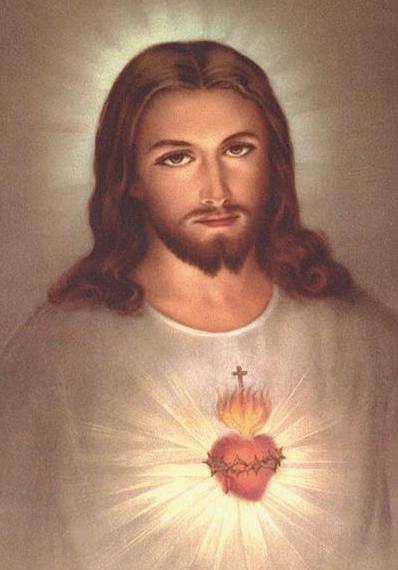
as the Sacred Heart of Jesus
is literally opened up for us
in the ultimate act of God's love for us,
for you and for me.
What wondrous love is this.
Have we really and fully opened ourselves to that love?
Do we really and fully let that love flow through us to the people around us?
...look upon him whom they have pierced.
Love one another as I have loved you, says the Lord.
(John 13:34)
Pray for your priests
"My brothers and sisters, pray for your priests.
Ask the Lord to bless them with the fullness of His love,
to help them be faithful ministers of Christ the High Priest,
so that they will be able to lead you to Him,
the fountain of your salvation."
Text from the Mass of Chrism
Thursday, June 22, 2006
Sodano replaced by Bertone
The Holy Father has also accepted the retirement of Cardinal Edmund Casimir Szoka as President of the Pontifical Commission for the Vatican City State, effective September 15. His replacement is Archbishop Giovanni Lajolo, currently Secretary of the Section for Relations with States at the Secretariat of State.
Do we forgive enough?
If you forgive others their transgressions,
your heavenly Father will forgive you.
But if you do not forgive others,
neither will your Father forgive your transgressions.
Do we forgive enough?
The face of the man
The images we have of the saints of old are often generic: the generic image of a young girl, the generic image of a monk, the generic image of a man with a beard, etc.
"True likenesses" exist for a few saints prior to the modern era, but most of these images were made by artists of average skill (at best).
Even in the age of photography, there are few high-quality portraits of canonized saints.
St. Thomas More is thus something of a rarity: a canonized saint who happened to have had his portrait done by a first class artist: indeed, one of the most famous portraitists of all time - Hans Holbein the younger.
And so we know the face of St. Thomas More.
It is the face of a man in the full bloom of middle age: possessing both wisdom and vigor.It is the face of a man with firm will and keen intellect. His was one of the great minds of his century and his works are still read today.
It is the face of a man who is looking at a great future. Within two years he would become chancellor of England.
It is the face of a man who would give it all up for God.
St. Thomas More was beheaded by the order of King Henry VIII 471 years ago because he would not agree to the King's divorce nor to the King's takeover of the Church in England.
The memory of St. Thomas More is celebrated on this day.
The star of Cambridge
John would stay close to many of his students, giving them guidance in their careers and even their personal lives.
When one of his brightest students had a crisis in his marriage, John did his best to help.
Sadly, his former student was already set on divorce... and more.
John remained true to his beliefs and continued to speak about these beliefs openly.
His former pupil was not amused.
He had John killed.
St. John Fisher, formerly of Cambridge University and later Bishop of Rochester (and Cardinal), was executed 471 years ago today by his former pupil King Henry VIII.
(adapted from an earlier post)
The baby died
The loss was devastating.
The father and mother decided to dedicate themselves totally to God. They gave away their wealth and withdrew to the monastic life.
The father, however, was not destined for a quiet life of prayer and solitude. He was pressured to become a priest and later to became a bishop.
As bishop he would serve the people of his diocese for more than 20 years. He became known for his writing, for his holiness, and for his devotion to the saints.
It was no surprise that when he died, he was recognized as a saint himself by everyone, including his sometime pen pal, St. Augustine.
St. Paulinus, native of Bordeaux, died in his adopted town and diocese of Nola (near Naples) 1575 years ago today.
(adapted from an earlier post)
Wednesday, June 21, 2006
Why is she smiling?
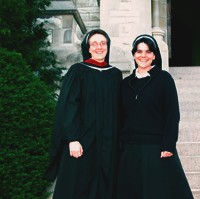
"Because she was recently voted upon to receive the Holy Habit and begin her novitiate!!! As you can easily imagine, Sr. Greta is counting the weeks, the days, the hours, the minutes, the seconds, and the nano-seconds until the big day of her vesitition on August 2, the feast of Blessed Jane of Aza, mother of St. Dominic (affectionately known by us as 'Grandma'!). Sr. Greta's joy is of a very bubbling and effusive nature, so much so that even the mere mention of her vestition will make her giggle! Her excitement and anticipation brings smiles to our faces and memories to our minds...."Please keep Sr. Greta in your prayers as she prepares, temporally and spiritually, for this beautiful monastic 'rite of passage.'"
from the Vocations blog Moniales OP
of the Dominican Nuns of Summit, New Jersey
Stem cell healing "we can all live with"
Catholic News Service has a full article online.
For the RIGHT reason
In today's Gospel (Matthew 6:1-6, 16-18), however, our Lord warns us to be very careful about doing things for the purpose of getting positive attention.
Take care not to perform righteous deeds
in order that people may see them;
otherwise, you will have no recompense from your heavenly Father.
When you give alms, do not blow a trumpet before you,
as the hypocrites do in the synagogues and in the streets
to win the praise of others.
Amen, I say to you, they have received their reward.
But when you give alms,
do not let your left hand know what your right is doing,
so that your almsgiving may be secret.
And your Father who sees in secret will repay you.
This is not to say that we should not be doing good things, but that we must be very honest and clear about our motives and do whatever we can to keep them as pure as possible.
Now is my way clear
now is the meaning plain:
Temptation shall not come in this kind again.
The last temptation is the greatest treason:
To do the right deed for the wrong reason.
(Thomas Becket in "Murder in the Cathedral" by T. S. Eliot)
We need to keep our focus not on ourselves, but on the needs of others and on the honor and glory of God.
We need to do the right things
for the right reason:
the love of our Lord and Savior Jesus Christ.
Christian Carnival
The young man was truly gifted
A successful career in the military and politics seemed assured (when he was four, they said, he was sometimes found already marching in uniform).
And then God touched his life.
From the age of seven onward, he devoted himself to the Lord. Even when he was bedridden by kidney disease a few years later, he considered it a blessing because it enabled him to concentrate even more on prayer.
Despite his father's opposition, he renounced his worldly goods and entered the Jesuits. He excelled at his studies and was considered one of the order's most exemplary young men.
In his fourth year of theological studies, an epidemic struck the city. Even though his own health was not the best, the young man was tireless in caring for the stricken.
Sure enough, his own health failed. He lingered on for three months before the Lord finally called him home at the age of 23.
Saint Aloysius Gonzaga died around midnight 415 years ago today.
(adapted from an earlier post)
Tuesday, June 20, 2006
Catholic Carnival
Dogs shall lick thy blood
The Gospel (Matthew 5:43-48) has some of the most beautiful expressions of God's universal love: a love that our Lord and Savior Jesus Christ calls us to manifest in our own lives:
Love your enemies,
bless them that curse you,
do good to them that hate you,
and pray
for them which despitefully use you
and persecute you;
That ye may be
the children of your Father which is in heaven:
for he maketh his sun to rise on the evil and on the good,
and sendeth rain on the just and on the unjust.
For if ye love them which love you,
what reward have ye?
do not even the publicans the same?
And if ye salute your brethren only,
what do ye more than others?
do not even the publicans so?
Be ye therefore perfect,
even as your Father which is in heaven is perfect.
On the other hand, the first reading (1 Kings 21:17-29) contains extremely vivid expressions of God's justice, beginning with this cheery prophecy:
Thus saith the LORD,
In the place where dogs licked the blood of Naboth
shall dogs lick thy blood...
The recipient of this warning is the notorious King Ahab. Despite, however, his recourse to fasting, sackcloth, and the Lord's forbearance, the prophecy eventually comes true (1 Kings 22:37-38):
So the king died, and was brought to Samaria;
and they buried the king in Samaria.
And one washed the chariot in the pool of Samaria;
and the dogs licked up his blood...
(Literature fans may remember this vivid image being recalled in Moby Dick [chapter 16]: "Oh! he ain't Captain Bildad; no, and he ain't Captain Peleg; he's Ahab, boy; and Ahab of old, thou knowest, was a crowned king!" "And a very vile one. When that wicked king was slain, the dogs, did they not lick his blood?")
Although few reach the rhetorical intensity of "dogs shall lick thy blood," some Christians seem to do nothing but splash endlessly in the dramatic denunciation of evil.
Other Christians seem to do nothing but soak endlessly in a soft rain shower of nonjudgmental mercy.
Sadly, each extreme tends to dwell on the parts of Scripture that support their approach while minimizing the parts of Scripture that go against their preferences.
We must embrace all of God's teaching, not only the parts that suit our particular tastes or particular situations.
We must not filter God.
Rather, you and I need to be transparent vessels of the Lord.
We must be truthful and we must be clear - as we look within our own hearts and as we give witness to others - about what is right and what is wrong, drawing not upon the current whims of culture but upon the eternal truth of God.
Likewise, as we look within ourselves and as we reach out to others, we must be open and boundless as channels of the indescribable mercy of God's universal love.
Mercy and justice, clarity and love - such is our God; so must we be.
Monday, June 19, 2006
Dark accusations and hard questions
There are some questions that are difficult in every age: Who is guilty? Who is innocent? Who is a victim? Who is a false accuser? What if that happened to me? Who is at fault? How can we be sure? How can the helpless be protected? How can the innocent be protected? How can people be healed?
It is important for us - as moral human beings and most especially as Christians - to be thoughtful, diligent, and firm in asking these questions and in always seeking the help of God who is infinitely merciful and inescapably just.
Archbishop of the capital city
The Holy Father has appointed as the new Archbishop Mark Benedict Coleridge, 57, up to now Auxiliary Bishop of Melbourne. Archbishop-elect Coleridge was ordained a priest for the Archdiocese of Melbourne in 1974 and worked in several parishes before being sent for studies in Rome in 1980. He studied at the Pontifical Biblical Institute until 1984 and obtained a License in Sacred Scripture. He then taught Scripture at Melbourne's Catholic Theological College (CTC) until 1988 when he returned to the Biblicum in Rome to earn his Doctorate degree. With that degree in hand, he returned to the CTC before being summoned back again to Rome in 1998 to work in the General Affairs section of the Secretariat of State. In 2002, he was named and consecrated Auxiliary Bishop for Melbourne. In 2004 he was appointed Chairman of the Roman Missal Editorial Committee of the International Commission for English in the Liturgy (ICEL).
Hard time for murder
He walked away from his life of easy pleasures and sought balance in a hard life of prayer.
Other men with blood on their hands would be moved to join him in this most austere monasticism, including a very high-profile politician and even his own father.
St. Romuald, Benedictine monk and founder of monasteries, died of natural causes 979 years ago today.
Sunday, June 18, 2006
Bloodless?
To be sure, in some senses, the modern age has been the bloodiest of all: consider the millions of people slaughtered in modern wars and the popularity of "slasher" movies and of television shows that wallow in Luminol.
But it is also a society that shies away from blood: television cameras rarely show the bodies of the slain, animal meat is packaged bloodlessly in clear plastic, and phlebotomists are feared by many.
We live in a culture that strives to be bloodless.
Yet the readings of this day - the Solemnity of the Most Holy Body and Blood of Christ - are overflowing with blood.
And this is supposed to be a good thing - indeed, a very good thing.
In dictionaries, the word "bloodless" has both literal and metaphorical meanings.
The literal meaning of "bloodless" is obvious, but the metaphorical meanings of "bloodless" are meaningful indeed: "lacking in spirit or vitality... lacking in human feeling."
Today's readings and today's celebration remind us that Christianity is not a bloodless faith: it is full of spirit, full of vitality, and full of feeling.
In our dichotomously bloodless culture, we sometimes try to water down these elements of our faith (and indeed of our humanity). Representations of the crucifixion thus become almost cartoon-like: bloodless in more ways than one.
By celebrating the most holy Body and the most precious Blood of Christ, we are celebrating that ultimate gift of God's spirit, God's vitality, and God's passion that has come to us in the life, death, and resurrection of our Lord and Savior Jesus Christ.
Today's readings (especially the first reading - Exodus 24:3-8 - and the Gospel - Mark 14:12-16, 22-26) also remind us of blood as a sign and instrument of commitment.
This is the blood of the covenant
that the LORD has made with you...
This is my blood of the covenant,
which will be shed for many.
And so we take solace and joy in Christ, in his covenant, in his passion, in his vitality, in his Spirit, in his Blood.
Soul of Christ, sanctify me.
Body of Christ, save me.
Blood of Christ, inebriate me.
Water from the side of Christ, wash me.
Passion of Christ, strengthen me.
O good Jesus, hear me.
Within Thy wounds, hide me.
Do not let me be separated from Thee .
From the malignant enemy, defend me.
At the hour of death, call me.
And bid me come unto Thee
That with Thy Saints I may praise Thee
through ages of ages.
Amen.
Anima Christi, sanctifica me.
Corpus Christi, salva me.
Sanguis Christi, inebria me.
Aqua lateris Christi, lava me.
Passio Christi, conforta me.
O bone Iesu, exaudi me.
Intra tua vulnera absconde me.
Ne permittas me separari a te.
Ab hoste maligno defende me.
In hora mortis meae voca me.
Et iube me venire ad te,
Ut cum Sanctis tuis laudem te
in saecula saeculorum.
Amen
Saturday, June 17, 2006
The Mantle
It is no mere gift of a cloak or exchange of ponchos: it is a classic symbolic action of passing on authority, wisdom and power.
Elijah's rhetorical question to Elisha is therefore ironic: Have I done anything to you?
Indeed he has done something to Elisha - or rather, God has.
We as Christians, by virtue of our baptism and the gift of the Holy Spirit, have had a mantle cast upon us.
It has indeed done something to us, and like Elisha, we must respond.
Like Elisha, we must attend to our responsibilities.
Like Elisha, we must follow and we must serve.
And then, when the opportunities present themselves, like Elisha and like Elijah, humbly bearing the mantle given us by God, we must make present the truth, the love, and the power of the Lord.
Friday, June 16, 2006
All Catholic young men... ask themselves...
"All Catholic young men who are serious about their faith ask themselves at some point: Is God calling me to be a priest? They see in the priest one who has dedicated his life in a particular way to Christ and to the service of His People. The priesthood is Christ's gift to the world. Nothing is more natural than for a young man to think: Is Christ offering this gift to me?
"The ministry of the priest in the Church is vital and irreplaceable. He preaches God’s word to the people of our time so that they may find true freedom in Christ. He offers the Holy Sacrifice of the Mass for the salvation of the world and gives to the faithful the Body and Blood of Christ to strengthen and heal them. He exercises leadership under the Bishop so that our communities may enjoy unity. He works with lay people, building them up through his ministry and in turn experiencing support from them.
"A sign that God is calling a man to serve Him as a priest is that the thought keeps returning to his mind. This is because the Holy Spirit is at work within his depths, gently but urgently prompting him to discover God's will. These web pages are designed for men in the Diocese of Leeds who feel that God may be calling them in this way."
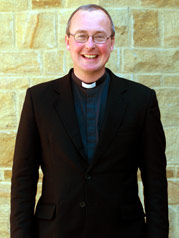
Rev Paul Grogan
Vocations Director
(from the website of the Diocese of Leeds)
Beyond the noisy things
What intimidates Elijah is "a tiny whispering sound" - for he recognizes it as the presence of God.
People in the world may be distracted and even terrified by loud and destructive things such as storms, fires and earthquakes, but all these things are temporary - even the things they may destroy are temporary.
What is not temporary is God.
When all things pass away, God will still be there. Without God, there is only eternally excruciating oblivion.
We need to attune ourselves to reach beyond the noisy things of this world and to listen quietly for the voice and the presence of God: a voice and a presence that brings peace, joy, and happiness, even when all things pass away.
Be still... pray in the name of Jesus... and listen.
(adapted from an earlier post)
The body part that causes sin
Every man has one.
Every woman has one too.
It is right between our ears.
Yes, we may have physiological impulses to do this or that, but the cause of sin is ultimately in the mind, for it is the mind that chooses to sin.
People sometimes forget this when they hear our Lord's words in today's Gospel (Matthew 5:27-32).
If your right eye causes you to sin,
tear it out and throw it away.
It is better for you to lose one of your members
than to have your whole body thrown into Gehenna.
And if your right hand causes you to sin,
cut it off and throw it away.
It is better for you to lose one of your members
than to have your whole body go into Gehenna.
But it is never one's eye that causes sin nor does a hand cause sin, nor even a particular lobe of the brain: sin in caused in the mind of the sinner.
Our Lord is not saying here that eyes and hands cause sin: what he is saying is that our response to sin in our lives must be as drastic as ripping out one’s eye or chopping off one’s hand.
We must look at ourselves and our lives with great precision and clarity.
What habits of thought, habits of speech or habits of action lead us astray or cause us to fall?
Tear them off, cut them out, and throw them away.
If emotional, intellectual or lifestyle changes - even drastic ones - are necessary to pull us out of spiritually unhealthy places, then we should do them (mindful of our solemn responsibilities).
It is better that than the alternative.
Lord Jesus Christ, son of the living God, be merciful to me, a sinner.
Thursday, June 15, 2006
I received... what I also handed on to you
"'For I received from the Lord
what I also handed on to you,
that the Lord Jesus
on the night when he was betrayed
took a loaf of bread,
and when he had given thanks,
broke it and said,
"This is my body that is for you.
Do this in remembrance of me."'
(1 Corinthians 11:23-24)
"So many people with so many ideas, but in the end it is we bishops, in union with our Holy Father, who have the responsibility of faithfully handing on to them what we have received from the Lord. Paul returned to that theme once again, when writing to Timothy:
"'Remind them of this,
and charge them before the Lord
to avoid disputing about words,
which does no good,
but only ruins the hearers.
Do your best to present yourself to God
as one approved,
a workman who has no need to be ashamed,
rightly handling the word of truth.'
(2 Timothy 2:14-15)
"The version of Mass that we currently use is clearly far from perfect. Those of you who celebrate Mass in both Spanish and English will know only too well the difference in richness between the two texts. The then bishops of ICEL recognised that from the beginning, and they knew that a revision would be needed. There was an urgent feeling in the early 1970s that the liturgy should be made available to the people as soon as possible, and the work was rushed. The revisiting of this was delayed for practical reasons, but also for ideological ones that caused many bishops grave concern, and that is sometimes forgotten. The chief preoccupation in many minds was, of course, that the liturgy be brought closer to the people. This aim could, and sometimes did, obscure the other aim, which was to preserve and transmit our inherited liturgical tradition and bring our people closer to that. During the initial stages of consultation on the third edition of the Missale Romanum, two theologians wrote to me, quite independently, and shared with me their belief that the Mass texts we currently use had severely diminished our appreciation of the richness of Eucharistic theology. This is clearly something to which we, as bishops, should be sensitive. The Holy Father said something similar during the course of last year’s Synod of Bishops. Of course, if you try to carry a cup of coffee across a room too quickly, much of the contents may spill. This time, we have tried to keep the coffee in the cup.
"We are at a very important moment in the whole of this process. If the bishops of the English-speaking countries can agree on a single version of the Mass, what a sign of catholicity that will be. But more than that, it will be a guarantee of catholicity for the future, not only in our own time, and not only in our own countries. Clearly I, and all my brother bishops of ICEL, believe that you, the bishops of the United States, have a most important role of leadership to play in just that. Thank you for giving me your attention."
(The conclusion of an address given this morning to the Bishops of the United States by the Right Reverend Arthur Roche, Bishop of Leeds, Chairman of the International Committee on English in the Liturgy [ICEL])
The little things
In the first reading (1 Kings 18:41-46), "a cloud as small as a man's hand" becomes a great storm (an interesting image at the start of hurricane season).
In the Gospel (Matthew 5:20-26), our Lord warns how small words can have dreadful consequences:
But whosoever shall say, Thou fool,
shall be in danger of hell fire.
We must take care to avoid doing the little things that are evil nonetheless.
We must never tire of the little things - a few good words or a tiny good deed - that may be the seeds of God's mighty grace.
Wednesday, June 14, 2006
Christian Carnival
How long will you straddle the issue?
Elijah appealed to all the people and said,
"How long will you straddle the issue?
If the LORD is God, follow him;
if Baal, follow him."
The people, however, did not answer him.
* * * * *
The LORD’s fire came down
and consumed the burnt offering,
wood, stones, and dust,
and it lapped up the water in the trench.
Seeing this,
all the people fell prostrate and said,
"The LORD is God! The LORD is God!"
Sometimes I would like to shout that same challenge at a number of people in our world and in our Church today - people who straddle the fence between the truth of universal faith and the demands of a particular culture.
But Christ did not hand the keys of the kingdom of heaven to me.
Moreover, if I consider things honestly, I am a straddler myself.
May God have mercy on me - a sinner.
May the fire of God's love and truth come down from heaven and fill my heart and mind.
May I become a truly worthy offering to my Lord and God.
May anything within me that is not of God be burnt and purged away.
May I be filled and may I overflow to others with the life-giving water of Christ.
The Lord is God.
The L