A Penitent Blogger

Mindful of my imperfections, seeking to know Truth more deeply and to live Love more fully.

Quid sum miser tunc dicturus? Quem patronum rogaturus? Cum vix iustus sit securus?
Recordare, Iesu pie, Quod sum causa tuae viae: Ne me perdas illa die...

Wednesday, August 31, 2005

More ways to help Katrina victims

People in the Galveston-Houston area are invited "to contribute to the largest SLEEPOVER IN TEXAS!"

This is an effort by the Society of St. Vincent de Paul Council of the Archdiocese of Galveston-Houston to gather particular items to "give comfort and cheer to the children affected by this disaster and who have found shelter in the Galveston-Houston area."

(News reports indicate that tens of thousands of refugees from New Orleans are to be relocated to the Astrodome in Houston.)

(Hat tip: Bill Cork)

"If you have tears..."

"...prepare to shed them now ."
(William Shakespeare, Julius Caesar, Act 3, scene 2)


On August 1, 1936, radio reporter Herbert Morrison was narrating the arrival of a flight from Europe.

Suddenly, he was reporting through his tears, as the airship burst into flame before his eyes.

On Monday of this week, WKRG-TV weekend anchor Jennifer Mayerle was reporting from the wreckage of Biloxi, Mississipi, when she asked a passer-by how he was doing.

Seconds later, she too was reporting through her tears, for heartbreak, despair, horror, and woe flowed from this man.

MAN: I'm not doing good.

REPORTER: What happened?

MAN: The house just split in half.

REPORTER: Your house split in half?

MAN: We got up in the roof, all the way to the roof, and water came and the house just opened up, divided…

REPORTER: Who was at your house with you?

MAN: My wife.

REPORTER: Where is she now?

MAN: Can't find her body. She's gone.

REPORTER: You can't find your wife?

MAN: No, she... I hold her hand as tightly as I could and she told me, you can't hold me. She said take care of the kids, and the grandkids...

The man identified himself as Hardy Jackson and his wife as Tonette.

The heartwrenching video is available in full on the WKRG website (RealPlayer format only)
rtsp://mgs.mgbg.com/wkrg/video/083105_jennifer_mayerle_man_on_street.rm
and an excerpt through a link from this CNN story
http://edition.cnn.com/2005/WEATHER/08/31/katrina.people/


UPDATE - Follow-up news reports on Hardy Jackson (whose name on the video was widely misunderstood as Harvey Jackson) appeared in mid-September.

Christian Carnival

This week's Christian Carnival - an ecumenical collection of posts from various Christian blogs - is online at Crossroads: Where Faith and Inquiry Meet.

Lift up your heads

“Keep your head down” is traditional advice for life (and for golf). The idea is to focus completely on the task at hand.

In today’s Gospel (Lk. 4:38-44), the example our Lord gives is not “Keep your head down” but “Lift up your heads... and keep them up.”

At daybreak, Jesus left and went to a deserted place.

The crowds went looking for him,

and when they came to him,
they tried to prevent him from leaving them.

But he said to them,
"To the other towns also I must proclaim
the good news of the Kingdom of God,
because for this purpose I have been sent."

Although he is fully engaged with the task of ministering to the people at hand, our Lord does not bury his head in it

He keeps his head lifted up in prayer to the Father, going to a deserted place in the morning to pray.

He keeps his head lifted up and his eye on the full panorama of his mission, of which the task at hand is only a part.

In our own lives, it is sometimes easy for us to feel overwhelmed: there are too many pressures, too much to do, too many needs to be met.

We should lift up our heads: always remembering to lift ourselves and our needs to the Lord in prayer and always keeping our eye clearly fixed on our fundamental obligations and on the purpose for which we have been sent.

Day of Prayer in Louisiana

Governor Kathleen Babineaux Blanco of Louisiana has declared today a Day of Prayer in the State of Louisiana, part of which was devastated by Hurricane Katrina.

"Pray for the victims and the rescuers. Please pray that God give us all the physical and spiritual strength to work through this crisis and rebuild.

"Please pray for patience for those anxiously waiting to hear from family members or to get word about their homes. Pray for the safety of our hard-working rescuers and those they are bringing to safety.

"I know, by praying together on Wednesday, that we can pull together and draw strength we need; strength, that only God can give us."

How do I know if I have a vocation?

"The simplest answer is that you do have a vocation... another word for 'calling.'

"Pope John Paul II said that 'every life is a vocation' – in the sense that every human life is a gift from God and every human being is created to give glory to and serve the Lord in some way. Our baptism gives us the power, right, and responsibility to live joyfully and generously – whether we are single, married, or given a unique role in the Church as a religious or ordained person.

"Are you wondering if you are called by God to serve the Church as a sister, brother, or ordained priest?

"The basic requirements for these vocations are a desire to pray, the ability to relate well to and serve others, the health and intellectual ability to complete the required studies, and positive affirmation from those who know you.

"The Vocations Office of the Diocese of Jackson can provide you with information on any type of vocation."

Vatican telegram in the wake of Katrina

DEEPLY SADDENED BY THE TRAGIC CONSEQUENCES OF THE RECENT HURRICANE IN THE UNITED STATES OF AMERICA, HIS HOLINESS POPE BENEDICT XVI ASSURES ALL THOSE EFFECTED OF HIS CLOSENESS IN PRAYER.

THE HOLY FATHER COMMENDS THE DECEASED TO THE LOVING MERCY OF ALMIGHTY GOD, AND UPON THEIR GRIEVING FAMILIES HE INVOKES DIVINE BLESSINGS OF STRENGTH AND CONSOLATION.

HIS HOLINESS LIKEWISE PRAYS FOR THE RESCUE WORKERS AND ALL INVOLVED IN PROVIDING ASSISTANCE TO THE VICTIMS OF THIS DISASTER, ENCOURAGING THEM TO PERSEVERE IN THEIR EFFORTS TO BRING RELIEF AND SUPPORT.

CARDINAL ANGELO SODANO

SECRETARY OF STATE

Tuesday, August 30, 2005

Helping the victims

The news is pretty ugly on the day following Hurricane Katrina’s broad stab into Louisiana, Mississippi and Alabama. Hundreds are feared dead and a million may be homeless. The water is rising in New Orleans and it may take weeks to pump it out.

Massive government and corporate resources are already being deployed, but Katrina’s victims will also need substantial assistance from nonprofit organizations.

The largest of these organizations is the American Red Cross. This is generally the best resource for individuals who want to help with the most immediate needs of Katrina’s victims.

Catholic Charities USA has sent technical assistance teams “to help the local Catholic Charities in the impacted areas with their response efforts.”

On its website, Catholic Charities says that “while local agencies along the Gulf Coast anticipate that they will be provide some type of emergency assistance in their communities, Catholic Charities' niche in disaster relief is to provide long-term recovery work. In fact, Catholic Charities agencies in Florida are still providing services to help people recover from last year's devastating hurricanes.

“Based on past disasters, possible long-term services that Catholic Charities may provide include temporary and permanent housing, direct assistance beyond food and water to get people back into their homes, job placement counseling, and medical and prescription drug assistance.

“Recovery work is underway in Dade County, FL, where Katrina caused extensive flooding when it stuck there last week. Catholic Charities of the Archdiocese of Miami has already distributed a large load of baby items, food, and other supplies to victims. Other aid that they will be providing includes assistance with food, shelter, rent, medicine, utilities, and mental health counseling.

“To help communities recover from the damage brought on by Hurricane Katrina, Catholic Charities USA is collecting financial donations that will fund agencies' emergency and long-term disaster recovery efforts.”

UPDATE - From the USCCB: "Bishop William S. Skylstad, President of the United States Conference of Catholic Bishops (USCCB), has announced that a National Collection for Hurricane Relief will be taken up in the 195 Catholic dioceses throughout the United States."

SECOND UPDATE - The Salvation Army and other organizations have also been active.

Personally, given the enormity of this disaster, I believe donations are most effective with organizations that have sufficient infrastructure to help on a massive scale.

Donors should always verify the reputation of any charity. http://www.give.org/ and http://www.guidestar.org/ are excellent resources for this purpose.

"I thought it was safe"

That is what many victims of Hurricane Katrina are saying today, especially those who barely escaped yesterday with their lives. Tragically, something like it is also being said by the loved ones of some who died.

It is a frightening coincidence – if that is what it is – that the long-scheduled first reading from 1 Thessalonians 5 includes the following verse:

For when they shall say, Peace and safety;
then sudden destruction cometh upon them,
as travail upon a woman with child;
and they shall not escape.


We human beings easily lull ourselves into a false sense of security. We imagine our buildings and cities to be invulnerable. We take our technology and modern comforts for granted.

And now, some middle class suburban neighborhoods in the most powerful nation on the planet will be without electricity for weeks - if not months.

(Sometimes we subdue the earth
and sometimes the earth subdues us.)

Many of us sitting securely in our living rooms foolishly comfort ourselves by uncharitably picking at the faults of some of the hurricane’s victims (“if they had evacuated, they wouldn’t be dead”). But while it is good to reaffirm the lessons of prudence, it is a mistake to think that prudence alone will make us perfectly safe.

The most important lesson of yesterday’s tragedy and of today’s first reading is that our human lives are fragile: somewhere in the world tomorrow some other man-made or natural disaster will wipe out more lives (God have mercy on them), you or I could drop dead before we draw our next breath (God have mercy on us), and the Day of the Lord is coming (come, Lord Jesus).

As Christians, we do not have to lull ourselves to sleep with a false sense of security or numb ourselves in various ways against existential dread. We can joyfully walk forward, awake and sober.

For God hath not appointed us to wrath,
but to obtain salvation by our Lord Jesus Christ,
Who died for us,
that, whether we wake or sleep,
we should live together with him.

Our security, our safety, our peace comes from our Lord and Savior Jesus Christ – no matter what prosperity or destruction may befall us.

Therefore let us not sleep, as do others;
but let us watch and be sober.

For they that sleep sleep in the night;
and they that be drunken are drunken in the night.

But let us, who are of the day, be sober,
putting on the breastplate of faith and love;
and for an helmet, the hope of salvation.

Catholic Carnival

This week's Catholic Carnival - a collection of posts from various Catholic blogs - is online at HerbEly.com.

Monday, August 29, 2005

They didn't make it

These terrible words are often said when people die, especially when a group of people endure some intense, life-threatening event – a firefight, a terrorist attack, a tsunami, or a hurricane – and some of them do not survive.

They didn't make it.

These words are often said by those who did make it, who did survive: the grief-stricken survivors who contemplate both the deaths of their comrades and loved ones and also the life ahead they now will not share.

They didn't make it.

These words reflect what the Thessalonians thought, the ones to whom St. Paul wrote today's first reading (1 Thes.4:13-18). They were in that first great, glorious generation of believers and they were looking forward to the imminent return of Christ in glory. They were ready for him to come back and take them all to heaven.

But then some of them died, before the Lord Jesus could come to get them.

This was a doubly heavy blow to the survivors, who not only mourned the loss of their brothers and sisters in the Lord, but who even wondered whether their dead comrades would be deprived of a share in the life and glory of Christ’s second coming.

St. Paul's words of comfort to the Thessalonians are words of comfort for us as well.

We do not want you to be unaware, brothers and sisters,
about those who have fallen asleep,
so that you may not grieve like the rest, who have no hope.
For if we believe that Jesus died and rose,
so too will God, through Jesus,
bring with him those who have fallen asleep.


Requiem aeternam dona eis, Domine,
et lux perpetua luceat eis.

* * * * *

When I saw that this was the scheduled reading today – a day when thousands of people (including people I know - may God keep them all in his care) are threatened by death from a hurricane – I was disturbed. Was it a sign? The response for today’s responsorial psalm seemed especially ominous.

The Lord comes to judge the earth.

I can imagine Father Richard, who ministers in a close suburb of New Orleans, reading this line with his characteristically reverential solemnity as the storm thunders all around him and his flock.

The Lord comes to judge the earth.

Miserere nobis, Domine.

* * * * *

The bottom line of today’s first readings and today's events is best summed up, I think, by a verse from another of St. Paul’s epistles (Rom. 14:8).

For if we live,
we live for the Lord,
and if we die,
we die for the Lord;

so then, whether we live or die,
we are the Lord's.


This is both a comfort and a challenge.

Whether we live or die this day, whether we face life's difficulties or face the Lord in judgment, we are the Lord's – he holds us in his hand and loves us in his mercy.

Have mercy on me, God, have mercy
for in you my soul has taken refuge.
In the shadow of your wings I take refuge
till the storms of destruction pass by.
(Psalm 57:2)

The challenge for us who remain, those who survive, is to live truly "for the Lord" – as men and women who belong to the Lord – not to live for our own safety or for our own pleasure, but to live every moment of our lives – every moment – for the good of others and for the glory of God.

The nation’s most powerful man

had a weakness for young ladies.

The moves of one young lady in particular caught his eye.

He called her over.

She came to him and whispered...

"I want you...

"...to give me...

"...right now...

" ...the head of John the Baptist on a platter."

Thus a sleazy moment in the corridors of power ended with the death of one of history’s greatest holy men.

Today the Church remembers the death of John the Baptist.

Sunday, August 28, 2005

Pray for New Orleans and the Gulf Coast

Father,
all the elements of nature
obey your command.


Calm the storms
and hurricanes that threaten us

and turn our fear of your power
into praise of your goodness.

Grant this
through our Lord Jesus Christ, Your Son,

who lives and reigns
with you and the Holy Spirit,

one God, forever and ever.
Amen.
Prayer in times of storms

Intimate yearning for God

Living faith is not a purely intellectual exercise, as today’s readings testify.

Indeed, today’s first reading (Jer. 20:7-9) and today's responsorial psalm (from Psalm 63) are poetic, powerful, and passionate in describing overwhelmingly deep emotional bonds with God.

Jeremiah begins with imagery of intense and dramatic seduction.

You duped me, O LORD, and I let myself be duped;
you were too strong for me, and you triumphed.


(How foolish we are when you and I resist God in our souls and in our lives. How truly empty the triumphs we seek for ourselves. May we, like Jeremiah, be overwhelmed by God’s grace and experience the wonders of God’s triumph.)

God’s triumph over Jeremiah, however, does not leave Jeremiah passive – quite the contrary.

I say to myself, I will not mention him,
I will speak in his name no more.
But then it becomes like fire burning in my heart,
imprisoned in my bones;
I grow weary holding it in, I cannot endure it.

(How dull, dreary, and lackluster our lives so often are. How wonderful it would be to feel the fire of God’s spirit truly burning in our hearts, pressing out from deep within our bones, overcoming all fear, and ready to pour forth in a glorious dynamism of grace and word and deed.)

A wonderfully deep, intimate yearning for God also fills David.

For you my flesh pines and my soul thirsts
like the earth, parched, lifeless and without water.
Thus have I gazed toward you in the sanctuary
to see your power and your glory…


(And how much more magnificent and jubilant is the attainment of God.)

For your kindness is a greater good than life;
my lips shall glorify you.
Thus will I bless you while I live;
lifting up my hands, I will call upon your name.
As with the riches of a banquet shall my soul be satisfied,
and with exultant lips my mouth shall praise you.
You are my help,
and in the shadow of your wings I shout for joy.


(And how firmly and gently do the bonds of God’s love hold his dear ones close)

My soul clings fast to you;
your right hand upholds me.

May we pray always for the graces that blessed Jeremiah and David, graces that overflow in superabundance in our Lord and Savior Jesus Christ: graces that make us yearn, graces that stir us to life, graces that flow like a torrent, graces that lift us to the heavens, and graces that draw us ever closer into the eternally living, loving mystery that is God.

Do not conform yourselves to this age

but be transformed by the renewal of your mind,
that you may discern what is the will of God,
what is good and pleasing and perfect.

Romans 12:2

Saturday, August 27, 2005

Young women deeply in love with God

"In 1869, five young women, deeply in love with God, desired to share their daily lives together in rural Wisconsin. St. Francis of Assisi's simple Gospel way of life inspired them. Today, the Franciscan Sisters of Christian Charity live whole-heartedly the loving spirit of their foundresses. They strive to live the Gospel in simplicity, built on faith in a loving God; joyful acceptance of poverty; love for the Church and selfless dedication to the service of others.

"The Franciscan Sisters of Christian Charity welcome young women, high school graduates to age 35, caught by the spirit of St. Francis and fired with a burning love for Jesus, to join them.

"The world needs you. God calls you. We invite you."

Franciscan Sisters of Christian Charity
2409 South Alverno Road
Manitowoc, WI 54220
920-682-7728
vocations@fscc-calledtobe.org
www.fscc-calledtobe.org

Progress even more

Are you happy? Do you feel content?

You may be a loser.

Sometimes we may in fact, by the goodness of God, be blessed with moments of relative happiness and contentment, but complete happiness and absolute contentment can be experienced only when God brings us to be immersed eternally in the vision of his infinite love.

If we stop short of that, if we seek and relish only happiness and contentment in this world, sooner or later we will be bitterly disappointed. Even in this life, the absence of growth comes with the onset of death.

So both of today’s readings (1 Thes. 4:9-11 and Mt. 25:14-30) exhort us not to be content and passive with what we have – like the lazy servant who buried his master’s treasure and consequently lost it all – but “to progress even more” in the ways and the grace and the service of God.

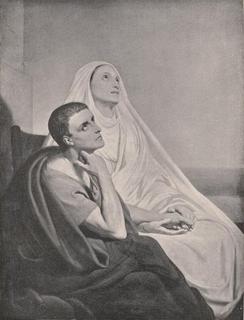
Then my mother said...

"'Son, for myself, I have no longer any pleasure in anything in this life. Now that my hopes in this world are satisfied, I do not know what more I want here, or why I am here.

"'There was indeed one thing for which I wished to tarry a little in this life, and that was that I might see you a Catholic Christian before I died. My God has answered this more than abundantly, so that I see you now made his servant and spurning all earthly happiness.

"'What more am I to do here?'

"I do not well remember what reply I made to her about this. However, it was scarcely five days later--certainly not much more--that she was prostrated by fever.

"While she was sick, she fainted one day and was for a short time quite unconscious. We hurried to her, and when she soon regained her senses, she looked at me and my brother as we stood by her, and said, in inquiry, 'Where was I?'

"Then looking intently at us, dumb in our grief, she said, 'Here in this place shall you bury your mother.'

I was silent and held back my tears; but my brother said something, wishing her the happier lot of dying in her own country and not abroad.

"When she heard this, she held him fast with her eye and an anxious face, because he cherished such earthly concerns, and then gazing at me she said, 'See how he speaks.'

"Soon after, she said to us both: 'Lay this body anywhere, and do not let the care of it be a trouble to you at all. Only this I ask: that you will remember me at the Lord's altar, wherever you are.'

* * * * *

"On the ninth day of her sickness, in the fifty-sixth year of her life and the thirty-third of mine, that religious and devout soul was set loose from the body.

"I closed her eyes; and there flowed in a great sadness on my heart and it was passing into tears, when at the strong command of my mind my eyes sucked back the fountain dry, and sorrow was in me like a convulsion. [...] But she neither died unhappy nor did she altogether die.

* * * * *

"So, when the body was carried forth, we both went and returned without tears. [...] Then I slept, and when I awoke I found my grief not a little eased. And as I lay there on my bed, those true verses of Ambrose came to my mind, for You are truly...

"'Deus, creator omnium,
Polique rector, vestiens
Diem decoro lumine,
Noctem sopora gratia;

"'Artus solutos ut quies
Reddat laboris usui
Mentesque fessas allevet,
Luctusque solvat anxios.'


"'O God, Creator of us all,
Guiding the orbs celestial,
Clothing the day with lovely light,
Appointing gracious sleep by night:

"'Thy grace our wearied limbs restore
To strengthened labor, as before,
And ease the grief of tired minds
From that deep torment which it finds.'


"And then, little by little, there came back to me my former memories of Your handmaid: her devout life toward You, her holy tenderness and attentiveness toward us, which had suddenly been taken away from me--and it was a solace for me to weep in Your sight...."

Excerpts from the Confessions of St. Augustine - Book 9, Chapters 10-12

Today the Church celebrates the memory of St. Monica, mother of St. Augustine

Friday, August 26, 2005

Protestant "Popewatch"

Mark D. Roberts, Senior Pastor at Irvine Presbyterian Church in California, has a regular feature on his blog (markdroberts.com) called "Popewatch." He is currently making extensive comments on some of what Pope Benedict XVI said during World Youth Day. While he is clear about having differences with certain Catholic positions, he has been generally very positive.

He is particularly enthusiastic about a quote from the Pope's welcoming address (even superimposing the quote on a picture in a nifty graphic at right).

"This is a phenomenal sentence: beautiful, true, and worthy of regular citation. I'm impressed here, not only with Benedict's theological insight, but also with his poetic ability."

Let's talk about... GOD

Sex - or the lack of it - seems to figure prominently in each of today’s readings: the Gospel (Mt. 25:1-13) is a parable full of virgins and in the first reading (1 Thes. 4:1-8) St. Paul warns against immorality, lustful passion, and exploitation with regard to marriage.

The fundamental point of both readings, however, is not sex, but God.

The Gospel is not really about virgins, but about being prepared in this life for the life to come. Likewise, St. Paul warns about particular forms of immorality, but his primary focus is on holiness and pleasing God.

The sins of the flesh (even if only adultery in the heart) are generally grave matter and deeply problematic on many levels and not just spiritual.

But while we must strive to avoid these sins
(and those things and situations that lead to them)
our focus dare not be
only on avoiding evil
but rather on holiness
and pleasing God.

Miserere mei, Deus,
secundum misericordiam tuam;
et secundum multitudinem miserationum tuarum
dele iniquitatem meam.
Amplius lava me ab iniquitate mea
et a peccato meo munda me.

Ps 51:3-4

Thursday, August 25, 2005

Vocations poster on mainstream media

That Matrix-style vocations poster from the Archdiocese of Indianapolis has been featured by the mainstream media (cable news anyway) in a very positive interview today by MSNBC's Chris Jansing with the man behind the poster, Father Jonathan Meyer.

The interview is available online at http://msnbc.msn.com/id/9075370/

''My mother always told me...''

"...never to wear my hat in church."

Bishop John Noonan following his ordination yesterday as Auxiliary Bishop of Miami (as quoted by the Miami Herald).

Long-distance love

We can’t always be with the ones we love, especially with all of the ones we love in Christ.

St. Paul feels the same way about those to whom he is writing in today’s first reading (1 Thes. 3:7-13).

May his words be our words always.

For this reason, brethren,
in all our distress and affliction
we have been comforted about you

through your faith;
for now we live, if you stand fast in the Lord.

For what thanksgiving can we render to God

for you, for all the joy
which we feel for your sake before our God,
praying earnestly night and day
that we may see you face to face
and supply what is lacking in your faith?

Now may our God and Father himself,
and our Lord Jesus,
direct our way to you;
and may the Lord make you
increase and abound in love
to one another and to all men,
as we do to you,
so that he may establish your hearts
unblamable in holiness

before our God and Father,
at the coming of our Lord Jesus

with all his saints.

Get medieval on you

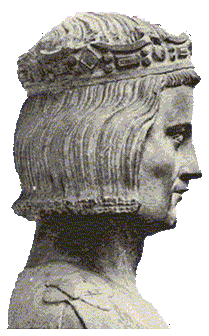
Disputes were decided by combat. Testimony was verified by ordeal. The word of the king was law. The acquisition of land by force was the rule. Early 14th century statue from the church of Mainneville, France - reputed to be a true likenessReligion was important only as a tool for power.

The young king thought differently.

He instituted systems of courts and written law. He negotiated treaties with neighboring rulers, acquiring some lands while handing over others to maximize political and economic stability for his people.

Most importantly, for the young king, religion was not a tool – quite the contrary, everything should be in service to faith.

He personally fed and served the poor daily. He built great houses of prayer and worship, including the glorious Sainte Chapelle.

The glorious interior of the Sainte Chapelle - click image for larger version and above link for more information and pictures


He would also come to the aid of important churches in other lands, no matter what the risk.

Louis IX, King of France, died of disease at the age of 56 in North Africa while on a failed campaign to rescue churches in the Holy Land, 735 years ago today. Saint Louis was canonized 27 years later.

Father Joseph

was from a very good family and was an excellent priest of the Diocese, rising to become Vicar General.

It wasn’t enough. He gave away his inheritance and left the country.

He would be concerned about the most neglected of society: poor children and victims of deadly contagious diseases. He cared for the sick and opened free schools for the children.

He started his own religious order to provide manpower for educating poor children. He faced much opposition, even from within the order he himself founded, and the order was driven out of existence (only to come back again – today his order, the Piarist Fathers number over 1400 in 32 countries around the world).

St. Joseph Calasanz died in Rome on this very day in 1648 at the age of 91.

Wednesday, August 24, 2005

"The Government considers to be extreme"

UK Home Secretary Charles Clarke published today a finalized "list of certain types of behaviours that will form the basis for excluding and deporting individuals from the UK."

A footnote to the press release states that, after consultation, the Home Secretary "removed 'the expression of views that the Government considers to be extreme and that conflict with the UK's culture of tolerance' from the list of (deportable) behaviours."

Vocations Awareness Weekend

The Archdiocese of Miami is holding a Vocations Awareness Weekend "for young men who are considering a vocation to the diocesan priesthood (Seniors in high school through 35 years of age)."

Friday November 11 at 8:00 p.m. through noon Sunday, November 13 at St. John Vianney College Seminary, Miami, Florida

"Este retiro es para jóvenes que estén interesados en la posibilidad de ser sacerdotes diocesanos que cursen 12 grado en high school hasta aquellos que tengan 35 años de edad.

"¡El cupo es limitado! Para más información, llamar al numero que aparece abajo."

(Space is limited - contact the Vocations Office for info)

ADOM--Vocations Office
9401 Biscayne Boulevard
Miami Shores, Florida 33138
Vocations@MiamiArch.org
Tel: 305-762-1137 * Fax: 305-754-7762

Christian Carnival

This week's Christian Carnival - an ecumenical collection of posts from various Christian blogs - is online at WalloWorld.

Coax a friend

They say that people should never discuss religion or politics and there is prudence in that saying: the strength of religious beliefs and political positions can destroy friendly conversations and relationships.

But in today’s Gospel (Jn. 1:45-51), Philip coaxes his friend Nathaniel to see Jesus with spectacular results.

"Amen, amen, I say to you,
you will see heaven opened and the angels of God
ascending and descending on the Son of Man."


We must respect our friends, relatives, coworkers and indeed all people – whether they believe as we do or not – yet we dare not be false to our faith.

Sometimes the gentle witness coaxes best.

Vatican appointments for Americans

Today the Holy Father named Father Michael A. Blume, S.V.D., as Apostolic Nuncio to the west Africa countries of Benin and Togo and named him an Archbishop. Archbishop-elect Blume was born in South Bend, Indiana, in 1946 and ordained a priest for the Divine Word Missionaries in 1972. He received a theology degree from the Gregorian University in Rome. He taught theology at a seminary in Ghana from 1975 to 1983. After that, he was his order's provincial for Ghana, Benin, and Togo from 1983 to 1990 and Secretary-General from 1990 to 1994. In 1995 he began working for the Pontifical Council for Migrants and Itinerant People and was named Under-Secretary in 2000. (Father Blume was not exactly a career diplomat, but he obviously has strong experience both in the region and in Rome.)

Also today, Archbishop William Levada, formerly Archbishop of San Francisco and currently Prefect for the Congregation of the Doctrine of the Faith, was named a member of the Congregation for Bishops (as was his predecessor).

Suffering for Christ

Today the Church celebrates the Feast of St. Bartholomew (also known as Nathaniel in John's Gospel).

Like most of the other Apostles, he preached in different parts of the world and was put to death for his faith in Christ.

An ancient tradition says that he was flayed alive. That is why he appears in Michelangelo's Last Judgement holding in one hand the skin that was cut from his body and the knife that was used in the other: signs of hateful violence and horrific suffering endured on account of faith and love and thus signs of his triumph.

Tuesday, August 23, 2005

Catholic Carnival

This week's Catholic Carnival - a collection of posts from various Catholic blogs - is online at LivingCatholicism.com.

Self-examination

Scribes, Pharisees, crooked preachers – these are the wicked people to which today’s readings refer.

Yet we walk a dangerous road if we think that these accusations and warnings could never apply to us.

Indeed, as we seek to imitate Christ more perfectly by his grace, we do well to use Scripture as a guide for our self-examination, even verses that may seem primarily directed at historical figures of the distant past.

Perhaps the most fundamental lesson of these readings comes at the very end, from the last verse of today’s Gospel (Mt. 23:23-26):

Woe unto you, scribes and Pharisees, hypocrites!
for ye make clean

the outside of the cup and of the platter,
but within they are full of extortion and excess.

Thou blind Pharisee,
cleanse first

that which is within the cup and platter,
that the outside of them may be clean also.

Many people today are very concerned with external appearances. Even among churchgoers, there is often an overriding focus on looking good in the eyes of others, while hiding one’s secret sins. Recent, extreme examples of this include the president of a Kansas congregation who turned out to be a sadistic serial killer and the Virginia man who associated with the strictest of congregations and devotional groups who turned out to be a traitor.

We may not be murderers and traitors, yet if we focus only on looking good while neglecting the pursuit of goodness within ourselves, we are not only fooling others, we are also fooling ourselves: for we cannot fool God. Sooner or later, our façade will crumble, our sin and our foolishness will be revealed, and there will be a heavy price to be paid.

Cleanse first that which is within...

(God, be merciful to me - a sinner.)
* * * * *

Woe unto you, scribes and Pharisees, hypocrites!
for ye pay tithe of mint and anise and cummin,
and have omitted the weightier matters of the law,
judgment, mercy, and faith:
these ought ye to have done,
and not to leave the other undone.
Ye blind guides, which strain at a gnat,
and swallow a camel.

Our Lord’s specific examples are generally not found in modern life, but our Lord’s warning is very relevant to our lives as Christians.

On the one hand, those of us who consider ourselves devout and orthodox frequently focus on particular details of faith and morality: these are what we talk about in sermons, discussion groups, blogs, letters to the editor, and even picket lines.

Our Lord’s words warn us to take a step back from time to time, look at the big picture, and honestly consider whether we are overlooking some other area of sinfulness in our lives - the proverbial elephant (or camel) in the living room- and also whether we are neglecting “the weightier matters of the law: judgment, mercy, and faith.”

On the other hand, our Lord adds the words “and not to leave the other undone.” These words speak to those who think that particular acts of morality or immorality don’t matter as long as you are a generally "good" person.

Of course, no amount of generic goodness, sacrificial philanthropy, or rigorous morality can get us into heaven – only the grace of our Lord and Savior Jesus Christ does that – but it is important this grace and our faith be manifested in every aspect of our lives: both in “the weightier matters” and in the details - for our own good, the edification of others, and the glory of God.

* * * * *

In the first reading (1 Thes. 2:1-8), St. Paul writes about himself and his ministry, but it is clear that he is contrasting himself with wicked preachers who were also going from church to church in those days.

In our own days we have seen ministers of the Gospel who seem very much like those wicked preachers: greedy people with “a cloak of covetousness,” feel-good preachers more interested in pleasing people than God, or individuals more interested in seeking their own power and glory than in the good of others.

Yet our primary focus in reading this passage should not be on those wicked preachers in the world today, but on ourselves, for each of us in different ways have been entrusted with the Gospel of Christ and have been called to pass it on to others.

By God’s grace, may we one day echo Paul’s words in our own hearts and in our own lives:

For our exhortation was not of deceit,
nor of uncleanness, nor in guile:
But as we were allowed of God
to be put in trust with the gospel, even so we speak;
not as pleasing men,

but God, which trieth our hearts.

For neither at any time used we flattering words,
as ye know,
nor a cloke of covetousness;
God is witness:

Nor of men sought we glory,
neither of you, nor yet of others,
when we might have been burdensome,

as the apostles of Christ.

But we were gentle among you,
even as a nurse cherisheth her children:
So being affectionately desirous of you,
we were willing to have imparted unto you,
not the gospel of God only,
but also our own souls,
because ye were dear unto us.

Young lady athlete

Know ye not
that they which run in a race run all,
but one receiveth the prize?
So run, that ye may obtain.
And every man that striveth for the mastery
is temperate in all things.
Now they do it to obtain a corruptible crown;
but we an incorruptible.


I therefore so run, not as uncertainly;
so fight I, not as one that beateth the air:
But I keep under my body,
and bring it into subjection:
lest that by any means,
when I have preached to others,
I myself should be a castaway.
1 Cor 9:24-27

These words of St. Paul rang in the heart of little Isabel. She was a beautiful child and could have had any man or life she wanted, but she wanted God.

From the time she was a little girl, she devoted herself to God with an amazing intensity. As she grew, so did the intensity of her devotion as she sacrificed all things to God and disciplined herself strictly in her pursuit of union with Christ. She took the name Rose as well as the habit of a third order Dominican and she secluded herself in her father’s garden. After she died, on August 24, 1617 at the age of 31, miracles blossomed.

In 1671, St. Rose of Lima became the first person born in the Americas to be canonized and her memory is celebrated on this day.

Monday, August 22, 2005

God, the Father of Mercies

Absolution being given at World Youth Day Saturday night (hat tip: Recta Ratio)through the death and resurrection of his Son
has reconciled the world to himself
and sent the Holy Spirit among us
for the forgiveness of sins;

through the ministry of the church
may God give you pardon and peace...


Deus, Pater misericordiarum,
qui per mortem et resurrectionem Fílii sui
mundum sibi reconciliavit
et Spiritum Sanctum effudit
in remissionem peccatorum,

per ministerium Ecclesiae
indulgentiam
tibi tribuat
et pacem...

HYPOCRITES!!

That is what they call us.

Hypocrites!!

That is their name for those who advocate moral perfection and yet fall short of perfection themselves in one way or another (sometimes abysmally short of perfection).

Hypocrites!!

That is the battle cry of those who want to do their own thing or to drift along with what’s popular in opposition to religious people who proclaim traditional morality.

Hypocrites!!

That is also the word in today's Gospel (Mt. 23:13-22) that our Lord hurls at the high-profile religious people around him.

Strangely enough, some of us find it easy to dodge our Lord’s accusation of hypocrisy: he’s talking to the notorious "scribes and Pharisees" – who look nothing like us.

On the other hand, we may sometimes find it less easy to brush off the accusations of hypocrisy thrown at us by people in our world today. Sometimes we stammer and become defensive. Sometimes we just slink away or never even try to share our moral beliefs with others.

Being a human being and a follower of Christ means that we must be honest about our vulnerability to accusations of hypocrisy, for we are sinners who aspire to perfection through the grace of Christ.

We must neither exempt ourselves from Christ’s warnings nor let ourselves be paralyzed by the denunciations of others.

Sure, we don’t look like the scribes and the Pharisees - we don’t wear elaborate robes and sit in prominent positions within the assembly (well, most of us don’t) - but we very much need to take our Lord’s words to heart.

You lock the Kingdom of heaven before men.
You do not enter yourselves,
nor do you allow entrance to those trying to enter.


Ironically, we may run afoul of this denunciation by trying to avoid accusations of hypocrisy. We may be aware that certain persistent behavior of ours is contrary to a precept of Scripture and the Church, so we don’t talk about it: leaving other people in the same darkness we have made for ourselves.

Rather than avoid the subject, we should be working with each other – even with painful honesty when necessary – to get past our hurdles through the grace of God and enter into the greater perfection to which he calls us.

You traverse sea and land to make one convert,
and when that happens you make him a child of Gehenna
twice as much as yourselves.

As I read this, I cannot help but think about those of us who blog about our faith on the World Wide Web. How often do we let our own imperfections mix into our cyber-witness? And think of how these imperfections can be magnified and multiplied, especially in the hyperlinked echo chambers of some of our blog communities.

When we evangelize others, we also need to be evangelizing ourselves. Even as our words journey to the other side of the world, we should also be focusing on our own journey to the fullness of truth and love in Christian faith and practice.

(I am far, far from perfect in all of this myself, yet I am grateful whenever I find that the writing of these reflections enables me to wrestle with my own limited understanding of God’s holy truth and with the flaws of my own life. Lord Jesus Christ, son of the living God, be merciful to me – a sinner.)

Just as we can not excuse ourselves from the warnings of Christ, so also we cannot let accusations of hypocrisy excuse us from Christ’s command to teach his word.

First, it is important to remember that it is not our word, but Christ’s.

The truth of God’s commands may be poorly served by some of his messengers, but that truth remains nonetheless. The moral authority of the Church and of Christian teaching comes from Christ, not from those who those who try - successfully or unsuccessfully - to pass that teaching on.

If those who proclaim the truth are faithful to that truth in all their words and deeds, how much more effective their proclamation! However, if those who proclaim the truth are not personally faithful to that truth, then their personal position is perilous, but the truth and its power remains.

The greatest danger comes when we forget that we ourselves are sinners, when we make ourselves sound as if the truth and wisdom that we speak comes from ourselves rather than from Christ, when we make it sound to others as if we have attained perfection while we are actually still struggling up the same road they are.

But if we fail to speak, if we let the denunciations of others silence us, if we evade or defer the command of Christ – waiting until we ourselves achieve a level of perfection that rivals the saints (who were always mindful of their own sinfulness) – then we let ourselves slip backwards down the road and we pave the way for others to slip back down with us – even further away from the light, from the truth, from the perfection to which we allegedly aspire.

It is not easy to face the accusations of hypocrisy; it is not easy to be confronted with our own sinfulness; but it is deadly not to be honest about the truth of Christ: deadly for those in need of that truth and doubly deadly for those of us who fail to share it.

"Son of man,
I have made you a watchman for the house of Israel;
whenever you hear a word from my mouth,
you shall give them warning from me.
If I say to the wicked, `You shall surely die,'
and you give him no warning,
nor speak
to dissuade him from his wicked way and save his life,
that wicked man shall die for his sin;
but I will hold you responsible for his death."
Ezekiel 3:17-18

We are sinners,
in desperate need
of the grace of our Lord and Savior Jesus Christ
and also
with the eternally serious obligation
of honestly proclaiming
the truth of Christ
and the need we all have for Christ’s grace.
"A laboratory of vocations"

"(World Youth Day) is a laboratory of vocations, because in the course of these days the Lord will not have failed to make his call heard in the hearts of many young people.

"It is a call which naturally must be received and internalized, if it is to put forth deep roots and thus bear good and lasting fruit.

"So many of the testimonies of young people and couples show that the experience of these world meetings, when it unfolds within a journey of faith, discernment and ecclesial service, can lead to mature decisions for marriage, religious life, priestly and missionary service."

from Pope Benedict's address to German bishops yesterday

The Queenship of Mary

is a doubly strange concept for many today.

To begin with, the notion of queenship sounds alien to some people in an age of democracy.

Moreover, some see such a title as “the Queenship of Mary” to be an example of ideas about Christ’s mother they consider “over-the-top” at best.

But it is a mistake to view such titles and devotions as the “Queenship of Mary” in isolation from the saving work of the One Mediator, our Lord and Savior Jesus Christ, as revealed in Scripture.

To be sure, Mary had a unique and critical role – beginning with her saying “Yes” to God, continuing through our Lord’s life and death on the cross, and even being present at the great Pentecost event – but everything Mary was and everything Mary did was made possible by the grace of Christ (her son though he was) and was a manifestation of her faith.

We see all of this tied together in the account of the Visitation (Lk 1), as Elizabeth proclaims the blessedness that flows from Mary’s faith and Mary herself exults in what has been done for her (and for all) by the grace of God her Savior.

We must remember also that our Lord promised a kingly eschatological role to his followers (e.g., Mt. 19:28).

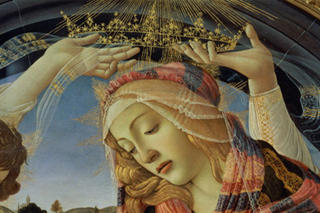
This kingly role that awaits us flows from the power of faith and the power of Christ’s grace – all of which was exemplified in that humble teenage mother who said “Yes” to God. For all of these reasons and more, the Church celebrates today the Queenship of Mary. detail from 'the Madonna of the Magnificat' by Sandro Botticelli

Farewell

"At the conclusion of this, my first visit to Germany as the Bishop of Rome and the Successor of Peter, I must express once again my heartfelt gratitude for the welcome given to me, to my collaborators and especially to the many young people who came to Cologne from every continent for this World Youth Day.

"The Lord has called me to succeed our beloved Pope John Paul II, whose inspired idea it was to initiate the series of World Youth Days.

"I have taken up this legacy with joy, and I give thanks to God for giving me the opportunity to experience in the company of so many young people this further step along their spiritual pilgrimage from continent to continent, following the Cross of Christ."

(from Pope Benedict's farewell at the Cologne/Bonn airport yesterday)

Word to the bishops

"Dear Brothers in the Episcopate,

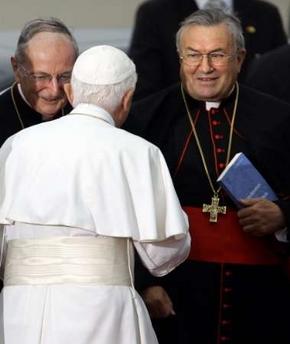
"I bless the Lord who has given me the joy of meeting you here, on German soil, at the conclusion of this Twentieth World Youth Day. I think we could say that the hand of Providence has been visible during these days, and not only has it given encouragement to me, the Successor of Peter, but it has also offered a sign of hope to the Church in this country, and above all to you, her Pastors.

* * * * *

"We know that on the face of this Church there are unfortunately also wrinkles, shadows that obscure her splendour. These too we should keep before us, in a spirit of unfailing love, at this moment of celebration and thanksgiving.

* * * * *

"May the memory of these hope-filled days spent in Cologne sustain your ministry, our ministry."

from an address to German bishops yesterday

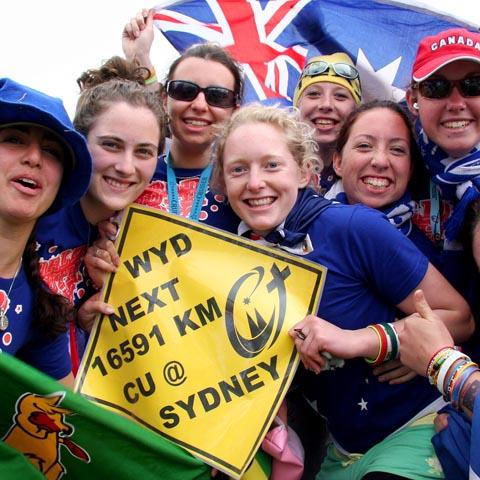
Next time, in Sydney

from Pope Benedict's Angelus message at World Youth Day yesterday:

"And now, as the living presence of the Risen Christ in our midst nourishes our faith and hope, I am pleased to announce that the next World Youth Day will take place in Sydney, Australia, in 2008."

Concluding and going forward

"Anyone who has discovered Christ must lead others to him. A great joy cannot be kept to oneself. It has to be passed on.

"In vast areas of the world today there is a strange forgetfulness of God. It seems as if everything would be just the same even without him. But at the same time there is a feeling of frustration, a sense of dissatisfaction with everyone and everything. People tend to exclaim: 'This cannot be what life is about!' Indeed not.

"And so, together with forgetfulness of God there is a kind of new explosion of religion. I have no wish to discredit all the manifestations of this phenomenon. There may be sincere joy in the discovery. Yet if it is pushed too far, religion becomes almost a consumer product. People choose what they like, and some are even able to make a profit from it.

"But religion constructed on a 'do-it-yourself' basis cannot ultimately help us. It may be comfortable, but at times of crisis we are left to ourselves.

"Help people to discover the true star which points out the way to us: Jesus Christ! Let us seek to know him better and better, so as to be able to guide others to him with conviction.

"This is why love for Sacred Scripture is so important, and in consequence, it is important to know the faith of the Church which opens up for us the meaning of Scripture. It is the Holy Spirit who guides the Church as her faith grows, causing her to enter ever more deeply into the truth (cf. Jn 16:13). Pope John Paul II gave us a wonderful work in which the faith of centuries is explained synthetically: the Catechism of the Catholic Church. I myself recently presented the Compendium of the Catechism, prepared at the request of the late Holy Father. These are two fundamental texts which I recommend to all of you.

"Obviously books alone are not enough. (You must) form communities based on faith!

"In recent decades movements and communities have come to birth in which the power of the Gospel is keenly felt. Seek communion in faith, like fellow travellers who continue together to follow the path of the great pilgrimage that the Magi from the East first pointed out to us.

"The spontaneity of new communities is important, but it is also important to preserve communion with the Pope and with the Bishops. It is they who guarantee that we are not seeking private paths, but are living as God’s great family, founded by the Lord through the twelve Apostles.


"Once again, I must return to the Eucharist.

"'Because there is one bread, we, though many, are one body” says Saint Paul (1 Cor 10:17). By this he meant: since we receive the same Lord and he gathers us together and draws us into himself, we ourselves are one.

"This must be evident in our lives. It must be seen in our capacity to forgive. It must be seen in our sensitivity to the needs of others. It must be seen in our willingness to share. It must be seen in our commitment to our neighbours, both those close at hand and those physically far away, whom we nevertheless consider to be close. Today there are many forms of voluntary assistance, models of mutual service, of which our society has urgent need. We must not, for example, abandon the elderly to their solitude, we must not pass by when we meet people who are suffering.

"If we think and live according to our communion with Christ, then our eyes will be opened. Then we will no longer be content to scrape a living just for ourselves, but we will see where and how we are needed. Living and acting thus, we will soon realize that it is much better to be useful and at the disposal of others than to be concerned only with the comforts that are offered to us.

"I know that you as young people have great aspirations, that you want to pledge yourselves to build a better world. Let others see this, let the world see it, since this is exactly the witness that the world expects from the disciples of Jesus Christ; in this way, and through your love above all, the world will be able to discover the star that we follow as believers.

"Let us go forward with Christ and let us live our lives as true worshippers of God! Amen."

(the conclusion of Pope Benedict's homily at World Youth Day yesterday)

The value of Sunday

"Jesus’s hour seeks to become our own hour and will indeed become so if we allow ourselves, through the celebration of the Eucharist, to be drawn into that process of transformation that the Lord intends to bring about. The Eucharist must become the centre of our lives.

"If the Church tells us that the Eucharist is an essential part of Sunday, this is no mere positivism or thirst for power.

"On Easter morning, first the women and then the disciples had the grace of seeing the Lord. From that moment on, they knew that the first day of the week, Sunday, would be his day, the day of Christ the Lord. The day when creation began became the day when creation was renewed. Creation and redemption belong together.

"That is why Sunday is so important.

"It is good that today, in many cultures, Sunday is a free day, and is often combined with Saturday so as to constitute a “week-end” of free time. Yet this free time is empty if God is not present.

"Dear friends! Sometimes, our initial impression is that having to include time for Mass on a Sunday is rather inconvenient. But if you make the effort, you will realize that this is what gives a proper focus to your free time. Do not be deterred from taking part in Sunday Mass, and help others to discover it too. This is because the Eucharist releases the joy that we need so much, and we must learn to grasp it ever more deeply, we must learn to love it. Let us pledge ourselves to do this – it is worth the effort!

"Let us discover the intimate riches of the Church’s liturgy and its true greatness: it is not we who are celebrating for ourselves, but it is the living God himself who is preparing a banquet for us. Through your love for the Eucharist you will also rediscover the sacrament of Reconciliation, in which the merciful goodness of God always allows us to make a fresh start in our lives."

(from Pope Benedict's homily at World Youth Day yesterday)

Christ, adoration, and union

"We are to become the Body of Christ, his own flesh and blood. We all eat the one bread, and this means that we ourselves become one.

"In this way, adoration, as we said earlier, becomes union. God no longer simply stands before us, as the one who is totally Other. He is within us, and we are in him. His dynamic enters into us and then seeks to spread outwards to others until it fills the world, so that his love can truly become the dominant measure of the world.
"I like to illustrate this new step urged upon us by the Last Supper by drawing out the different nuances of the word 'adoration' in Greek and in Latin.

"The Greek word is proskynesis.

"It refers to the gesture of submission, the recognition of God as our true measure, supplying the norm that we choose to follow. It means that freedom is not simply about enjoying life in total autonomy, but rather about living by the measure of truth and goodness, so that we ourselves can become true and good. This gesture is necessary even if initially our yearning for freedom makes us inclined to resist it. We can only fully accept it when we take the second step that the Last Supper proposes to us.

"The Latin word for adoration is ad-oratio – mouth to mouth contact, a kiss, an embrace, and hence ultimately love.

"Submission becomes union, because he to whom we submit is Love. In this way submission acquires a meaning, because it does not impose anything on us from the outside, but liberates us deep within.

"Let us return once more to the Last Supper. The new element to emerge here was the deeper meaning given to Israel’s ancient prayer of blessing, which from that point on became the word of transformation, enabling us to participate in the 'hour' of Christ.

"Jesus did not instruct us to repeat the Passover meal, which in any event, given that it is an anniversary, is not repeatable at will. He instructed us to enter into his 'hour.' We enter into it through the sacred power of the words of consecration – a transformation brought about through the prayer of praise which places us in continuity with Israel and the whole of salvation history, and at the same time ushers in the new, to which the older prayer at its deepest level was pointing. The new prayer – which the Church calls the 'Eucharistic Prayer' – brings the Eucharist into being. It is the word of power which transforms the gifts of the earth in an entirely new way into God’s gift of himself and it draws us into this process of transformation.

"That is why we call this action 'Eucharist,' which is a translation of the Hebrew word beracha – thanksgiving, praise, blessing, and a transformation worked by the Lord: the presence of his 'hour.'

"Jesus’s hour is the hour in which love triumphs. In other words: it is God who has triumphed, because he is Love."
(from Pope Benedict's homily at World Youth Day yesterday)

Transformation

"Dear young friends,

"Yesterday evening we came together in the presence of the Sacred Host, in which Jesus becomes for us the bread that sustains and feeds us (cf. Jn 6:35), and there we began our inner journey of adoration. In the Eucharist, adoration must become union.

"At the celebration of the Eucharist, we find ourselves in the 'hour' of Jesus, to use the language of John’s Gospel. Through the Eucharist this 'hour' of Jesus becomes our own hour, his presence in our midst.

"Together with the disciples he celebrated the Passover of Israel, the memorial of God’s liberating action that led Israel from slavery to freedom. Jesus follows the rites of Israel. He recites over the bread the prayer of praise and blessing. But then something new happens. He thanks God not only for the great works of the past; he thanks him for his own exaltation, soon to be accomplished through the Cross and Resurrection, and he speaks to the disciples in words that sum up the whole of the Law and the Prophets: ' This is my Body, given in sacrifice for you. This cup is the New Covenant in my Blood.' He then distributes the bread and the cup, and instructs them to repeat his words and actions of that moment over and over again in his memory.

"What is happening? How can Jesus distribute his Body and his Blood?

"By making the bread into his Body and the wine into his Blood, he anticipates his death, he accepts it in his heart and he transforms it into an action of love. What on the outside is simply brutal violence, from within becomes an act of total self-giving love.

"This is the substantial transformation which was accomplished at the Last Supper and was destined to set in motion a series of transformations leading ultimately to the transformation of the world when God will be all in all (cf. 1 Cor 15:28).

"In their hearts, people always and everywhere have somehow expected a change, a transformation of the world. Here now is the central act of transformation that alone can truly renew the world: violence is transformed into love, and death into life. Since this act transmutes death into love, death as such is already conquered from within, the resurrection is already present in it. Death is, so to speak, mortally wounded, so that it can no longer have the last word. To use an image well known to us today, this is like inducing nuclear fission in the very heart of being – the victory of love over hatred, the victory of love over death.

"Only this intimate explosion of good conquering evil can then trigger off the series of transformations that little by little will change the world. All other changes remain superficial and cannot save. For this reason we speak of redemption: what had to happen at the most intimate level has indeed happened, and we can enter into its dynamic. Jesus can distribute his Body, because he truly gives himself.

"This first fundamental transformation of violence into love, of death into life, brings other changes in its wake. Bread and wine become his Body and Blood. But it must not stop there, on the contrary, the process of transformation must now gather momentum. The Body and Blood of Christ are given to us so that we ourselves will be transformed in our turn."

(the beginning of Pope Benedict's homily at World Youth Day yesterday)

Sunday, August 21, 2005

They shall not prevail

Our Lord’s words in today’s Gospel (Mt. 16:13-20) are very familiar – especially for Catholics – and yet his words remain both astounding and powerful.

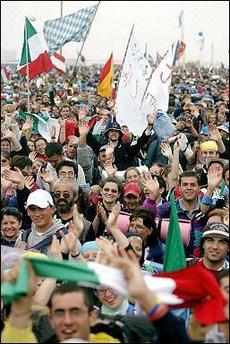
It is possibly no coincidence that the World Youth Day events are scheduled to culminate on the day this Gospel is read, as Pope Benedict XVI in a unique and dramatic way carries on the Petrine ministry that began with these words.

But there is also a dark hint in these words of power: a note of darkness barely softened by modern translations.

The gates of hell.

In speaking of his Church, our Lord says that “the gates of hell shall not prevail against it.”

The "gates of hell" encompass all that is evil - all that is opposed to God - and we seem to see these gates everywhere in these days.

There are many forces in the world on the attack today: opposed to God, opposed to the Church, opposed to faithful Christian living, even opposed to the very notion of objective morality.

They shall not prevail.

There are also many things in our world that oppose God by pushing in their own selfish directions: in popular culture, in politics, in science, in our churches, and even within ourselves.

They shall not prevail.

It is sometimes easy to get discouraged. Every day, the world seems to get worse. Every day, selfish people denigrate holy things. Every day, temptations tug at us and sin seems to overwhelm us.

They shall not prevail.

Upon this rock I will build my church;
and the gates of hell shall not prevail against it.

The better you know...

"It is only when a young man has had a personal experience of Christ that he can truly understand the Lord’s will and consequently his own vocation.

"The better you know Jesus the more his mystery attracts you. The more you discover him, the more you are moved to seek him. This is a movement of the spirit which lasts throughout life..."

from an address August 19 by Pope Benedict XVI to seminarians at World Youth Day

(Photograph of priests and seminarians reacting to Pope Benedict's election 4 months before.)

Saturday, August 20, 2005

Vigil with the youth

"Dear young friends,

"In our pilgrimage with the mysterious Magi from the East, we have arrived at the moment which Saint Matthew describes in his Gospel with these words: 'Going into the house (over which the star had halted), they saw the child with Mary his mother, and they fell down and worshipped him' (Mt 2:11).

"Outwardly, their journey was now over. They had reached their goal. But at this point a new journey began for them, an inner pilgrimage which changed their whole lives."

* * * * *

"The Magi from the East are just the first in a long procession of men and women who have constantly tried to gaze upon God’s star in their lives, going in search of the God who has drawn close to us and shows us the way.

"It is the great multitude of the saints – both known and unknown – in whose lives the Lord has opened up the Gospel before us and turned over the pages; he has done this throughout history and he still does so today. In their lives, as if in a great picture-book, the riches of the Gospel are revealed. They are the shining path which God himself has traced throughout history and is still tracing today....


"The saints and the blesseds did not doggedly seek their own happiness, but simply wanted to give themselves, because the light of Christ had shone upon them. They show us the way to attain happiness, they show us how to be truly human.

"Through all the ups and downs of history, they were the true reformers who constantly rescued it from plunging into the valley of darkness; it was they who constantly shed upon it the light that was needed to make sense – even in the midst of suffering – of God’s words spoken at the end of the work of creation: 'It is very good.'"

* * * * *

"Now I want to express this in an even more radical way: only from the saints, only from God does true revolution come, the definitive way to change the world.

"In the last century we experienced revolutions with a common programme – expecting nothing more from God, they assumed total responsibility for the cause of the world in order to change it. And this, as we saw, meant that a human and partial point of view was always taken as an absolute guiding principle.

"Absolutizing what is not absolute but relative is called totalitarianism. It does not liberate man, but takes away his dignity and enslaves him.

"It is not ideologies that save the world, but only a return to the living God, our Creator, the guarantor of our freedom, the guarantor of what is really good and true. True revolution consists in simply turning to God who is the measure of what is right and who at the same time is everlasting love.

* * * * *

"There is much that could be criticized in the Church. We know this and the Lord himself told us so: it is a net with good fish and bad fish, a field with wheat and darnel.

"Pope John Paul II, as well as revealing the true face of the Church in the many saints that he canonized, also asked pardon for the wrong that was done in the course of history through the words and deeds of members of the Church.

"In this way he showed us our own true image and urged us to take our place, with all our faults and weaknesses, in the procession of the saints that began with the Magi from the East.

"It is actually consoling to realize that there is darnel in the Church. In this way, despite all our defects, we can still hope to be counted among the disciples of Jesus, who came to call sinners.

"The Church is like a human family, but at the same time it is also the great family of God, through which he establishes an overarching communion and unity that embraces every continent, culture and nation. So we are glad to belong to this great family; we are glad to have brothers and friends all over the world.

"Here in Cologne we discover the joy of belonging to a family as vast as the world, including heaven and earth, the past, the present, the future and every part of the earth. In this great band of pilgrims we walk side by side with Christ, we walk with the star that enlightens our history.

“'Going into the house, they saw the child with Mary his mother, and they fell down and worshipped him' (Mt 2:11).

"Dear friends, this is not a distant story that took place long ago. It is with us now. Here in the sacred Host he is present before us and in our midst. As at that time, so now he is mysteriously veiled in a sacred silence; as at that time, it is here that the true face of God is revealed. For us he became a grain of wheat that falls on the ground and dies and bears fruit until the end of the world (cf. Jn 12:24). He is present now as he was then in Bethlehem. He invites us to that inner pilgrimage which is called adoration. Let us set off on this pilgrimage of the spirit and let us ask him to be our guide. Amen."

from a vigil celebration with the youth this evening

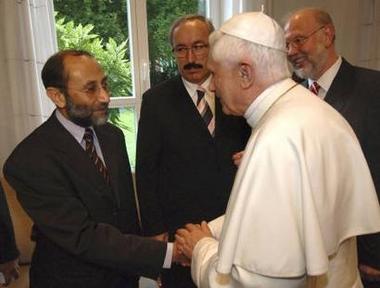
Meeting with Muslims

"Dear Muslim Friends!

"It gives me great joy to be able to be with you and to offer you my heartfelt greetings....

"I turn to you, dear Muslim friends, to share my hopes with you and to let you know of my concerns at these particularly difficult times in our history.

* * * * *

I am certain that I echo your own thoughts when I bring up as one of our concerns the spread of terrorism.... Those who instigate and plan these attacks evidently wish to poison our relations, making use of all means, including religion, to oppose every attempt to build a peaceful, fair and serene life together.

"Terrorism of any kind is a perverse and cruel decision which shows contempt for the sacred right to life and undermines the very foundations of all civil society.

"If together we can succeed in eliminating from hearts any trace of rancour, in resisting every form of intolerance and in opposing every manifestation of violence, we will turn back the wave of cruel fanaticism that endangers the lives of so many people and hinders progress towards world peace....

"Dear friends, I am profoundly convinced that we must not yield to the negative pressures in our midst, but must affirm the values of mutual respect, solidarity and peace.

"The life of every human being is sacred, both for Christians and for Muslims. There is plenty of scope for us to act together in the service of fundamental moral values....

"During my meeting last April with the delegates of Churches and Christian communities and with representatives of the various religious traditions, I affirmed that 'the Church wants to continue building bridges of friendship with the followers of all religions, in order to seek the true good of every person and of society as a whole' (L’Osservatore Romano, 25 April 2005, p. 4).

"Past experience teaches us that relations between Christians and Muslims have not always been marked by mutual respect and understanding. How many pages of history record battles and even wars that have been waged, with both sides invoking the name of God, as if fighting and killing the enemy could be pleasing to him.

"The recollection of these sad events should fill us with shame, for we know only too well what atrocities have been committed in the name of religion.

"The lessons of the past must help us to avoid repeating the same mistakes. We must seek paths of reconciliation and learn to live with respect for each other’s identity. The defence of religious freedom, in this sense, is a permanent imperative and respect for minorities is a clear sign of true civilization."

* * * * *

"As Christians and Muslims, we must face together the many challenges of our time. There is no room for apathy and disengagement, and even less for partiality and sectarianism. We must not yield to fear or pessimism. Rather, we must cultivate optimism and hope. Interreligious and intercultural dialogue between Christians and Muslims cannot be reduced to an optional extra. It is in fact a vital necessity, on which in large measure our future depends....

"I pray with all my heart, dear Muslim friends, that the merciful and compassionate God may protect you, bless you and enlighten you always. May the God of peace lift up our hearts, nourish our hope and guide our steps on the paths of the world."

from an address to representatives of Muslim communities

The Foreigner

In today's first reading (click here for a reflection on today's Gospel) we hear the rest of the familiar story of Ruth: the account of how a woman from an alien land became the great-grandmother of one of the greatest figures in the history of Israel - King David.

Key to the sequence of events is this exchange between Ruth and her future husband:

Casting herself prostrate upon the ground, she said to him, "Why should I, a foreigner, be favored with your notice?"

Boaz answered her: "I have had a complete account of what you have done for your mother-in-law after your husband's death....

Although Ruth was doubtlessly attractive, there were certainly many other attractive girls in the area who were significantly younger and true Israelites.

Boaz looked beyond Ruth's background and based his opinion of her on her virtues, her faithfulness, and the way she lived her life.

Do we do the same?

He was born an aristocrat

  • He motivated nearly all his brothers and friends to become monks with him.
  • He reformed an entire religious order.
  • He advised kings and popes.
  • He was an important figure at an Ecumenical Council.
  • He ended schisms and launched campaigns.
  • He wrote magnificent works of faith.
  • He inspired one of history’s greatest poets.
  • He was the first member of his order to become a saint.
  • He was solemnly declared a Doctor of the Church.
  • Today, thousands follow his example in imitating Christ.

Sadly, uninformed people today only know about the dog.

St. Bernard of Clairvaux, the great reformer of the Cistercian order, died on this very day in 1153.

Friday, August 19, 2005

The teacher

Pope Benedict at a seminary today

Ecumenical Meeting today

"Dear Brothers and Sisters,

"Permit me to remain seated after such a strenuous day. This does not mean I wish to speak 'ex cathedra.' Also, excuse me for being late. Unfortunately, Vespers took longer than foreseen and the traffic was slower moving than could be imagined.

"I would like now to express the joy I feel on the occasion of my Visit to Germany, in being able to meet you and offer a warm greeting to you, the Representatives of the other Churches and Ecclesial Communities.

* * * * *

"Among Christians, fraternity is not just a vague sentiment, nor is it a sign of indifference to truth. As you have just said, bishop, it is grounded in the supernatural reality of the one Baptism which makes us members of the one Body of Christ (cf. 1 Cor 12:13; Gal 3:28; Col 2:12).

"Together we confess that Jesus Christ is God and Lord; together we acknowledge him as the one mediator between God and man (cf. 1 Tim 2:5) and we emphasize that together we are members of his Body (cf. Unitatis Redintegratio, 22; Ut Unum Sint, 42).

"Based on this essential foundation of baptism, a reality comes from him which is a way of being, then of professing, believing and acting. Based on this crucial foundation, dialogue has borne its fruits and will continue to do so.

"I would like to mention the re-examination of the mutual condemnations, called for by John Paul II during his first visit to Germany in 1980, and .... 'Joint Declaration on the Doctrine of Justification' (1999), which grew out of that re-examination and led to an agreement on basic issues that had been a subject of controversy since the sixteenth century.

"We should also acknowledge with gratitude the results of our common stand on important matters such as the fundamental questions involving the defence of life and the promotion of justice and peace.

"I am well aware that many Christians in this country, and not only in this country, expect further concrete steps to bring us closer together.

"I myself have the same expectation.

"It is the Lord’s command, but also the imperative of the present hour, to carry on dialogue, with conviction, at all levels of the Church’s life.

"This must obviously take place with sincerity and realism, with patience and perseverance, in complete fidelity to the dictates of one’s conscience in the awareness that it is the Lord who gives unity, that we do not create it, that it is he who gives it but that we must go to meet him."

* * * * *

"Another urgent priority in ecumenical dialogue arises from the great ethical questions of our time.

"In this area, modern, searching man rightly expects a common response on the part of Christians, which, thanks be to God, has often been forthcoming.... but unfortunately, this does not always happen.

"Because of contradictory positions in these areas, our witness to the Gospel and the ethical guidance which we owe to the faithful and to society lose their impact and often appear too vague, with the result that we fail in our duty to provide the witness that is needed in our time.

"Our divisions are contrary to the will of Jesus and they disappoint the expectations of our contemporaries.

"I think that we must work with new energy and dedication to bring a common witness into the context of these great ethical challenges of our time."

* * * * *

"I am convinced that if more and more people unite themselves to the Lord’s prayer 'that all may be one” (Jn 17:21), then this prayer, made in the name of Jesus, will not go unheard (cf. Jn 14:13; 15:7, 16, etc.). With the help that comes from on high, we will also find practical solutions to the different questions which remain open, and in the end our desire for unity will come to fulfilment, whenever and however the Lord wills.

"Now let us all go along this path in the awareness that walking together is a form of unity. Let us thank God for this and pray that he will continue to guide us all."

from Pope Benedict's address to an ecumenical gathering today

UPDATE: As said earlier, the Holy Father speaks so well off the top of his head. Indeed, he deviated a number of times from his prepared text (which I have generally followed in most of these posts). Sandro Magister of L'Espresso has copied in his Sept. 2 column the actual transcript from the Vatican web site and I have adjusted the above excerpts accordingly. (Hat tip: Amy Welborn)

The Pope goes to seminary

"Dear Seminarians,

"I greet all of you with great affection and gratitude for your festive welcome
and particularly for the fact that you have come to this gathering from so many countries the world over.

* * * * *

"The Magi set out because of a deep desire which prompted them to leave everything and begin a journey. It was as though they had always been waiting for that star. It was as if the journey had always been a part of their destiny, and was finally about to begin.

"Dear friends, this is the mystery of God’s call, the mystery of vocation. It is part of the life of every Christian, but it is particularly evident in those whom Christ asks to leave everything in order to follow him more closely.

"The seminarian experiences the beauty of that call in a moment of grace which could be defined as 'falling in love.'

"His soul is filled with amazement, which makes him ask in prayer: 'Lord, why me?' But love knows no 'why;' it is a free gift to which one responds with the gift of self."

* * * * *

"The seminary years are a time of journeying, of exploration, but above all of discovering Christ. It is only when a young man has had a personal experience of Christ that he can truly understand the Lord’s will and consequently his own vocation.

"The better you know Jesus the more his mystery attracts you. The more you discover him, the more you are moved to seek him. This is a movement of the spirit which lasts throughout life...."

from an address to seminarians earlier today

Family ties

Mothers-in-law in some cultures are the frequent subject of jokes and indeed not every married person has a wonderful relationship with their in-laws.

Today’s first reading tells a very different story: the first part of the familiar story of Ruth (from the book of that same name) in which Ruth forsakes her homeland and pagan religion to accompany her mother-in-law and embrace her mother-in-law’s faith – faith in the Lord God of Israel.

Ruth’s mother-in-law had not been intent on converting her – quite the contrary – and yet it was through her that Ruth came to know the Lord.

It is an example to us of how the simple witness of our lives can prove to be the instruments by which others – even our own family members – can be brought deeper into the faith.

Although clarity about faith in charity is important, arguments about religion are usually counterproductive, especially with relatives. The simple witness of a life fully lived in Christ, however, can be a much more effective instrument of grace – for the stranger we meet as well as for the ones we know and love.

The Priest of Hearts

Love was very important to John: not just any love, but the love of God – the love that flows from the heart of our Lord and Savior Jesus Christ and fills the hearts of the saints, most especially our Lord’s mother.

Intent on focusing on that love, when he was 14, John took a vow of chastity and several years later was ordained a priest.

He would be instrumental in promoting public devotion to the love of God through the Sacred Heart of Jesus (and manifested in the Holy Heart of Mary). He wrote many prayers still used today.

St. John Eudes died on this very day in 1680 and was canonized in 1925.

She scores

Old friends visit their friend in the cloister


The Catholic Educator's Resource Center has a reprint of a great article about a successful professional basketball player who became a Poor Clare nun.

Poor Clare Monastery of Mary, Mother of theChurch
2505 Stonehedge Drive
Alexandria, Virginia 22306-2499

Commemorative yarmulke

"Visit - Pope Benedict XVI... 19 August 2005"

Pope at Cologne Synagogue

"Ladies and Gentlemen,
Dear Brothers and Sisters!

"Shalom lechem! It has been my deep desire, during my first visit to Germany since my election as the Successor of the Apostle Peter, to meet the Jewish community of Cologne and the representatives of Judaism in Germany. By this visit I would like to return in spirit to the meeting that took place in Mainz on 17 November 1980 between my venerable predecessor Pope John Paul II, then making his first visit to this country, and members of the Central Jewish Committee in Germany and the Rabbinic Conference.

"Today too I wish to reaffirm that I intend to continue on the path towards improved relations and friendship with the Jewish People, following the decisive lead given by Pope John Paul II (cf. Address to the Delegation of the International Jewish Committee on Interreligious Consultations, 9 June 2005: L’Osservatore Romano, 10 June 2005, p. 5)."

* * * * *

"This year marks the sixtieth anniversary of the liberation of the Nazi concentration camps, in which millions of Jews – men, women and children – were put to death in the gas chambers and ovens. I make my own the words written by my venerable Predecessor on the occasion of the sixtieth anniversary of the liberation of Auschwitz and I too say: 'I bow my head before all those who experienced this manifestation of the mysterium iniquitatis.' The terrible events of that time must 'never cease to rouse consciences, to resolve conflicts, to inspire the building of peace' (Message for the Liberation of Auschwitz, 15 January 2005)."

* * * * *

"In the forty years that have passed since the conciliar Declaration Nostra Aetate, much progress has been made, in Germany and throughout the world, towards better and closer relations between Jews and Christians.... Yet much still remains to be done. We must come to know one another much more and much better. Consequently I would encourage sincere and trustful dialogue between Jews and Christians, for only in this way will it be possible to arrive at a shared interpretation of disputed historical questions, and, above all, to make progress towards a theological evaluation of the relationship between Judaism and Christianity. This dialogue, if it is to be sincere, must not gloss over or underestimate the existing differences: in those areas in which, due to our profound convictions in faith, we diverge, and indeed precisely in those areas, we need to show respect for one another.

"Finally, our gaze should not only be directed to the past, but should also look forward to the tasks that await us today and tomorrow. Our rich common heritage and our fraternal and more trusting relations call upon us to join in giving an ever more harmonious witness and to work together on the practical level for the defence and promotion of human rights and the sacredness of human life, for family values, for social justice and for peace in the world.

"The Decalogue (cf. Ex 20; Dt 5) is for us a shared legacy and commitment. The Ten Commandments are not a burden, but a sign-post showing the path leading to a successful life.

"This is particularly the case for the young people whom I am meeting in these days and who are so dear to me. My wish is that they may be able to recognize in the Decalogue a lamp for their steps, a light for their path (cf. Ps 119:105).

"Adults have the responsibility of handing down to young people the torch of hope that God has given to Jews and to Christians, so that 'never again' will the forces of evil come to power, and that future generations, with God’s help, may be able to build a more just and peaceful world, in which all people have equal rights and are equally at home.

"I conclude with the words of Psalm 29, which express both a wish and a prayer: 'May the Lord give strength to his people, may he bless his people with peace.'"

from Pope Benedict XVI's address today at the synagogue of Cologne

Priests killed in Colombia

Father Sanchez was teaching a high school religion class yesterday when gunmen came in, dragged him outside, and shot him to death: the third priest to be killed this week, according to press reports.

Monday, two priests driving on a country road were killed with gunfire and explosives. Two laborers traveling with them were also killed.

Sixty priests, a bishop, an archbishop, and three nuns have been killed in the past two decades, many of those by armed groups involved in Colombia's ongoing civil war.

Requiescant in pace

Thursday, August 18, 2005

Pope in the Cathedral

Dear Brothers and Sisters,

"I am pleased to be with you this evening in Cologne, a city that I love for the many memories which it evokes for me.

"For a number of years I lived in the neighbouring city of Bonn as a professor, and from there I would often come to Cologne where I had many friends.

"It was, I am convinced, by a special design of Providence that I soon became a friend of the then Archbishop, Cardinal Joseph Frings, who gave me his full confidence and called me to be his theologian for the Second Vatican Council, which meant that I was able to play an active part in that historic event."

* * * * *

"The city of Cologne would not be what it is without the Magi, who have had so great an impact on its history, its culture and its faith....


"In honour of the Magi the inhabitants of Cologne produced the most exquisite reliquary of the whole Christian world and, as if that were not sufficient, they raised above it an even greater reliquary, this stupendous Gothic Cathedral which, after the ravages of war, once more stands before visitors in all the splendour of its beauty."

* * * * *

"Yet Cologne is not just the city of the Magi. It has been deeply marked by the presence of many saints; these holy men and women, through the witness of their lives and the imprint they left on the history of the German people, have helped Europe to grow from Christian roots.

"I think above all of the martyrs of the first centuries, like young Saint Ursula and her companions, who, according to tradition, were martyred under Diocletian. How can one fail to remember Saint Boniface, the Apostle of Germany, whose election as Bishop of Cologne in 745 was confirmed by Pope Zachary?

"The name of Saint Albert the Great is also linked to this city; his body rests nearby in the crypt of the Church of Saint Andrew. In Cologne Saint Thomas Aquinas was a disciple of Saint Albert and later a professor.

"Nor can we forget Blessed Adolph Kolping, who died in Cologne in 1865; from a shoemaker he became a priest and founded many social initiatives, especially in the area of professional training.


"Closer to our own times, our thoughts turn to Edith Stein, the eminent twentieth-century Jewish philosopher who entered the Carmelite Convent in Cologne taking the name of Teresa Benedicta of the Cross, and later died in the concentration camp at Auschwitz. Pope John Paul II canonized her and declared her a co-patroness of Europe, together with Saint Bridget of Sweden and Saint Catherine of Siena.

"In these and all the other saints, both known and unknown, we discover the deepest and truest face of this city and we become aware of the legacy of values handed down to us by the generations of Christians who have gone before us. It is a very rich legacy.

"We need to be worthy of it."

From Pope Benedict XVI's address at the Cathedral of Cologne

The Barque of Peter

Pope Benedict XVI waves from a boat on the river Rhine in Cologne.


Afterward, the Holy Father led pilgrims to the doors of Cologne Cathedral.

Pope's words at Airport (excerpts)

"Mr. President, Distinguished Political and Civil Authorities, Your Eminences and Venerable Brothers in the Episcopate, Dear Citizens of the Federal Republic,

My Dear Young People!

"With deep joy I find myself for the first time after my election to the Chair of Peter in my beloved homeland, in Germany. With deep emotion I thank God who has enabled me to begin my Pastoral Visits outside Italy with this visit to the nation of my birth. I have come to Cologne for the Twentieth World Youth Day, which had already been planned by my Predecessor, the unforgettable Pope John Paul II. I am sincerely grateful to all present for the warm welcome given to me."

* * * * *

"Like the Magi, all believers – and young people in particular – have been called to set out on the journey of life in search of truth, justice and love.

"The ultimate goal of the journey can only be found through an encounter with Christ, an encounter which cannot take place without faith.

"Along this interior journey we can be guided by the many signs with which a long and rich Christian tradition has indelibly marked this land of Germany: from great historical monuments to countless works of art found throughout the country, from documents preserved in libraries to lively popular traditions, from philosophical inquiry to the theological reflection of her many great thinkers, from the spiritual traditions to the mystical experience of a vast array of Saints. Here we find a rich cultural and spiritual heritage which even today, in the heart of Europe, testifies to the fruitfulness of the Christian faith and tradition.

"The Diocese and the region of Cologne, in particular, keep the living memory of great witnesses to Christian civilization. Among others, I think of Saint Boniface, Saint Ursula, Saint Albert the Great, and, in more recent times, Saint Teresa Benedicta of the Cross (Edith Stein) and Blessed Adolph Kolping. May these, our illustrious brothers and sisters in the faith, who down the centuries have held high the torch of holiness, be 'models' and 'patrons' of the World Youth Day which we now celebrate."

Rash words

In today’s first reading (Jgs 11:29-39a), one of Israel’s ancient judges makes a thoughtless but solemn vow with horrific results, leading him to slay his only child.

It is a warning for us to be discerning with our commitments and careful with our words.

Miserere mei, Domine.

The old nun asked a question

"Many of our holy fathers in the faith - men who were pillars of the Church - did not die martyrs. Why do you think that was?"

The other nuns offered various answers. The old nun paused and spoke again.

"Well, I myself think it was because there is another martyrdom: the martyrdom of love.

"Here God keeps his servants and handmaids in this present life so that they may labor for him -- and he makes of them martyrs and confessors.

"I know that WE are meant to be martyrs of this kind..."

"Of what kind, Mother?" a sister asked.

"Yield yourself fully to God," said the old nun, "And you will find out!"

The old nun herself found out.

Jane de Chantal, founder of the Sisters of the Visitation, died just short of her 70th birthday. She was canonized in 1767 and her memory is celebrated on this day.

Off the top of his head

The wind blew Pope Benedict's zucchetto off his head just as he was exiting the airplane upon his arrival in Germany.

Just as well. He speaks brilliantly off the top of his head.

It all begins with a question

"It all begins with a question. A longing. A desire to know.

"The one thing we have learned from this process we call 'discernment' or the understanding of God's will for our own lives is that in order to answer the question, 'Are you called?' you must first ask some questions of your own.

"Very often those considering a vocation ask, 'What are the signs of a religious vocation?' How do I know if God is calling me?' There is no easy, clear-cut answer....

"Our Congregation's Renovator, Blessed George Matulatis-Matulewicz, believed that a person could discern God's will by reflecting on the reality that 'God draws us to Himself and guides us to this or that way of life through our holy desires, affections, aspirations, propensities, longings and so on ...'


From the Vocations pages of
the Congregation of Marians of the Immaculate Conception

Pope returns to Germany

Pope Benedict XVI has just arrived in Cologne, Germany for World Youth Day.

The Gothic Cathedral of the Ages

Cathedrals and other great churches always used to take a long time to build, but none quite like the Cathedral of Cologne.

For one thing, it took longer to build than perhaps any other church building in history. Construction began in 1248. It ground to a halt by 1560. It restarted in 1842 and...
was completed in 1880!

It should be no surprise that during the centuries of construction the dominant symbol of Cologne was the 14th century construction crane towering above the city.

Generally speaking, over the course of the decades and centuries that it took to build a cathedral, significant changes were usually made in the plans along the way.

Thus, a second remarkable thing about the long history of the construction of Cologne's Cathedral is that it essentially followed the same plan from the beginning. As it was being completed, the Cathedral of Cologne was widely hailed and widely imitated, inspiring St. Patrick's Cathedral in New York City.

Then, less than 70 years after it was completed, this slowly wrought jewel was heavily damaged during the second World War.

Repairs were completed in 1956 and renovations have continued over the years since.


Like most Gothic cathedrals, the use of vertical space in the Cathedral of Cologne is awe-inspiring and beautiful, giving glimpses of heaven amid the shadows of earth.


The great windows are not only majestic and brilliant with color, but also educative and descriptive of the history of salvation and the mysteries of faith.


In most Gothic cathedrals, the statues appear to us today as cold, stern, lifeless, and sometimes even frightening. The 13th century statuary of the Cathedral of Cologne, however, includes statues that are lively, colorful, and even playful (sanctity does not have to be stuffy).


The east end of the Cathedral was the very first part to be completed. On the banks of the river Rhine it sits regally, like the most glorious of crowns.

Cathedrals traditionally were integral parts of the cities in which they were built, towering above all else and yet nestled snugly within the heart of the city and its life, embracing the people and pointing towards God.(Yes, I really, really like this cathedral!)

Wednesday, August 17, 2005

Things were so much better

"You hear people complaining about this present day and age because things were SO much better in former times.

"I wonder what would happen if they could be taken back to the days of their ancestors - would we not still hear them complaining?

"You may think past ages were good, but it is only because you are not living in them."


from a sermon by St. Augustine, who died in the year 430

(from today's Office of Readings - emphasis added)

World Youth Hair Day


One of the participants today at World Youth Day in Cologne (Köln)

Christian Carnival

This week's Christian Carnival - a collection of posts, etc. from various sources - is online at all kinds of time.

Reaction to the death of Frère Roger

Pope Benedict XVI at the end of his General Audience this morning:

"We have spoken together of sadness and joy. As a matter of fact, I received this morning very sad, dramatic news. During vespers yesterday evening, dear Frère Roger Schutz, founder of the Taizé community, was attacked and killed, probably by an unbalanced individual.

"This news impacts me all the more because just yesterday I received a letter from Frère Roger that was very moving, very friendly. In it, he writes that from the depth of his heart he wanted to tell me that 'we are in communion with you and with those who are gathered in Cologne.' Then he writes that, due to the condition of his health, it would unfortunately not be possible for him to come personally to Cologne, but that he would be spiritually present together with his brethren.

"At the bottom of this letter, he writes me how much he has the desire to come to Rome to meet me and to tell me that 'our Taizé community wants to walk in communion with the Holy Father.' Then he writes in his own hand: 'Holy Father, I assure you of my feelings of profound communion. Frère Roger Schutz of Taizé.'

"At this moment of sadness, we can only entrust to the goodness of the Lord the soul of this faithful servant of his. We know that the sadness – as we have now heard in the Psalm (Psalm 125) – will give birth again to joy. Frère Schutz is in the hands of eternal goodness, of eternal love, and has arrived at eternal joy. He admonishes us and exhorts us to be faithful laborers in the vineyard of the Lord always - even in sad situations - sure that the Lord accompanies us and gives us his joy."


From Taizé's website:
"Frère Roger has entered the life of eternity

"During the evening prayer on Tuesday 16 August, in the midst of the crowd surrounding the Community in the Church of Reconciliation, a woman - probably mentally disturbed - struck Brother Roger violently with knife blows. He died a few moments later.

"In its sorrow, the Taizé Community thanks all those who are supporting it by their affection and their prayer. On the morning of 17 August, after Brother Roger’s death, the following prayer was read in the church:

"'Christ of compassion, you enable us to be in communion with those who have gone before us, and who can remain so close to us. We confide into your hands our Brother Roger. He already contemplates the invisible. In his footsteps, you are preparing us to welcome a radiance of your brightness.'

"The funeral of Brother Roger will take place on Tuesday 23 August at 14.00.

"Each afternoon, from 15.00 to 19.00, his body is placed in the church of Taizé, so that all who wish may go and meditate close by him.

"Eight years ago, Brother Roger designated Brother Alois to succeed him, as the person in charge of the community. Brother Alois has entered straightaway into his ministry as servant of communion at the heart of the community."

Blogging from Cologne

The Cathedral of Cologne, rising from the banks of the Rhine Many, many bloggers are at World Youth Day, passing on their experiences to the blogsphere (alas, I am not one of them). Here are just three:

www.youngandcatholic.com

World Youth Day Wednesday

World Youth Day participants inside Cologne CathedralPilgrimage to the Cathedral of Cologne

Masses

Morning prayer in parishes

Catechesis

The Sacrament of Reconciliation

Musical Picnic

Youth Festival and Ecumenical Religious Services

http://www.wjt2005.de/

Resentment and the generosity of God

In today’s Gospel (Mt. 20:1-16) we have the familiar parable of day laborers being hired at different times during the day, but all receiving the same daily wage (a reminder for us to pray for day laborers and for others who struggle for work.)

On one level, the parable symbolizes a resentment that long-faithful people sometimes have toward the newly converted: they haven’t paid their dues; they don’t deserve what we’ve earned by our years of faithfulness.

The truth is that when it comes to salvation, what we receive is far, far above what we could ever hope to earn – not even in a thousand lifetimes. The differences between what the always-faithful people have done and what newly-converted have done are laughingly inconsequential in comparison to the infinite grace given to us in our Lord and Savior Jesus Christ.

The more we are filled with the grace and the love of God, the more we will recognize that the salvation of 'latecomers' actually increases our joy and cause for celebration.

Meanwhile, we need to pray: pray for ourselves, that we may be more filled with that grace, love, and joy; pray for those we resent, that they may share in our joy; pray for all those who have not yet come fully into the faith and life of Christ; pray to our God and Father, who is rich in generosity and mercy.

Sports Illustrated and boys...

Sister Mary Martha Hetzler, O.P."...may be unlikely invitations for a vocation but that is how God called me.

"I grew up Canadian, an hour east of Vancouver, British Columbia, but I left after high school to attend Christendom, a small Catholic college in Virginia.

"I must confess that although I grew up Catholic, the Faith was not the main influence in my decision to attend the college. In fact, once I arrived, I began to go to daily Mass only to impress a boy I liked.

"It worked – but it also had the inevitable consequence of deepening my faith. Holy hours, rosary processions, even classes took on a personal importance as I felt an unexplained desire to absorb everything Catholic.

"(Ironically, that 'boy' is now an ordained priest and here I am in the convent!)

"In 1998, I finished my studies in theology and began to teach....

"In the midst of this teaching, I received an article published in a Sports Illustrated magazine to read. It was about a young woman, an international professional basketball player, who loved what she did, was good at it had great friends, family, boyfriends and money…everything. But for her it wasn’t satisfying; she gave it all up to join a cloistered Poor Clare community.

"It was a very disturbing article for me to read—there were too many similarities of disposition. With a leap of faith - five months and a visit to St. Cecilia later - I bought a one-way ticket to Nashville.

"I thought coming to St. Cecilia Convent would be a sacrificial act for me – a complete renunciation of the world. But even more, I thought that I would have to renounce myself to fit into the “sister” mold – stretching, shrinking, squeezing into it at all costs. And while I will take vows of chastity, poverty and obedience at the end of my novice year, I have learned that religious life is not about negating or erasing anything , but developing and discovering who I really am.

"Now I am in the same place as my former students, but God is the teacher, forming my whole person and chipping away the fears and faults that cover up the person I am.

"In doing so, He has given me more happiness, freedom and energy that I could ever have imagined – and I have only been here a year!

"I have a whole lifetime more!

"The irony of giving your whole life to God in religious life is that He gives it all back, with interest!

"The sacrifice is real, but God works with nature and enriches it with His grace. "

Sister Mary Martha Hetzler, O.P.


from the website of the Nashville Dominicans

Tuesday, August 16, 2005

From the World Youth Day Opening Mass


* * * * *


Cardinal Joachim Meissner, Archbishop of Cologne"Brothers and Sisters!

"Welcome to the Archdiocese of Cologne! We are delighted that you are all here.

"We are celebrating the first World Youth Day with two Popes: with Pope John Paul II in heaven above, and with our Pope Benedict XVI here on earth.

"What an amazing celebration of faith this will be!

"Three weeks before he died, the Holy Father called me to his room in the Gemelli hospital and asked me, 'Are they still waiting for me in Cologne?' I replied, 'Holy Father, we are faithfully waiting for you.'

"We now call up to heaven: 'Holy Father John Paul II, we are waiting for you!'

"And we call to Rome: 'Holy Father Benedict XVI, we are waiting for you!'

Cardinal Joachim Meissner, Archbishop of Cologne
Opening Mass Homily, World Youth Day 2005 (excerpt)

A legend is slain at Vespers

Brother Roger, founder of the ecumenical religious community Taizé was stabbed to death during Vespers this evening by someone identified as mentally disturbed.

Brother Roger, who started the community during the second World War near Cluny, France, was 90.

Requiescat in pace.


UPDATE: Click here for reaction by the Holy Father and a statement from the Taizé community.

Soak the rich

"It is easier for a camel to go through the eye of a needle,
than for a rich man to enter into the kingdom of God."

The words of our Lord in today’s Gospel (Mt. 19:23-30) are a slap in the face for rich people everywhere.

Indeed, many people get defensive when they hear these words.

Some take refuge in comforting interpretations by obliging preachers and scholars who usually refer to a gate in Jerusalem called the Needle’s Eye (through which camels had to pass on their knees) or who idiosyncratically retranslate “camel” as “rope”.

The message being conveyed in these interpretations is essentially “It’s hard, but don’t worry, you CAN do it.”

This feel-good message is explicitly contradicted by our Lord’s very next statement: "With men this is impossible... "

Sorry, rich people, there is nothing you can do that will get you into heaven (but stay tuned).

The other defensive position that people take is to deny that the passage applies to them because they aren’t really “rich.”

Sorry, not-really-rich people, when our Lord says, “With men this is impossible,” he means you too.

"With men this is impossible;
but with God all things are possible."


Here, of course, we have the ultimate answer: we are not saved by riches, nor by lack of riches, nor by anything we can do – we are saved by the grace of God in our Lord and Savior Jesus Christ.

All of us, rich and poor, need the soaking rain of God’s love and mercy.

* * * * *

This, of course, does not mean that we should be passive or complacent, that we can just go on with our lives and follow our whims.

No, we must be faithful to the Lord in all of the opportunities and challenges before us.

Material goods
– whether the superabundance of the rich
or even the few possessions of the poor –
represent especially important opportunities
and serious challenges
for all of us.

Our Lord refers to these challenges most gloriously in the Sermon on the Mount:

"Lay not up for yourselves treasures upon earth,
where moth and rust doth corrupt,
and where thieves break through and steal:


"But lay up for yourselves treasures in heaven,
where neither moth nor rust doth corrupt,
and where thieves do not break through nor steal:


"For where your treasure is,
there will your heart be also."
Matthew 6:19-21


The first part of this passage recalls the words of Ecclesiastes

"For what hath man of all his labour,
and of the vexation of his heart,
wherein he hath laboured under the sun?


"For all his days are sorrows, and his travail grief;
yea, his heart taketh not rest in the night.


"This is also vanity."
Ecclesiastes 2:22-23


This insight also calls to my mind an old Gershwin song:

"Folks with plenty of plenty,
they got a lock on the door
Afraid somebody's gonna rob 'em
while they're out a'makin' more
What for?"


These are not challenges for the super-rich alone. Indeed, such concerns may be an even greater burden for those with far fewer possessions.

The most significant challenge, however, is in the very last verse of the above Gospel passage:

"For where your treasure is,
there will your heart be also."

Rich or poor, we can base so much of ourselves on material things - so much of our attention, so much of our hope for contentment – that Christ is no longer the focus of our lives, no longer the source of our hope, no longer the source from which we seek contentment.

St. Augustine most famously and beautifully recounted how he foolishly pursued happiness in the things of this world and later recognized God as the true and only source of real fulfillment (Confessions, X.xxvii[38])

"Late have I loved thee,
O Beauty so ancient and so new,
late have I loved thee.

"For see, thou wast within
and I was without,
and I sought thee out there.

"Unlovely, I rushed heedlessly
among the lovely things thou hast made.

"Thou wast with me, but I was not with thee.

"These things kept me far from thee
(even though they were not at all
unless they were in thee).

"Thou didst call and cry aloud,
and didst force open my deafness.
Thou didst gleam and shine,
and didst chase away my blindness.
Thou didst breathe fragrant odors
and I drew in my breath;
and now I pant for thee.
I tasted,
and now I hunger and thirst.
Thou didst touch me,
and I burned for thy peace."

Whether we are truly wealthy or only have a few possessions, the challenge and the reality is clear:

"Where your treasure is,
there will your heart be also."


* * * * *

Materials goods are also opportunities for us.

First, they are opportunities for us to fulfill our obligations: especially to our children and our families (mindful, of course, that we must also teach our children to keep their hearts set on the things of heaven).

Second, material goods also represent opportunities for us to help others and to do things for the glory of God. The greater the wealth, the greater the opportunity (and also the greater the danger).

Many holy men and women throughout history (such as St. Stephen of Hungary) have possessed kingly resources and have used them brilliantly to aid people in need and to build up the People of God.

Yet, even for the most generous of benefactors there are dangers, such as the danger of focusing too much on material goods and not spiritual goods, the danger of glorifying oneself, the danger of trying to buy one’s way into heaven, and the danger of not doing enough -- "for unto whomsoever much is given, of him shall be much required" (Lk. 12:48b).

* * * * *

Finally, material goods present a very particular, special opportunity – a radical option to which the Lord calls some, but not all: the opportunity to give it all away.

That is the vocation to which Christ calls the young man earlier in Matthew 19. That is the vocation that Peter and the disciples have answered.

"Then answered Peter and said unto him,
'Behold, we have forsaken all, and followed thee;
what shall we have therefore? '

"And Jesus said unto them, 'Verily I say unto you,
That ye which have followed me,
in the regeneration
when the Son of man shall sit in the throne of his glory,
ye also shall sit upon twelve thrones,
judging the twelve tribes of Israel.

"'And every one that hath forsaken houses,
or brethren, or sisters, or father, or mother,
or wife, or children, or lands, for my name's sake,
shall receive an hundredfold,
and shall inherit everlasting life.'"

While all of us are to live in this world with our hearts set only on the things of heaven, there are some among us who are called to give up all the things of this world for the sake of Christ and the Gospel.

Not all of us are called to this full and explicit evangelical poverty – true responsibilities cannot be lightly set aside – but this lifestyle can be a powerful witness.

Many holy men and women throughout history have answered this call and their holiness has been a beacon for the world: people such as St. Francis of Assisi, St. Dominic, and Blessed Mother Teresa of Calcutta – people who remind all of us that the greatest treasure is the treasure laid up for us in heaven.

* * * * *

Rich or poor or in-between,
may all of us seek
the soaking rain of God’s love and mercy;

May we use the things we have
for the good of others and the glory of God;

And may we not tie our hearts to the things of this world,
but may we live in this world for the treasures of heaven.


Catholic Carnival XLIII

This week's Catholic Carnival - a collection of posts from various Catholic blogs - is online at DeoOmnisGloria.com.

The theme is "The Woven Tapestry."

Church of St. Etienne, Toulouse, France

World Youth Day begins today

Today is the opening Mass for World Youth Day in Cologne, Germany.

Live streaming video in English is available at http://www.weltjugendtag.tv/ Video on demand is also available on that site as well as separate streams are available in German, French, and Dutch).

What parents can do to foster vocations

"Some parents talk directly about vocations to the priesthood and religious life. Others simply try to help their children to learn Christian values. Here are some suggestions parents and families can do to foster vocations:

  • "Talk positively and enthusiastically about activities of priests and religious.
  • "Encourage role playing for the very young, help them to think about ways in which they can care for and help people.
  • "Make prayer a normal part of family decision-making.
  • "Look for opportunities to share with those who have less. Teach children to share.
  • "Discuss your response when a neighbor is sick, unemployed, lonely, or misunderstood.
  • "Encourage your children to volunteer their time, talents, and gifts.
  • "Pray with and for each family member.
  • "Speak about your life – as a husband or wife, father or mother – as a vocation.
  • "Set aside a family time each week – give each child time to share.
  • "Give children opportunities to lead prayer and to pray in their own words.
  • "Invite priests and religious into your home.
  • "Challenge the young adults to look at church-related vocations. Tell them about gifts of ministry you see in them.
  • "Ask your children’s friends what they are thinking about for life choices. They may not say anything but on the other hand, they may pick up your interest and be more prepared to talk to you than to their own parents.
  • "Take part in parish activities together as a family. "

From the Vocations website of the Diocese of Austin

A father's advice to his son

"My beloved son, delight of my heart, hope of your posterity, I pray, I command, that at every time and in everything, strengthened by your devotion to me, you may show favor not only to relations and kin, or to the most eminent, be they leaders or rich men or neighbors or fellow-countrymen, but also to foreigners and to all who come to you.

"By fulfilling your duty in this way you will reach the highest state of happiness.

"Be merciful to all who are suffering violence, keeping always in your heart the example of the Lord who said, 'I desire mercy and not sacrifice.'

"Be patient with everyone, not only with the powerful, but also with the weak.

"Finally, be strong lest prosperity lift you up to much or adversity cast you down. Be humble in this life, that God may raise you up in the next.

"Be truly moderate and do not punish or condemn anyone immoderately. Be gentle so that you may never oppose justice. Be honorable so that you may never voluntarily bring disgrace upon anyone. Be chaste so that you may avoid all the foulness of lust like the pangs of death.

"All these virtues I have noted above make up the royal crown, and without them no one is fit to rule here on earth or attain to the heavenly kingdom."


* * * * *

Stephen's son would be later killed in a hunting accident

Stephen's life thereafter would be filled with grief and many troubles

Stephen, first king of Hungary, died in August 1038

45 years later, both he and his son were declared saints

The memory of St. Stephen of Hungary is celebrated on this day.

Monday, August 15, 2005

And then she returned home

If you do the math, the last verse of today’s Gospel (Lk. 1:39-56 – the familiar story of the Visitation) sounds just a little odd.

Mary remained with her about three months
and then returned to her home.

At the Annunciation, Mary had been told that Elizabeth was in her sixth month. Mary then stayed about three months with Elizabeth and left. Six plus three equaling nine, it sounds as if Mary left right around the time Elizabeth’s baby was born.

Why did Mary leave at that particular time? Whatever the details of the situation were, it is pretty safe to say that Elizabeth was well taken care of at that point and that Mary had reached a significant point in her own, even more momentous pregnancy.

* * * * *

But, coming as it does on this Solemnity of the Assumption, this last verse takes on additional resonance as we celebrate Mary’s coming to the end of her earthly life and being assumed into heaven.

Mary remained with her about three months
and then returned to her home


Mary stayed a short time on this earth and then she went home... to heaven.

* * * * *

Three months... a short time.

People often say “Life is short” – sometimes as a fatalistic justification for indulging oneself (by the way, a safety tip: selfishness and debauchery do not set you up for a good eternity).

Life truly is short, as anyone who has thought about it (or had to think about it) will quickly attest.

Indeed, people often think back on some important moment earlier in their lives and say, “It seems like yesterday.” In that sense, when one looks back on one’s life – even one that may be statistically longer than the average human lifespan – it can seem very short indeed: even as short as three months.

Also, when one considers the great scope of history – the thousands of years of human history and the multitude of generations that have been born, died and turned to dust – the length of our life seems very short indeed: as short as three months.

How are we spending our three months?

Have we been wasting it on pursuing pleasures that vanish like wisp of smoke? Have we been wasting it by vacillating, dithering, and procrastinating? (God have mercy on me)

Mary remained with Elizabeth for three months. She followed the Lord’s will and she cared for others.

How should we spending what’s left of our three months?

What if – God forbid – we should find out that we have literally only three months to live? What would we do differently? How would we prepare ourselves for eternity?

Why aren’t we living that way now?

* * * * *

The last part of the verse profoundly resonates with today’s Feast of the Assumption:

...And then (she) returned to her home.

"...that the Immaculate Mother of God, the ever Virgin Mary, having completed the course of her earthly life, was assumed body and soul into heavenly glory."
Pius XII – Munificentissius Deus


Some Catholics are apathetic about the Doctrine of the Assumption. Not knowing much about it, they just categorize it as one of “those Mary things” and go on with whatever they’re doing with their lives. Some others are defensive about it, mindful of objections to the doctrine by some Protestants.

The fundamental reality underlying the teaching of the Assumption, however, is something that all Christians can and should celebrate: that our destiny is to be with the Lord body and soul, that our eternal happiness will not be merely some ethereal, incorporeal beatitude.

For the Lord himself
shall descend from heaven with a shout,
with the voice of the archangel, and with the trump of God:
and the dead in Christ shall rise first:
Then we which are alive and remain
shall be caught up together with them in the clouds,
to meet the Lord in the air:
and so shall we ever be with the Lord.
1 Thessalonians 4:16-17

By the grace of our Lord Jesus Christ, the one savior of mankind, what is being celebrated in the Assumption awaits all who believe and serve the Lord: returning to our home, body and soul.

Mary remained with her about three months
and then returned to her home


The Feast of the Assumption reminds us that our lives on this earth are short and that the Lord has prepared wonders for those whom he loves.

Today's celebration also leaves us with this question: when the Lord calls us home – perhaps years from now or perhaps before we can take our next breath – will we be ready?

Miserere mei, Domine.

How much more Mary...

And Enoch walked with God:
and he was not;
for God took him.
Gen 5:24

By faith Enoch was translated
that he should not see death;
and was not found,
because God had translated him:
for before his translation
he had this testimony,
that he pleased God.
Hebrews 11:5

And it came to pass,
as they still went on, and talked,
that, behold, there appeared a chariot of fire,
and horses of fire,
and parted them both asunder;
and Elijah went up by a whirlwind into heaven.

2 Kings 2:11

And she spake out with a loud voice, and said,
Blessed art thou among women,
and blessed is the fruit of thy womb.
And whence is this to me,
that the mother of my Lord should come to me?
For, lo,
as soon as the voice of thy salutation
sounded in mine ears,
the babe leaped in my womb for joy.
And blessed is she that believed:
for there shall be a performance of those things
which were told her from the Lord.
Luke 1:42-45


"...and if He had prepared a place in heaven for the Apostles,
how much more for His mother;
if Enoch had been translated and Elijah had gone to heaven,
how much more Mary..."
Theoteknos, Bishop of Livias (near Jericho), c. 600 A.D.

Today the Church celebrates the Assumption of the Blessed Virgin Mary.

Sunday, August 14, 2005

All nations

The common theme of today’s readings is clear: the universality of God’s kingdom.

The first reading (from Isaiah 56) culminates in the great words

For my house shall be called
a house of prayer for all peoples.

In the second reading (from Romans 11), St. Paul writes of “the reconciliation of the world.”

In the Gospel (Mt. 15:21-28), the Lord provokes and rewards the faith of a woman deemed a foreigner.

Even the Responsorial Psalm (from Ps. 67) repeats this theme

May God have pity on us and bless us;
may he let his face shine upon us.
So may your way be known upon earth;
among all nations, your salvation.

May the nations be glad and exult
because you rule the peoples in equity;
the nations on the earth you guide.

May the peoples praise you, O God;
may all the peoples praise you!
May God bless us,
and may all the ends of the earth fear him!

This theme is quite appropriate for this week, as young people come from all parts of the globe to gather for World Youth Day in Cologne, Germany.

This theme is also an invitation for each of us to grow.

You and I are finite human beings. We are limited in the number of individuals we can really know or even think about. We cannot speak every language. We cannot understand every culture. We cannot experience everything every person on the planet experiences.

But God embraces us all in his Son, our Lord and Savior Jesus Christ.

Of course, not every person on the planet understands this. Many – far too many – do not know and accept Jesus Christ – even in “Christian nations.”

You and I, therefore, as members of the body of Christ, have much work to do, so that God’s way and God’s salvation may be known more fully among all nations.

You and I, as members of the household of God, have much work to do, so that all of our houses of worship may more truly become houses of prayer for all people.

The word “diversity” is often thrown about nowadays; sometimes it is used (consciously or unconsciously) as an instrument of paternalism, of tokenism, of rebellion - even as an assault on objective values.

It is important for us to embrace the diversity of God’s kingdom: not the cynical diversity of political correctness, but the diversity built on Christ’s command to teach all nations.

This may require us to move outside of our “comfort zones.”

Some of us are only comfortable with people who share our same language, culture, and general appearance. Christ’s command to teach all nations calls us to reach out with the love and truth of Christ to those who are different from ourselves.

Some of us, on the other hand, are not comfortable confronting the “dictatorship of relativism” by asserting the absolute truth and the unique salvation that comes in our Lord Jesus Christ, the Savior. Christ’s command to teach all nations calls us to reach out with the love and truth of Christ even to those who do not agree.

May the peoples praise you, O God;
may all the peoples praise you!
May God bless us,
and may all the ends of the earth fear him!

Saturday, August 13, 2005

Are you sure? (Y/N)

In today’s first reading (Jos. 24:14-29) we have Israel’s great renewal of the covenant at Shechem, beginning with Joshua’s glorious invitation and challenge to the people:

Fear the LORD
and serve him completely and sincerely.
Cast out the gods your fathers served…
and serve the LORD.

If it does not please you to serve the LORD,
decide today whom you will serve,
the gods your fathers served...
or the gods of (those)
in whose country you are dwelling.

As for me and my household,
we will serve the LORD.

The people agree to serve the Lord, but Joshua warns them:

"You may not be able to serve the LORD,
for he is a holy God;
he is a jealous God...

But the people answered Joshua,
"We will still serve the LORD."

Joshua therefore said to the people,
"You are your own witnesses
that you have chosen to serve the LORD."
They replied, "We are, indeed!"

I am absurdly reminded of a question that the old MS-DOS personal computer operating system used to ask: Are you sure? (Y/N)

(The question became so familiar that it became fodder for humor [“If Microsoft built cars… before deploying the airbag in an accident, it would ask, Are you sure? (Y/N)”])

The reality is that you and I are being asked these questions all the time in real life: will you serve the Lord? Are you sure?

All the time we are tempted to fall back on old ways, to serve old gods.

Will you serve the LORD?

Are you sure? (Y/N)

All the time we are tempted to serve the priorities of this world, the gods of those in whose country we dwell.

Will you serve the LORD?

Are you sure? (Y/N)

He knew the Pope was weak

He – a brilliant priest and a famous preacher – knew that the Pope was being manipulated by a scheming fellow in his entourage.

And then, the Pope died and the schemer was elected to be the new Pope.

This was a disaster and something had to be done.

The priest gathered around him those who still believed as he did in order to keep the true Church alive. Inevitably, he was elected as its head.

Some years later, he was deported and imprisoned. To his great surprise, he found himself with a fellow prisoner who was the successor of the Popes he had denounced.

To his greater surprise, he realized the error of his own ways and became reconciled to this legitimate Bishop of Rome. Thus the schism he had caused was ended.

Pope St. Pontian and anti-pope St. Hippolytus both died as martyrs and their memory is celebrated on this day.

Friday, August 12, 2005

Commitment, weakness, and grace

Today’s Gospel (Mt. 19:3-12) deals with two hot-button topics: divorce and celibacy.

The topic of celibacy has become a bit more prominent in recent days, as accusations have spread widely of an alleged affair between a high profile priest in New York and his secretary.

No matter who we may be – single, married or celibate – we are all subject to temptation: whether from physical desire, perceived emotional need, or some combination of both.

Absolute protection from temptation can be found neither in marriage nor in celibacy.

Both marriage and celibacy are lifetime commitments, but both of them are best lived with daily renewal. Especially in this hedonistic world, taking one’s lifetime commitment for granted can be a quick trip to disaster.

Every day, it is good for the married person to renew one’s commitment to one’s spouse, to the sacredness of the commitment, and to the godly path of which this commitment is a part. Most importantly, it is absolutely necessary every day to pray for the graces to persevere and to accomplish God’s glory in that commitment.

Every day, it is good for the celibate person to renew one’s commitment to one’s vocation, to the sacredness of the commitment, and to the Kingdom of Heaven to which that commitment is dedicated. Most importantly, it is absolutely necessary every day to pray for the graces to persevere and to accomplish God’s glory in that commitment.

So also for the single person, not committed at this moment to either marriage or celibacy, it is good every day to renew one’s commitment to maintaining chastity and to finding the Lord’s path for one’s life. Most importantly, it is absolutely necessary every day to pray for the graces to persevere and to accomplish God’s glory through whatever path the Lord has chosen.

We are all sinners. Sad to say, we too often fail (if only by committing adultery in our hearts), but we always can and must return to the right path by the Lord’s grace.

We must not diminish the seriousness of our sins, but neither should we despair nor be discouraged when we fall or when someone else falls.

* * * * *

All men cannot receive this saying,
save they to whom it is given.

For there are some eunuchs,
which were so born from their mother's womb:
and there are some eunuchs,
which were made eunuchs of men:
and there be eunuchs,
which have made themselves eunuchs
for the kingdom of heaven's sake.

He that is able to receive it, let him receive it.


As for celibacy, as the Lord says, it is a gift, something “given,” something precious, even though it is not something everyone “is able to receive.”

The difficulty of celibacy is evident even in today’s Gospel. The translation given in some lectionaries softens the language considerably by using the term “incapable of marriage.” The traditional and more accurate translation (as given above) is “eunuch” – one who has been castrated.

This is to be understood in a spiritual sense only (the ancient scholar Origen, for example, has been universally and rightly rebuked for physically castrating himself).

Even so, the idea of being castrated or a eunuch in ANY sense is not a pleasant one: there is the same sense of powerlessness, loss of identity and purpose, and openness to ridicule.

The failures of other celibates – whether with adult women or (most horribly and shamefully) with children – make it worse: increasing the ridicule, the crisis of identity, and the powerlessness.

Yet it is precisely in the depth of that struggle that we find part of the answer to the question “Why should there be celibacy?” – not only because of the freedom it gives to serve God and his people, not only as a special imitation of Christ, not only in its unique form of dedication to God, but even in the inherent challenges of the celibate state, of spiritually being a eunuch, especially in a time of scandal.

It is a powerful occasion for the grace of God to shine forth.

And to keep me from being too elated
by the abundance of revelations,
a thorn was given me in the flesh,
a messenger of Satan, to harass me,
to keep me from being too elated.

Three times I besought the Lord about this,
that it should leave me;
but he said to me,
"My grace is sufficient for you,
for my power is made perfect in weakness."

I will all the more gladly boast of my weaknesses,
that the power of Christ may rest upon me.
For the sake of Christ, then,
I am content with weaknesses, insults, hardships,
persecutions, and calamities;
for when I am weak, then I am strong.
(2 Cor. 12:7-10)

Married, celibate or single, we are all weak human beings.

As Christians and as brothers and sisters within the Church, we need to do all we can to strengthen each other in living our commitments faithfully.

When we fall in our human weakness, we should help each other rise up and continue on the path to holiness. If the weakness is a dangerous one (as in the case of pedophiles or abusive spouses), there must be firm protection against the danger and care for the victims: accompanied but not diminished by justice, mercy, and compassion for the one who is weak.

While we must be mindful about our weaknesses and the failures among us, however, they cannot be our focus. Rather, we must keep our eyes fixed on the goal of perfection and eternal life that Christ offers us together with the graces to reach that goal (for we are weak).

Married people need to be encouraged to continue nurturing their married lives together. Celibate people need to be encouraged to continue nurturing the precious gift they have been given. Single people need to be encouraged to continue discerning carefully the Lord’s path for their lives and avoiding the temptations against chastity.

Likewise, each of us – married, single, or celibate – need to be signs to each other: signs of the value of commitment, signs of living the Gospel faithfully, signs of forgiveness, and signs of grace.

Thursday, August 11, 2005

Forgiveness

Today’s Gospel reading (Mt. 18:21-19:1) should challenge us – perhaps even frighten us.

Through the infinite grace and mercies of our Lord and Savior Jesus Christ, we are forgiven the sins we have all committed against the perfect love and beauty of God.

So great is the forgiveness we receive!

Do we extend that forgiveness toward those who offend or harm us?

Or do we risk hearing these words at the Judgment?

You wicked servant!
I forgave you your entire debt
because you begged me to.
Should you not have had pity
on your fellow servant,
as I had pity on you?

May God have mercy on us all
and may we have mercy on each other.

The nun

There were many stories about the nun.

There was the story of when armed men tried to break into the convent. She was very ill at the time, but she rose up immediately. She came to her window with the fear of God in her eye and holding the Eucharist in her hand. There was a dazzling light and the armed men fled in terror.

A little later, a literal army of men began to assemble outside. She then knelt down with the other sisters and prayed. A terrific thunderstorm came out of nowhere and all the men fled for good.

But the most interesting story about the nun is that she was once young and beautiful, a child of wealth and privilege, but that she forsook all the things of this world for the joy and love of Christ, following the example of another child of wealth and privilege in the town: a young man they called Francis.

St. Clare of Assisi died of natural causes on this very day in the year 1253. Tens of thousands of Poor Clare nuns continue to follow her example of prayer and devotion to Christ, from Kiryushi, Japan, to Birmingham, Alabama (the convent of Mother Angelica, founder of EWTN).

Wednesday, August 10, 2005

"If you are a woman of courage...

"...not afraid of a challenge,
filled with love for Jesus,
then we invite you to open up to God's call
and join us with joyful spirit."

The Sisters of the Most Holy Soul of Christ develop a deep inner life with Jesus in their souls and then fulfill their apostolic mission in Poland, Florida, and Cameroon, by educating children, running retreats, caring for the sick, serving the poor, assisting in parishes, and encouraging the faithful to carry out their own apostolic missions in the world.

From the website of the Sisters of the Most Holy Soul of Jesus

Giving it all away

Today’s readings (2 Cor. 9:6-10 and Jn. 12:24-26) are proper to today’s Feast of St. Lawrence. The common theme is very clear: giving.

St. Lawrence Distributing Alms - by Fra Angelico - Chapel of Nicholas V - the VaticanOne reason for this may be a story about St. Lawrence’s last days. He was a deacon of the Diocese of Rome and had been left in charge of its treasury – the bishop and 6 other deacons having just been martyred. The Imperial government ordered him to hand everything over.

Rather than do that, it is said that Lawrence distributed the contents of the diocesan treasury to the poor of the city. When he appeared before the authorities, they asked him where the treasures of the Church were. Lawrence pointed to the crowd of the sick and the poor that had come with him. “Here,” he said, “Are the treasures of the Church.”

Today’s readings and St. Lawrence’s example may be very challenging to us. We would like to be generous, to help the poor and to give glory to God, but we live in uncertain times and our personal finances may be tight.

To be sure, it is good for us to be prudent. Moreover, if we have responsibilities for others (children or other relatives), we have a solemn obligation to be prudent with the resources we have.

On the other hand, how much of our time and money is not being used for truly worthy purposes but is instead being sucked dry by the lifestyle of today’s world?

(May God have mercy on me.)

Certainly we should not be irresponsible, but could we not spend more of our time and money for better purposes?

Whoever sows sparingly
will also reap sparingly,
and whoever sows bountifully
will also reap bountifully.
Each must do as already determined,
without sadness or compulsion,
for God loves a cheerful giver.

Whoever loves his life
loses it,
and whoever hates his life in this world
will preserve it for eternal life.

About Larry

People told stories about Larry. Everyone knew that he was a deacon of the Church, that he was well thought of, and that he was arrested during one of those large-scale roundups by the authorities.

Some said he was originally from Spain. Some said that when he was asked to show where the “riches” of the Church were kept, he pointed to the poor. Some said that he ran into one of his old mentors in prison as he was being led to his execution. Many said that Larry was killed by being burned alive (and afterwards he always appeared in paintings with a gridiron).

What is accepted by historians is that St. Lawrence, deacon of the Church of Rome, was executed under the emperor Valerian on this very day in the year 258.

(from an earlier post)

O Lord, my heart is not proud

Nor haughty my eyes.
I have not gone after things too great
Nor marvels beyond me.

Truly I have set my soul
In silence and peace.
As a child has rest in its mother's arms,
Even so my soul.

O Israel, hope in the Lord
Both now and forever.

"Psalm 130 (131) presents the familiar theme of spiritual childhood. At its centre we find the image of a young child peacefully resting in its mother’s arms.

"This scene is in marked contrast to the arrogant attitude depicted at the beginning of the Psalm: an attitude the believer rejects in favour of humble trust in the Lord.

"Far from being blind or automatic, such abandonment is a conscious, serene and mature entrustment of self to God.

"Just as the conclusion of the Psalm invites all Israel to hope in the Lord, we too place our hope in the one who gathers us to himself and offers us certainty, peace and life.

"But heeding the words of John Cassian, a Christian writer who lived at the turn of the fifth century, we must guard against conceit which destroys all virtues and afflicts most especially the powerful.

"Let us make the Psalmist’s words our own and turn to the Lord not with pride but in silence and peace."

Benedict XVI - from this morning's General Audience

Christian Carnival

This week's Christian Carnival - an ecumenical collection of posts from various Christian blogs - is online at In the outer...

Tuesday, August 09, 2005

The Ratzinger Brothers

Pope Benedict XVI visiting his older brother, Fr. Georg Ratzinger, last Friday, who was recovering from heart surgery.

(Hat tip: Recta Ratio and L'Osservatore Romano)

Helplessness and anxiety

In today’s first reading (Dt. 31:1-8), Moses is preparing Israel for his imminent death.

This is more than a moment in ancient history or even salvation history. It is more than just a story recounted in venerable prose.

It is also a very basic, very human moment: a moment of helplessness and anxiety.

Moses, of course, has been the mighty hero of Israel: the man who had stood up to Pharaoh, the man who had saved Israel from destruction time and time again, the man who had taught them nearly everything they knew about God.

Now, this mighty hero is very, very old. His mobility is greatly impaired. Moreover, he knows that he will not be able to do what he had waited his entire life to do: he is going to die before reaching the goal of his life – the Promised Land.

Some of us have an idea of what that is like: to be physically unable to do things we once took for granted, to realize that we will die without fulfilling the dreams of our youth, to stare closely into the dark portal of death.

Surely it is a moment of helplessness and anxiety.

But not for Moses.

Instead, at this moment, the feelings of helplessness and anxiety are washing over the people of Israel and those who will have to lead them when Moses is gone.

Moses had been their leader, their protector, and their mentor – the only one they had ever known. Whenever they had ever been afraid or in need, they had always gone to Moses and Moses always took care of them.

Now Moses is going to die.

Surely it is a moment of helplessness and anxiety.

But Moses speaks powerful words of comfort to them:

Be strong and of a good courage,
fear not, nor be afraid…
for the LORD thy God,
he it is that doth go with thee;
he will not fail thee, nor forsake thee.


Moses reminds them that God is the One who is with them, that God is the One upon whom they can rely, and that God can bring them through any difficulty.

As for us, all those upon whom we have relied may die and all those who comfort us may depart, but God is always there: loving and caring for his faithful people.

Such are the words of comfort Moses gives to Israel. Such is the comfort that Moses himself feels in his heart.

He may not be able to move around as he once did, but he always feels the Lord at his side.

The fearful unknown of death lies before him, like a great cave of impenetrable darkness, but Moses has left all doubts behind and trusts totally in the continued goodness of the Lord – no matter what.

Unconquerable comfort fills Moses’ being and that is the comfort he shares with the Israelites... and with us.

Indeed, for us, this comfort is even greater and more undeniable, for we are blessed with the infinite graces of our Lord and Savior Jesus Christ and his wonderful Holy Spirit.

Life may try to afflict us with times of helplessness and anxiety, but no matter what happens and no matter whom we may lose in our lives, our protection is unassailable, our comfort unstoppable, and our joy irrepressible because God is always with his faithful children.

“Since the Catholic Bishops have meddled...

“…in affairs that have nothing to do with them, all the Catholic Jews will be deported by the end of this week. No intervention (in their favor) will be respected."

So said the Nazis the day after their actions were condemned from every Catholic pulpit in Holland.

Within the week, several hundred had been rounded up, including two Carmelite nuns who were biological siblings and converts from Judaism. They were taken out of their convent on August 2, 1942 and brought to Auschwitz a week later, where they were immediately put to death.

One of these two sisters had been a brilliant philosopher – a protégé of the famous Edmund Husserl. Her writings before and after her conversion would influence a young Polish priest and philosophy student who would become the great Pope John Paul II.

Sister Teresa Benedict of the Cross, whose birth name was Edith Stein, was put to death on this very day 63 years ago. She was beatified in Cologne, Germany, in 1987 and declared a saint in 1998.

Catholic Carnival LXII - 3 Journeys

The Journey of Faith


In The Power of Faith, HMS Blog gives a "reflection on Sunday’s Gospel reading about Jesus’ walking on the water, focusing on the meaning and importance of faith."

In A time to offend, and... , A Penitent Blogger (your unworthy servant) humbly reflects on when we should avoid offending others and when we must offend.

For The Feast of the Transfiguration of the Lord, Quenta Nârwenion has a "quote from Venerable John Henry Newman, C.O., dealing with the Transfiguration of Our Lord, and the way it foreshadows the world to come. "


In Avoiding mediocrity, Toward Contemplation (my other blog) offers reflections by the founder of the Congregation of the Blessed Sacrament, St. Peter Julian Eymard.


In The Danger of Sola Doctrina, Confessions of a Hot Carmel Sundae offers "a discussion of the difference between believing that faith alone saves and believing that agreeing with the faith alone doctrine saves, and why the latter is dangerous to a Christian's walk with God."

CowPi Journal presents The Passenger: "A short story about a mystical moment when a person decides who is going to navigate his journey."


The Journey of Evolution


In Evolution and Intelligent Design, Crusader of Justice offers "perspective on the recent controversy regarding intelligent design."

In Disagreement is not a bad thing: Evolution and the Catholic Church, Angry in the Great White North observes that "disagreement and debate within the Roman Catholic Church is part of the process of understanding the truth. In this case, the issue of evolution is being debated by learned and sincere men on both sides."


The Journey from Conception to Death


In Susan Torres Update, Ramblings of a GOP Soccer Mom gives "an update to a previous post I had on the woman who suffered a stroke and was kept alive for the benefit of her (then) unborn daughter" and on this Catholic family's "commitment to living the Gospel of Life."

In Comparing Doctors - Frist and Mengele, Our Word and Welcome to It says that supporters of embryonic stem cell research say it "can yield breakthroughs in treating illness. Funny, that's what some other doctors said once."

In Don't Know Much About History, Either, Be Here Mondays has "a follow-up to an earlier post about Doug Melton, the busy, busy stem-cell researcher."

In Ardeth Wood, Dunmoose the Ageless is "commemmorating the second anniversary of an unsolved murder case here in Ottawa."

In John Roberts, Catholicism, and Abortion, Ales Rarus answers questions Rob Carr of Unspace posed "regarding Supreme Court Nominee John Roberts for his Catholic friends in the blogosphere."


In Hiroshima 60 Years Later, DSS Hubris reflects on morality and nuclear weapons.


In Proud To Be Catholic, An American Housewife reflects on "suffering and death," drawing upon the late Pope John Paul II's Apostolic Letter Salvifici Doloris and her husband's recent death.

Monday, August 08, 2005

A time to offend, and...

Today’s Gospel (Mt. 17:22-27) may sound a little strange to modern ears, dealing with an archaic “Temple Tax” and with the miraculous finding of a coin in the mouth of a fish.

Unfortunately, in this contemporary culture of “shock jocks” and “in your face,” these pivotal words of our Lord in today’s Gospel may sound a little strange too:

But that we may not offend them...

To be sure, there is also a “Politically Correct” mentality in today’s culture that ostensibly seeks to keep anyone from offending anyone (a “feel good” mentality with its own seriously dark side).

Make no mistake: Jesus is not “PC.” Our Lord is never afraid to offend when necessary, but in this instance he explicitly chooses not to do so.

We find something of a parallel in Romans 15:1-2:

We who are strong
ought to put up with the failings of the weak
and not to please ourselves;
let each of us please our neighbor for the good,
for building up.


In the Gospel, our Lord establishes the theological grounds for not complying with a specific requirement of Jewish religious life (the temple tax). Likewise, in his letter to the Romans, St. Paul has already established the theological grounds for not complying with certain other specific requirements of Jewish religious life (dietary laws, etc.).

But both St. Paul and our Lord subsequently indicate the value of complying with specific requirements that technically do not apply to them.

Why comply with an “inapplicable” requirement? To “please our neighbor for the good,” as St. Paul says, “for building up.” He makes it all explicitly clear in Romans 14:20-21:

For the sake of food, do not destroy the work of God.
Everything is indeed clean,
but it is wrong for anyone
to become a stumbling block by eating;
it is good not to eat meat or drink wine
or do anything that causes your brother to stumble.

This is in direct contrast to the idea of doing things “because I can” – with no regard to anything or anyone other than oneself. This is what St. Paul means when he warns us against “pleasing ourselves.”

In our own lives, you and I will probably never be confronted about failing to pay the temple tax nor are we likely to scandalize others by flaunting religious dietary laws.

Even so, you and I need to give careful consideration to how what we say and do might offend other people and affect their spiritual lives unjustly.

Sometimes we may be in the “right” – there may be nothing objectively wrong about a particular thing we do – but our words or actions may confuse or discourage someone whose understanding of these matters is not as strong and clear.

On the other hand, sometimes our “fuller understanding” may be just rationalization and our being careful not to offend the “weak-minded” may thus be an opportunity for examining our own consciences better.

Of course, we must never “go along” or be so hesitant to offend that we cause confusion about the truth (in Galatians 2, St. Paul gives an example of the limits of accommodation).

Our concern about offending others is a concern about not putting obstacles in their path. Our primary concern is the truth and their salvation, not their feelings.

Our focus should be, to paraphrase St. Paul (2 Cor. 6:3), giving no offence in any thing, that the work of God should not be blamed.

May God have mercy on us all.

Foreigners, aliens, immigrants

Inter alia, both of today's readings (Dt. 10:12-22 and Mt. 17:22-27) talk about foreigners and aliens. In the Old Testament reading, the Lord is very clear.

You too must befriend the alien,
for you were once aliens yourselves in the land of Egypt.

As discussed earlier, we as Christians must approach the challenges of immigration not with the reflexes of progressivism or of conservativism, but in accordance with clear-eyed reason and with our faith.

Desperate need for sound, orthodox preaching

"St Dominic founded his Order of Preachers in 1216, to respond to a desperate need for sound, orthodox preaching in the face of a fatally confused notion of God, of Christ and his Church. His vision grew as he saw the need for sound preaching for the whole Church in every age.

"St Dominic's age was not unlike our own - one in need of a new evangelisation with so many baptised Catholics so far from their faith. The Friars Preachers were to be modern apostles, sent out to the rest of the world to preach the truth of the one God who revealed himself in the Lord Jesus, the Word made flesh.

"The Dominican friars of Australia and New Zealand invite you to share with us the vision of St Dominic, and the contemporary living out of that vision. We ask you to consider the Dominicans as you seek to respond to God's call in your life. We offer you the opportunity to live a joyful life in the service of the Gospel of Jesus Christ, praising his name, blessing his people, and boldly preaching his word. The spring-time of the Church needs courageous apostles!"

Fr Dominic Murphy, O.P.
Promoter of Vocations

From the Dominican Vocations website of the Province of the Assumption

A cult had taken hold of the town

The cult denounced marriage, childbearing, and eating meat. They advocated cohabitation and suicide.

The Church spoke out, but with little effect: partly because the churchmen there lived very comfortable lives that did not seem to resonate with spiritual values.

The Pope sent two special missionaries to do what they could. One was a 30-something priest from Spain.

The two missionaries exhorted the problematic churchmen to embrace again the values of the Gospel. They engaged the cult leaders in vigorous debate.

They made great progress, but there was also a great backlash. Violence and vindictive investigations followed.

In the face of all this, the Spanish priest appealed constantly for peace, healing and forgiveness (while continuing to assert the truths of the faith).

The priest resolved to start his own religious order: focused on strong preaching and Christian austerity. He encountered obstacles, but he also found powerful allies.

Some say that one night the Spanish priest had a dream about a beggar and then met the beggar the very next day. The beggar embraced the priest and said, "You are my companion and must walk with me. If we hold together, no earthly power can withstand us."

The beggar’s name was Francis and he was from the small Italian city of Assisi. The Spanish priest’s name was Dominic de Guzman. The orders that these two men founded would change Christendom forever.

St. Dominic, founder of the Order of Preachers (the Dominicans), died in August 1221, and his memory is celebrated on this day.

Sunday, August 07, 2005

Intimidated by a whisper

"Those who always shout are often ignored," people sometimes say (usually quiet people), "Raising your voice lowers your effectiveness."

That advice doesn’t always seem to work in today’s world, but it does resonate with today’s readings.

In today’s Gospel (Mt. 14:22-33), Peter is intimidated by strong winds.

In today’s first reading (from 1 Kings 19), Elijah is not intimidated by rock-shattering winds. Nor is he intimidated by an earthquake or by a terrific fire (even though he is inside a cave).

What intimidates Elijah is “a tiny whispering sound” – for he recognizes it as the presence of God.

People in the world may be distracted and even terrified by loud and destructive things such as storms, fires and earthquakes, but all these things are temporary – even the things they may destroy are temporary.

What is not temporary is God.

When all things pass away, God will still be there. Without God, there is only eternally excruciating oblivion.

We need to attune ourselves to reach beyond the noisy things of this world and to listen quietly for the voice and the presence of God: a voice and a presence that brings peace, joy, and happiness, even when all things pass away.

Be still... pray in the name of Jesus... and listen.

Saturday, August 06, 2005

Lord, it is good that we are here

These are Peter’s words in today’s Gospel (Mt. 17:1-9) as he beholds the Transfiguration of our Lord.

In our lives on this earth, you and I may not experience transfigurations very often (probably not at all), but we do have moments in which we feel God’s love and presence in an especially powerful way and it is in moments such as those that we joyfully say,

Lord, it is good that we are here

May our Lord and Savior Jesus Christ bless us continually with the grace to feel his love, his presence, his righteousness, and his glory.

May we always recognize his being with us in all of the things we do and even in all of the things we may suffer for his sake, so that no matter what happens we may say,

Lord, it is good that we are here.

Transfiguration

Detail from 'The Transfiguration' by Raphael - Vatican Museum Jesus took Peter, James, and his brother, John,
and led them up a high mountain by themselves.
And he was transfigured before them;
his face shone like the sun
and his clothes became white as light.

And behold, Moses and Elijah appeared to them,
conversing with him.

Then Peter said to Jesus in reply,
"Lord, it is good that we are here.

Matthew 17:1-4a

Friday, August 05, 2005

The Son of Man coming in his kingdom

In today’s Gospel (Mt. 16:24-28), our Lord says,

Amen, I say to you, there are some standing here
who will not taste death
until they see the Son of Man coming in his Kingdom.


Many interpreted our Lord’s words as indicating that his Second Coming would come within one generation, before the death of all those who saw him. Indeed, some Christians were so convinced of Christ’s imminent return that they stopped everything and just waited.

Another interpretation of these words, however, can be found in this brief exchange between Christ and one of those being crucified with him:

Then he said,
"Jesus, remember me when you come into your kingdom."

He replied to him,
"Amen, I say to you, today you will be with me in Paradise."
Luke 23:42-43

That is not to say that there will be no Second Coming. Indeed, the Lord says in today’s Gospel,

For the Son of Man will come with his angels
in his Father's glory,
and then he will repay each according to his conduct.


The Lord will come again, but he has already come into his kingdom through his cross.

“We wait in joyful hope for the coming of our Savior, Jesus Christ,” but we do not wait passively. Indeed, Christ has given us work to do, so that we may share in that kingdom:

Whoever wishes to come after me
must deny himself,
take up his cross,
and follow me.


Thy Kingdom come, Thy Will be done

Mother of WHAT?!

Some people are taken aback when they hear Mary described as “Mother of God.”

The purpose of this title is to express a critically important truth about Jesus, not simply to say nice things about his mother.

Some people used to say that Mary was only the mother of Christ’s human nature, making it seem almost as if there were two Christs: one human, one divine.

In fact, there is only one Lord Jesus Christ. Mary gave birth to Jesus: a single person fully human and fully divine. In that sense Mary can thus be called Mother of God (Mother in the sense of giving birth to One who is God, not in the sense that she was the cause of God).

The expression “Mother of God” is therefore primarily an affirmation of the unity of the person of our Lord Jesus Christ.

One of the most important churches in the city of Rome was dedicated to this truth. The dedication of that church, the Basilica of St. Mary Major, is celebrated throughout the world on this day.

Thursday, August 04, 2005

A knock too far

In today’s first reading (Nm. 20:1-13), Moses makes the mistake of his lifetime.

The Lord’s response is stern.

"Because you were not faithful to me
in showing forth my sanctity before the children of Israel,
you shall not lead this community
into the land I will give them."

Moses will die and be buried within sight of the Promised Land, but not inside it.

What did he do that was so bad?

It seems that he knocked twice with his staff on the rock from which God said the water would flow: not once, but twice.

Why did Moses do this? Was it impatience? Was it a lack of faith? The text here does not say.

At first, Moses’ punishment might seem unfair and even frightening (if Moses could be punished so badly just for knocking twice instead of once, what chance do we miserable sinners have?).

The difference between Moses and us is basically twofold. On the one hand, you and I don’t regularly speak with God face to face in the same way Moses did nor have we parted the Red Sea as Moses did. It was therefore a much bigger deal for Moses to “go wobbly” – especially in front of the entire People of God.

On the other hand, compare Moses’ lack of response to the response of King David when he was told of the punishment for his biggest sin.

Then David said to Nathan,
“I have sinned against the LORD."
Nathan answered David:
“The LORD on his part has forgiven your sin:
you shall not die.”

(2 Sam. 12:13)

Moses says nothing, while David is repentent.

Of course, there would still be terrible consequences because of David’s sin, but the Lord would remain with David and would sustain him in all the things to come.

Even more so may we be assured of God’s steadfast love through our Lord and Savior Jesus Christ when we repent.

(Lord Jesus Christ, son of the living God, be merciful to me – a sinner.)

A nice guy, but not bright

That is what people thought of him when he was trying to become a priest.

That is also what other priests thought of him after he was ordained a priest (to everyone’s amazement).

He was assigned to a parish in the boondocks, to a town where very few people cared about Church (thus limiting the damage some feared he might clumsily do).

Nothing much was heard for a while, but as the years passed, everyone in the region noticed that many, many people were passing through the small town with the not-so-bright priest.

They were people from all parts of the country and from all walks of life, but they were all people who shared the same need – the need for conversion, the need for forgiveness – and nobody was a more grace-filled minister of conversion and forgiveness than this not-so-bright priest in the boondocks.

As many as twenty thousand people would come to him every year and he would spend as much as 18 hours a day in the confessional.

The man whom other priests had thought was not too bright, would outshine them all and would become their patron saint.

St. Jean Baptiste Marie Vianney, the Curé d'Ars, the patron saint of parish priests, died on this very day in 1859.

Death and life

Jason Torres rushed his wife Susan to the hospital last May. She was diagnosed with stage IV melanoma and declared brain dead. Because she was pregnant, she was kept on life support in hopes that her unborn child could be saved.

On Tuesday morning, baby girl Susan Anne Catherine Torres was delivered by Caesarean section at Virginia Hospital Center in northern Virginia. She was born at 27 weeks, 1 pound 13 ounces, and 13.5 inches.
Susan Anne Catherine Torres and her father's hand
The Washington Post reports that yesterday, after Father Paul Scalia (note by Penitens: Fr. Scalia is the parochial vicar at her parish and son of Justice Antonin Scalia) gave her last rites and prayed the Hail Holy Queen, life support was discontinued and the new mother died.

A fund to help defray medical expenses has been set up at www.susantorresfund.org

Funeral arrangements are pending.

UPDATE: Catholic News Service gives a report on the funeral (which was held August 6) with questionable quotes attributed to Fr. Scalia.

FINAL UPDATE: September 12, 2005 - Baby girl Susan Anne Catherine Torres rejoined her mother this morning in eternity. Requiescant in pace.

Wednesday, August 03, 2005

The Matrix is ended. Go in peace.

Catholic News Service reports on a Vocations poster from the Archdiocese of Indianapolis.

"'Just as Keanu Reeves fought against the powers of evil, a priest comes to help people fight against sin. There is a battle out there,' explained Father Jonathan Meyer, associate director of youth and young adult ministry for the Archdiocese of Indianapolis."

(Hat tip: Catholic Girl Talk and Martha, Martha.)

UPDATE: This story has reached the mainstream media (cable news anyway) with a very positive interview with Father Meyer by MSNBC's Chris Jansing on August 25: http://msnbc.msn.com/id/9075370/

Doom of the daunted

In today’s first reading (from Numbers 13), the Lord has brought the Children of Israel to the Promised Land, but they are afraid to go forward. They tremble, cry, and complain.

What follows are the inevitable consequences of their wallowing in fear.

By my life, says the LORD,
I will do to you just what I have heard you say.
Here in the desert shall your dead bodies fall.


This is in stark contrast to the woman in today’s Gospel (Mt. 15:21-28) who is not daunted in the slightest by what seems like an insulting rebuke.

May you and I never be daunted in following the Lord and in doing what is right.

Christian Carnival

This week's Christian Carnival - an ecumenical collection of posts from various Christian blogs - is online at Dunmoose the Ageless.

Tuesday, August 02, 2005

"Wanted: A few good women"

  • "Must be able to totally give of themselves and say "no" to the ways of the world.
  • "Candidate must be willing to turn away from home, family, possessions, the prospect of marriage and children--and she must be totally ready to lose her own will.
  • "She must be prepared for long hours of manual labor, service to community, and--above all--be willing, indeed desire to pray, pray, pray.

"In fact, most in the world see the life of a cloistered nun in just such terms. But to the heart that is called to serve the lord in a contemplative life, these are not things to despise, but things to embrace!

"We desire to help our troubled world by a life of prayer;
pray to, commune with, and live in the presence of our loving God;
live solitude in the midst of community life;
and be a hidden leaven of grace in and for the world."

from the website of Carmel of Port Tobacco

(in La Plata, Maryland - site of the first Carmelite monastery in the United States)

Catholic Carnival

This week's Catholic Carnival - a collection of posts from various Catholic blogs - is online at HerbEly.

Family feud

In today’s first reading (Nm. 12:1-13), dissension arises against Moses: led by his very own sister Miriam. Even his brother Aaron, who had worked so closely with Moses, joins their sister against him.

First, they denounce him for having a non-Israelite wife. Then, they shift to what sounds like an egalitarian argument.

Hath the LORD indeed spoken only by Moses?
Hath he not spoken also by us?


It doesn't take much to see all of this dissent and denunciation as being motivated primarily by envy and by the desire for power and prestige.

Moses' approach is quite the opposite.

Now the man Moses was very meek,
above all the men which were upon the face of the earth.

He even prays for his sister when she is striken. His approach is very much like that which our Lord and Savior Jesus Christ sets out for us.

Ye know that the princes of the Gentiles
exercise dominion over them,
and they that are great exercise authority upon them.
But it shall not be so among you:
but whosoever will be great among you,
let him be your minister;
And whosoever will be chief among you,
let him be your servant:
Even as the Son of man came not to be ministered unto,
but to minister,
and to give his life a ransom for many.
(Matthew 20:26b-28)

The answer to both of Miriam's rhetorical questions is a qualified "yes." She is called a "prophetess" in Exodus 15:20 and of course Aaron is given a key role by the Lord in Exodus 4.

But in today's first reading, the Lord makes it very clear that Moses' role is very different.

And he said, Hear now my words:
If there be a prophet among you,
I the LORD will make myself known unto him in a vision,
and will speak unto him in a dream.

My servant Moses is not so,
who is faithful in all mine house.

With him will I speak mouth to mouth,
even apparently, and not in dark speeches;
and the similitude of the LORD shall he behold:
wherefore then were ye not afraid
to speak against my servant Moses?

God may indeed speak and work through many, but in the working of God among human beings there is a proper diversity (while preserving a fundamental equality).

St. Paul elaborates on this at length in 1 Corinthians 12:

Now there are diversities of gifts,
but the same Spirit.
And there are differences of administrations,
but the same Lord.
And there are diversities of operations,
but it is the same God which worketh all in all....

All these worketh that one and the selfsame Spirit,
dividing to every man severally as he will.
For as the body is one, and hath many members,
and all the members of that one body,
being many, are one body:
so also is Christ....

If the ear shall say,
Because I am not the eye, I am not of the body;
is it therefore not of the body...?

If the whole were hearing, where were the smelling?
But now hath God set the members
every one of them in the body,
as it hath pleased him....

And the eye cannot say unto the hand,
I have no need of thee:
nor again the head to the feet,
I have no need of you.


Nay, much more those members of the body,
which seem to be more feeble, are necessary....

And God hath set some in the church,
first apostles, secondarily prophets,
thirdly teachers, after that miracles,
then gifts of healings, helps,
governments, diversities of tongues.


Sadly, much of the dissension among Christ's faithful arises ultimately from disputes about power and prestige, in tragic contrast to our Lord's words:

But it shall not be so among you.

Church should not be a family feud. Rather our emphasis should be first of all on service - to Christ and to each other - and on rejoicing in the diversity of the ways that we serve in truth and love....

Even as the Son of man came
not to be served,
but to serve,
and to give his life a ransom for many.

Obstacles to ministry

People said that priests were immoral. They said that priests conspired to advance the interests of the Church against the interests of the people.

Peter wanted to be a priest.

Despite the unpopularity of Catholic priests and his family’s opposition, Peter entered a Marist seminary.

Then, Peter got terribly sick and had to leave.

Peter recovered, entered the diocesan seminary, was ordained a priest and later rejoined the Marists.

As the years went on, he continued to encounter obstacles to ministering to people with the truth and love of Jesus Christ. Not only was there widespread anticlericism, but there was also a extreme but widespread idea about people's unworthiness.

Since he had been a child, Peter had been especially devoted to the presence of the Lord in the Blessed Sacrament. In his forties, he felt called to center his life on drawing people closer to Christ through that devotion and established two new religious orders that would spread around the world.

St. Peter Julien Eymard, founder of the Congregation of the Blessed Sacrament and Servants of the Blessed Sacrament, died at the age of 57 in 1868 and his memory is celebrated on this day.

(Adapted from an earlier post)

The people in the government had ideas

They had ideas about the Church, about how it should be run and what it should teach.

They put pressure on the Church and its bishops, treating very badly those who did not go along.

Sad to say, many people in the Church went along.

One bishop, with the unusual name of Eusebius, who was faithful to the teaching of the Church, was confronted with papers that denounced innocent people. He refused and was deported.

Even in exile, he continued to be harassed, but he made the best he could of the situation. He traveled wherever he could be of assistance, to encourage others who upheld the truth and to bring peace whenever possible.

Eventually he returned to his home diocese, where he died (some say he was killed).

The memory of Eusebius of Vercelli, bishop and martyr of the fourth century, is celebrated on this day.

Monday, August 01, 2005

I can’t! It’s too much!

In today’s first reading (Nm. 4:b-15), Moses despairs, overwhelmed by the burden of caring for the cranky Children of Israel.

I cannot carry all this people by myself,
for they are too heavy for me.
If this is the way you will deal with me,
then please do me the favor of killing me at once,
so that I need no longer face this distress.

In today’s Gospel (Mt. 14:22-36), Peter also feels overwhelmed, as he tries to walk on the water like Christ.

But when he saw how strong the wind was
he became frightened;
and, beginning to sink, he cried out,
"Lord, save me!"


A 19th century woodcut illustration by Julius Schnoor von Carolsfeld
While none of us are likely to have the particular challenges of Moses and Peter, we may feel a certain resonance with their plights.

It is sometimes easy for us to feel overwhelmed, especially in this chaotic world. Sometimes the responsibilities and the challenges feel too great and we despair even of survival.

It is at times such as these that we most especially need to call upon the Lord, with honesty and humility, as did Moses and Peter -- and the Lord will respond.

Immediately Jesus stretched out his hand
and caught him,
and said to him,
"O you of little faith,
why did you doubt?"

Make no mistake: while the Lord came at once to Moses’ aid, there was not a magical turnaround in his situation: many challenges would remain. Likewise, Peter was saved from drowning, but not without a nightmarish fright and getting very, very wet.

So too we can call upon the Lord with absolute confidence in his saving help, but with no illusions about the difficulties we may still have to endure.

We may have reason to feel overwhelmed in our lives,
but if we remain close to the Lord and call upon him in our need,
no matter what we may still have to suffer and endure,
God will remain with us
and carry us through every difficulty
to everlasting happiness, peace and salvation
in and through our Lord and Savior Jesus Christ.

Deus in adiutorium meum intende
O God, come to my assistance.

Domine ad adiuvandum me festina
O Lord, make haste to help me.

(Opening versicles and responses from the Liturgy of the Hours)

The boy was a prodigy

He was a master of the keyboard by 13.

When he was 16, he received his law degree.

By his mid-twenties, he was at the top of his profession and living the high life.

And then he crashed to earth: blowing a big case.

He took a little time off and thought about his life. It was then that he felt the call to a religious vocation.

He was ordained a priest at 30. He preached and ministered to street people and also worked with different religious orders.

When he was 36, he founded his own religious order, but was not elected Superior General until a decade later.

He encountered many obstacles – at one point, nearly everyone abandoned him – but he persevered.

When he was 66, the Pope made him a bishop. Although he faced many challenges there (including disasters in the local economy and even an assassination attempt), he reinvigorated his diocese.

But illnesses piled up, even partial paralysis. His resignation, however, was not accepted until he was 78, whereupon he returned to his cell, ready to die.

But he would still have a long road to travel. His order continued to be buffeted by many forces. At times, even his spiritual life would offer little refuge, as he was spiritually afflicted from many directions.

Finally, on this very day in 1787, Alphonsus Liguori died at the age of 90. Six years later the religious order he had founded, the Redemptorists, was fully restored. St. Alphonsus Ligouri was canonized in 1839 and declared a Doctor of the Church in 1871.

What shall we pray for this month?

Pope Benedict's general prayer intention for the month of August is:

"That World Youth Day may inspire or reawaken in young people the desire to meet Christ and find in Him the guide of their own lives."

His mission intention is:

"That the priests, religious men and women, seminarians and laity from mission countries who are completing their formation in Rome, may find their stay in the 'Eternal City' a time of spiritual enrichment."

(Source: Vatican Information Service)