A Penitent Blogger

Mindful of my imperfections, seeking to know Truth more deeply and to live Love more fully.

Quid sum miser tunc dicturus? Quem patronum rogaturus? Cum vix iustus sit securus?
Recordare, Iesu pie, Quod sum causa tuae viae: Ne me perdas illa die...

Tuesday, October 31, 2006

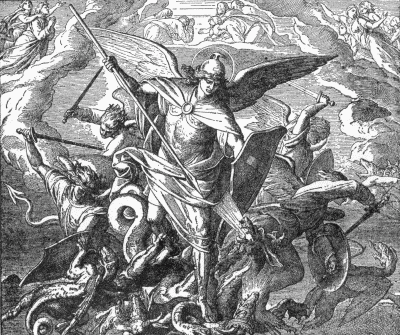
Saint Michael the Archangel

Saint Michael the Archangel
defend us in battle;
be our protection
against the wickedness and snares of the devil.
May God rebuke him, we humbly pray:
and do thou, O Prince of the heavenly host,
by the power of God, thrust into hell
Satan and all the evil spirits
who prowl about the world
seeking the ruin of souls.
Amen.

Leo XIII

Sancte Michael Archangele,
defende nos in proelio;
contra nequitiam et insidias diaboli
esto praesidium.
Imperet illi Deus, supplices deprecamur:
tuque, Princeps militiae Caelestis,
satanam aliosque spiritus malignos,
qui ad perditionem animarum
pervagantur in mundo,
divina virtute in infernum detrude.
Amen.


(adapted from a previous post)

We few

Today, many, many people - including many, many children - are going to celebrate witches, demons and many evil things.

Today, many people are planning to vote on behalf of the destruction of human life or against the protection of moral values.

Today, the airwaves, the media, and the Internet seem to overflow with people who reject God or any objective morality.

We seem to be outnumbered.

Yet in today's Gospel (Luke 13:18-21), our Lord Jesus Christ reminds us of the even more overwhelming power that small, outnumbered things can have through the grace of God.

Then said he,
Unto what is the kingdom of God like?
and whereunto shall I resemble it?

It is like a grain of mustard seed,
which a man took, and cast into his garden;
and it grew, and waxed a great tree;
and the fowls of the air lodged in the branches of it.

And again he said,
hereunto shall I liken the kingdom of God?
It is like leaven,
which a woman took and hid in three measures of meal,
till the whole was leavened.

No matter what we may face, "we few, we happy few," may we plant seeds faithfully and may God's grace make us his leaven for the world.

Catholic Carnival

This week's Catholic Carnival - a collection of posts from various Catholic blogs - is online at The Magdalene Diaries.

Appointments and resignations

The Holy Father today...

  • "Accepted the resignation from the office of Prefect of the Congregation for the Clergy, presented by Cardinal Dario Castrillon Hoyos, upon having reached the age limit.
  • "Appointed Cardinal Claudio Hummes O.F.M., archbishop of Sao Paulo, Brazil, as prefect of the Congregation for the Clergy.
  • "Accepted the resignation from the office of archpriest of St. Peter's Basilica, presented by Cardinal Francesco Marchisano. He is succeeded by his coadjutor, Archbishop Angelo Comastri, prelate emeritus of Loreto, Italy,vicar general for Vatican City State, president of the Fabric of St Peter's.

  • "Accepted the resignation from the office of auxiliary of the archdiocese of New York, U.S.A., presented by Bishop Robert A. Brucato, upon having reached the age limit.

  • "Appointed Fr. Thomas Chung An-zu of the clergy of Tainan, Taiwan, chaplain of the Fu Jen Catholic University, as auxiliary of the archdiocese of Taipei... Taiwan. The bishop-elect was born in Yunlin, Taiwan, in 1952 and ordained a priest in 1981.
  • "Appointed Fr. Fausto Gaibor Garcia, chancellor and pastor of the cathedral of Guaranda, Ecuador, as auxiliary of the diocese of Riobamba... Ecuador. The bishop-elect was born in Gauranda in 1952 and ordained a priest in 1981."
Source: Vatican Information Service

Monday, October 30, 2006

Do not be deceived

Most of us have become very good at rationalizing (God have mercy on me).

Our sinful inclinations so easily take advantage of human reason, especially when such rationalization is supported by the smooth words of "experts" - on television, in academia, and sometimes even within the Church.

Today's first reading (Ephesians 4:32-5:8) reminds us that we need to follow Christ and his ways of truth and love and that we should not be dissuaded by the vain words and empty arguments of those who would tempt us to pleasurable paths that ultimately and inevitably end in futility and pain.

Be ye therefore followers of God,
as most dear children:
And walk in love,
as Christ also hath loved us
and hath delivered himself for us,
an oblation and a sacrifice to God
for an odour of sweetness.

But fornication and all uncleanness or covetousness,
let it not so much as be named among you,
as becometh saints:
Or obscenity or foolish talking or scurrility,
which is to no purpose:
but rather giving of thanks.

For know you this and understand:
That no fornicator
or unclean or covetous person
(which is a serving of idols)
hath inheritance in the kingdom of Christ and of God.

Let no man deceive you with vain words.
For because of these things
cometh the anger of God
upon the children of unbelief.
Be ye not therefore partakers with them.

For you were heretofore darkness,
but now light in the Lord.

Walk then as children of the light.

Sunday, October 29, 2006

A Way of Life and Mystery

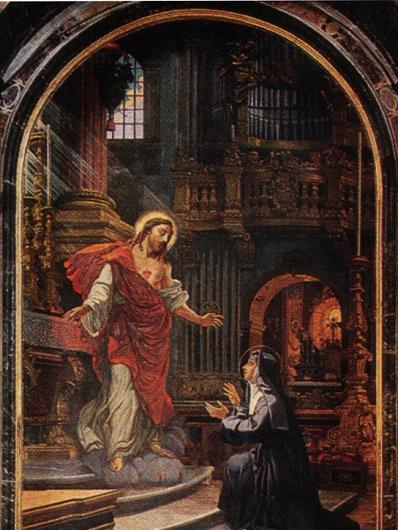
"A vocation to religious life is always a mystery. Even more of a mystery when this call is a call to leave the world and join a Cloistered, Contemplative Community. It is as real and needed today as it was centuries past.

"There is a magnetic beauty about Contemplative Life which whets the human appetite for God. Contemplatives witness to the holiness of God and the unfathomable love which lies behind the story of Jesus. He is our Way; our Truth; and our Life. This truth has so captured our hearts that we are willing to leave the material world and vow ourselves to live our Baptismal Life to the full.

"This is how the Passionist Nuns of today take the pains and sufferings of this world seriously. In other words, we go to the heart of the mystery of God's love, Jesus Crucified and Risen. By our apostolate of prayer, Contemplatives constantly challenge the Church and the World with Christ's Story. We proclaim who Jesus is and what the Kingdom of God means.

"Christ is always young in the heart of a Contemplative!"


from the website of
the Passionists Nuns of Whitesville, Kentucky

www.passionistnuns.org

Bring them back

In some places, our churches are quite full.

In some places, our churches are quite empty: cavernous museum pieces where multitudes once worshipped.

Even where our churches are full, there are often many people who have fallen away from the Church and the practice of the faith.

Today's readings give us a trumpet call of hope and a clear path to follow.

The first reading (Jeremiah 31:7-9) sounds the trumpet call and follows at once with the beginning of our path:

Behold, I will bring them back
from the land of the north;
I will gather them from the ends of the world,
with the blind and the lame in their midst,
the mothers and those with child;
they shall return as an immense throng.


The path begins with recognition of people's many desperate needs. People today are indeed hurting - inside and outside the Church - but the deepest hurts and the most fundamental needs are often the least recognized.

Why are these needs unrecognized? We find answers in today's Gospel (Mark 10:46-52) where a blind man cries out for help, only to be silenced by other people.

Our Lord calls the blind man, asks him a question, and cures the man of his blindness, but not before adding a particularly interesting statement.

Jesus told him,
"Go your way; your faith has saved you."

Immediately he received his sight
and followed him on the way.

On one level, the crying need of the blind man was being drowned out by the louder voices around him: people with agendas that did not include compassion for a beggar by the side of the road. They were marching with Christ to Jerusalem: something much more important than a loudmouthed panhandler.

So too we can get so caught up in the important things we are doing that we can neglect to listen to the crying needs, the aching hurts, and the withering emptiness afflicting the people around us, most especially those who have left the faith.

Sometimes we can even neglect to listen to the needs, the hurts and the emptiness within ourselves.

Indeed, on another level, the most desperate need in this Gospel is not the crying need of the blind man, for he has faith (as our Lord tells him, "Your faith has saved you").

Indeed, more truly wretched than the blind man begging on the side of a dusty road are the people around him: people who are gung-ho for the Jesus Road Show but who lack compassion, who lack faith, and who even lack the awareness that they are lacking these things.

Our path therefore begins in recognizing need - not the just the loud and obvious needs, but even more importantly the stealthy yet deadlier needs among us and within us: especially in those who have left the faith and most especially our own deficiencies of faith, compassion, and awareness.

***

From that beginning, the next step in the path follows quickly:

They departed in tears,
but I will console them...


And so we go from recognition and awareness to sympathy, sympathy exemplified in today's second reading (Hebrews 5:1-6)

He is able to deal patiently with the ignorant and erring,
for he himself is beset by weakness.

This is in imitation of Christ the true High Priest, as we know from the previous chapter (Hebrews 4:15-16).

For we do not have a high priest
who is unable to sympathize with our weaknesses,
but one who has similarly been tested in every way,
yet without sin.

So let us confidently approach the throne of grace
to receive mercy
and to find grace for timely help.


And so, when we encounter those who have left the faith or other people suffering from hurts and weaknesses, as Christians we must have and show sympathy (while avoiding sin).

Many people have blamed rude, unsympathetic, or uncaring clergy or laypeople for their departure from the faith. Of course, there is almost always a deeper reason, a deeper hurt, but it is important for us as followers of Christ to listen for hurts and needs - both the loud ones and the hidden ones - and to be truly sympathetic while remaining ourselves faithful to the truth.

***

Our sympathy must indeed be true - true to the hurt but also true to reality and most of all true to reality as revealed by faith.

We must sympathize but we cannot just leave these people to wallow in their needs, especially in their spiritual needs. We must take the next step, as the first reading tells us:

They departed in tears,
but I will console them
and guide them;
I will lead them
to brooks of water,
on a level road,
so that none shall stumble.


By the grace of God we can help bring people into the practice of the faith not just by awareness of their needs and by sincere sympathy, but also by taking the next step... and the next step... and the next step: walking with them, guiding them, and leading them with the help of the Holy Spirit on the road that leads to the fullness of the life-giving waters that flow from Christ - waters that heal every hurt and fulfill every need.

As you and I continue our walk with Christ, we must imitate Christ: listening for both the loud and the silent cries of need around us, reaching out with our hearts with sympathy and truth, and helping those we meet walk more fully in the light and the spirit of our Lord and Savior Jesus Christ.

Take courage;
get up,
Jesus is calling you.
Saturday, October 28, 2006

A model for Vocation Discernment


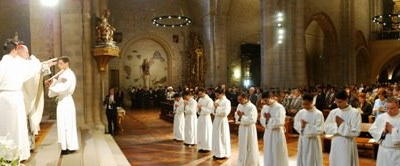
"Announcing a new model and opportunity for Vocation Discernment! Are you trying to figure out what God is asking of you? Have you considered the possibility of the sacred priesthood? Would you benefit from an opportunity every month to pray, reflect, and get your questions answered? If so then Animae Via is exactly for you!

"SCHEDULE:

I. Dinner in Rectory

II. Exposition of the Blessed Sacrament

III. Quiet Meditation/Adoration

III. Evening Prayer

IV. Reflection from Priest

V. Benediction

VI. Discussion time with Q & A


"'The Eucharist is at the centre of all prayer initiatives. The sacrament of the Altar holds a decisive value for the birth of vocations and for their perseverance, because from Christ's redemptive sacrifice those called are able to draw strength to dedicate themselves entirely to the proclamation of the Gospel. It is good that adoration of the Blessed Sacrament goes hand-in-hand with the Eucharistic Celebration, thus prolonging, in a certain sense, the mystery of the Holy Mass. Contemplating Christ, truly and substantially present under the species of bread and wine, can give rise in the heart of the person called to the priesthood or to a particular mission in the Church the same enthusiasm that led Peter to exclaim on the mount of the Transfiguration: "Lord, it is good that we are here! "'
- Pope John Paul II"


from the Vocations website of the Diocese of St. Petersburg


click here for more information.

"What does it mean to be called?"


"It means knowing oneself as infinitely loved,
discovering within yourself a desire to give everything.
It is the assurance that God is enough
and everything else is not enough.


"To be called is to receive a gift that surpasses
all understanding. A gift that is nothing
less than God himself.
A gift he longs to give.

"God calls each one uniquely.
For some, His call is heard at a very young age
and for others later in life.
He may make His voice heard
at a moment of prayer
or in the midst of an amusement
that suddenly becomes meaningless.

"It can be dramatic,
so that one can point to the exact instant
of His invitation,
or it can come as a gradual realization
over the course of years.


"God is a lover who respects our freedom.
He does not overwhelm or coerce.
His voice is soft
and we can ignore it
or drown it out
with the noise of the world."


from the website of
the Bethlehem Monastery of the Poor Clares
Barhamsville, Virginia

www.poor-clares.org

(They also have a blog at
http://pcmonastery.blogspot.com)

New Auxiliary for Detroit

The Holy Father today has named as Auxiliary Bishop for the Archdiocese of Detroit Msgr. Daniel E. Flores, a priest of the Diocese of Corpus Christi, Rector of the Cathedral in Corpus Christi and Vice Rector of St. Mary’s Seminary in Houston. Bishop-elect Flores was born August 28, 1961 in Palacios, Texas. He attended public school and then went to the University of Texas for two years before entering Holy Trinity Seminary in Irving, Texas, where he studied Philosophy and Theology. He was ordained a priest for Corpus Christi June 30, 1988, and was assigned Parochial Vicar for the Cathedral, Secretary to the Bishop, Vice-Chancellor, and Master of Ceremonies. From 1989 to 1997 he was Rector of the St. John Vianney House of Studies. From 1992 to 1997 he was also Episcopal Vicar for Priestly Formation and Education (Director of Priestly Vocations). Sent to Rome’s North American College, he studied theology at the University of St. Thomas Aquinas, obtaining his S.T.L. in 1997 and his doctorate in 2000. Returning from Rome, he was named Chancellor of the Diocese of Corpus Christi. Since 2001 he has been Adjunct Professor of the Faculty of Theology at the University of St. Thomas for St. Mary’s Seminary. From 2002 until today he has been Vice Rector of the seminary. Since 2006 he has been Rector of the Cathedral of Corpus Christi. In addition to English, he knows Spanish, Italian, and Latin.

In other bishop news, the Holy Father has also today accepted the retirement of the Most Rev. Medardo Joseph Mazombwe, Archbishop of Lusaka, Zambia. He is succeeded by the Coadjutor of the Archdiocese, the Most Rev. Telesphore George Mpundu.

Tidings of carpet and joist

We are all familiar with the idea that we are members of the Body of Christ.

In today's first reading (Ephesians 2:19-22) we hear again a different way of understanding the same reality.

You are no longer strangers and sojourners,
but you are fellow citizens with the holy ones
and members of the household of God,
built upon the foundation of the Apostles and prophets,
with Christ Jesus himself as the capstone.

Through him the whole structure is held together
and grows into a temple sacred in the Lord;
in him you also are being built together
into a dwelling place of God in the Spirit.

Each of us - you and I - are pieces being put together into the most magnificent work of construction the universe has ever seen: "a temple sacred in the Lord… a dwelling place of God in the Spirit."

Most of us - including me particularly - are very small and insignificant pieces in that glorious edifice. Some of us may be floor joists; some of us may be carpet nails.

Sometimes we may not be able at all to figure out where or how we could fit into something so wonderful and glorious.

But God is the builder: he knows perfectly that blueprint of incomprehensible majesty and he also knows perfectly, lovingly, each piece of the building - you and me.

May we let ourselves be grasped by the Lord so that through his will and in his grace we may fully and totally fit in: that we may find our destiny, comfort, and eternal joy as pieces fit together by the Lord's own design into the dwelling place of God himself.

The other ones

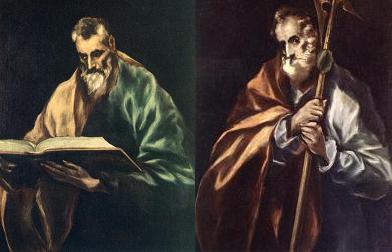
His name was Simon, but he wasn't THE Simon.

His name was Judas, but he wasn't THE Judas.

They were each one of the twelve, specially chosen by Christ himself, and yet both of them shared names with colleagues who would be much more famous (or infamous).

They were the other ones.

Thus "other" Simon is often called Simon the Zealot, to distinguish him from Simon Peter, and the "other" Judas is called Judas the son of James or Jude or Jude Thaddeus.

But the only name that really mattered for them was the name of Jesus: a name that they exalted and spread everywhere they could, a name for which they both died.

The Feast of the Apostles Simon and Jude is celebrated on this day.

(adapted from an earlier post)

Friday, October 27, 2006

Priesthood vocations blog


Southwark Vocations is a "Blog for promoting priesthood in the Archdiocese of Southwark (UK). Here you will find information about vocations activities in Southwark as well as information of interest to anyone considering diocesan priesthood."

That which unites us

There are many things on which we may disagree, sometimes quite legitimately, even within our churches and our families.

But St. Paul reminds us in today's first reading (Ephesians 4:1-6) of those things which can and should bring us together: things to remember the next time we find ourselves sliding into a fight with those to whom we should be closer than we are.

I, a prisoner for the Lord,
urge you to live in a manner
worthy of the call you have received,
with all humility and gentleness, with patience,
bearing with one another through love,
striving to preserve the unity of the spirit
through the bond of peace;
one Body and one Spirit,
as you were also called
to the one hope of your call;
one Lord, one faith, one baptism;
one God and Father of all,
who is over all
and through all
and in all.

Thursday, October 26, 2006

Division and truth

"That they may be one" is the prayer of Christ and it is the prayer of many of us Christians.

We hear something that sounds a little different, however, in today's Gospel (Luke 12:49-53):

Do you think that I have come
to establish peace on the earth?

No, I tell you, but rather division.
From now on a household of five
will be divided,
three against two and two against three;
a father will be divided against his son
and a son against his father,
a mother against her daughter
and a daughter against her mother,
a mother-in-law against her daughter-in-law
and a daughter-in-law against her mother-in-law.

Our Lord indeed prays for unity, but it is a unity based on truth, against which the world rebels - and therein lies the source of the division (as we hear in the Gospel passage in which Christ prays "that they may be one").

I have given them thy word;
and the world has hated them
because they are not of the world,
even as I am not of the world.

I do not pray
that thou shouldst take them out of the world,
but that thou shouldst keep them from the evil one.

They are not of the world,
even as I am not of the world.

Sanctify them in the truth;
thy word is truth.

As thou didst send me into the world,
so I have sent them into the world.

And for their sake I consecrate myself,
that they also may be consecrated in truth.

I do not pray for these only,
but also for those who believe in me
through their word,
that they may all be one;
even as thou, Father, art in me,
and I in thee,
that they also may be in us,
so that the world may believe
that thou hast sent me.

The glory which thou hast given me
I have given to them,
that they may be one even as we are one,
I in them and thou in me,
that they may become perfectly one,
so that the world may know
that thou hast sent me
and hast loved them
even as thou hast loved me.

As St. Paul does in today's first reading (Ephesians 3:14-21), may we work and pray for perfect unity through the truth of Christ.


I kneel before the Father,
from whom every family in heaven and on earth is named,
that he may grant you in accord with the riches of his glory
to be strengthened with power
through his Spirit in the inner self,
and that Christ may dwell in your hearts through faith;
that you, rooted and grounded in love,
may have strength to comprehend
with all the holy ones
what is the breadth and length and height and depth,
and to know the love of Christ that surpasses knowledge,
so that you may be filled with all the fullness of God.

Now to him
who is able to accomplish far more
than all we ask or imagine,
by the power at work within us,
to him be glory in the Church and in Christ Jesus
to all generations, forever and ever.
Amen.

Wednesday, October 25, 2006

Christian Carnival

This week's Christian Carnival - an ecumenical collection of posts from various Christian blogs - is online at Participatory Bible Study Blog.

Good news, challenging news

Today's first reading (Ephesians 3:2-12) reminds us of the wonder and the glory of our being humble channels of the good news of our Lord and Savior Jesus Christ - in whatever way he has called us to serve.

I became a minister
by the gift of God's grace
that was granted me
in accord with the exercise of his power.

To me,
the very least of all the holy ones,
this grace was given,
to preach to the Gentiles
the inscrutable riches of Christ,
and to bring to light for all
what is the plan of the mystery
hidden from ages past
in God who created all things,
so that the manifold wisdom of God
might now be made known through the Church
to the principalities and authorities in the heavens.

This was according to the eternal purpose
that he accomplished in Christ Jesus our Lord,
in whom we have boldness of speech
and confidence of access through faith in him.

Today's Gospel (Luke 12:39-48) reminds us of the challenge that comes with our being given knowledge of that good news.

That servant who knew his master's will
but did not make preparations
nor act in accord with his will
shall be beaten severely;
and the servant who was ignorant of his master's will
but acted in a way deserving of a severe beating
shall be beaten only lightly.

Much will be required
of the person entrusted with much,
and still more will be demanded
of the person entrusted with more.

Lord Jesus Christ, son of the living God, be merciful to me - a sinner.

God, give me the strength to do your will ever more fully in the name of Jesus.

Tuesday, October 24, 2006

Stem cells

(with apologies to Robert Bolt and St. Thomas More)

"I have one question which I’d like to ask the witness. That’s a scientific study you are holding, Richard. May I see it?

"'These data also mandate caution in the clinical application of HES cell–derived grafts, given their potential for phenotypic instability and undifferentiated expansion.' What is this?"

"Embryonic stem cells might cause brain tumors"

"Tumors? Why Richard, it profits a man nothing to give his soul for the whole world....But for tumors?"

Tear down this wall

In today's first reading (Ephesians 2:12-22), St. Paul writes of how Christ has broken down the "middle wall of partition" between Jews and Gentiles and how those "who sometimes were far off are made nigh by the blood of Christ."

Tragically, in the years and centuries since St. Paul wrote those words, some people have worked very hard to rebuild that wall.

Not only that, over the centuries, even more walls have been erected: walls between those who accept Christ but who do not accept each other.

But the separation between Christians and Jews will not stand forever (as St. Paul writes in Romans 11).

Likewise, the walls that Christians have built up among themselves will not and cannot stand.

Sadly, over the past few decades, many of the efforts to bring down these walls through ecumenical dialogue have been unsuccessful. In some instances, the walls have gotten thicker and the distances between some Christians even greater.

We need to do what we can to continue this dialogue, with humble honesty, heartfelt charity, deep concern for the true common good, absolute devotion to the truth of Christ, and (most importantly) unceasing prayer: that the Lord Jesus Christ may tear down the walls between us and within us so that we may be one in him.

For through him
we both have access
by one Spirit
unto the Father.

Now therefore ye are no more strangers and foreigners,
but fellowcitizens with the saints,
and of the household of God;
And are built

upon the foundation of the apostles and prophets,
Jesus Christ himself being the chief corner stone;
In whom all the building fitly framed together
groweth unto an holy temple in the Lord:
In whom ye also are builded together
for an habitation of God
through the Spirit.

Catholic Carnival

This week's Catholic Carnival - a collection of posts from various Catholic blogs - is online at the luminous miseries blog.

Uncontainable

He started working at the age of twelve as a weaver in his native village.

A little over 30 years later, he would be an Archbishop and the founder of a religious order. He would go on to be an advisor to a Queen and a trusted ally of the Pope.

Throughout the many phases of his ministry, his zeal was uncontainable, even though it earned him so much opposition that he was the object of rumor-mongering and even assassination attempts. But it did not deter him.

"The love of Christ arouses us, urges us to run, and to fly, lifted on the wings of holy zeal.

"The man who truly loves God also loves his neighbor. The truly zealous man is also one who loves, but he stands on a higher plane of love so that the more he is inflamed by love, the more urgently zeal drives him on. But if anyone lacks this zeal, then it is evident that love and charity have been extinguished in his heart.

"The zealous man desires and achieves all great things and he labors strenuously so that God may always be better known, loved and served in this world and in the life to come, for this holy love is without end....

"For myself, I say this to you: The man who burns with the fire of divine love is a son of the Immaculate Heart of Mary, and wherever he goes, he enkindles that flame; he desires and works with all his strength to inflame all men with the fire of God’s love.


"Nothing deters him:
he rejoices in poverty;
he labors strenuously;
he welcomes hardships;
he laughs off false accusations;
he rejoices in anguish.
He thinks only
of how he might follow Jesus Christ
and imitate him by his prayers,
his labors,
his sufferings,
and by caring always and only
for the glory of God
and the salvation of souls."


St. Anthony Claret, Archbishop of Santiago de Cuba and founder of the Claretians, died 136 years ago today.

(from an earlier post)

Monday, October 23, 2006

The ruler of the power of the air

In today's first reading (Ephesians 2:1-10), St. Paul refers to Satan in a way that may sound strange to us.

You were dead
in your transgressions and sins
in which you once lived
following the age of this world,
following the ruler of the power of the air,
the spirit that is now at work in the disobedient.


Among the explanations that scholars give for this reference is an ancient Jewish conception of the atmosphere as a place where evil spirits flit unseen about us.

For many of us, this may sound like something out of a silly horror movie.

And yet the concept of Satan as "ruler of the power of the air" has more than a little resonance with our experience of the world today, for indeed modern culture often seems an atmosphere thick with messages of selfishness, slams against religion, and the exaltation of self-serving subjectivity over God-created reality.

The effects of this poisonous atmosphere are painfully easy to see, from the violence and depravity we see in the news to the brokenness in our families and our lives.

Yet the "ruler of the power of the air" cannot prevail against the Lord of heaven and earth.

We may have been led astray, but God can bring us back and keep us on the course that leads into the fullness of joy by the power of his grace.

All of us once lived among them
in the desires of our flesh,
following the wishes of the flesh and the impulses,
and we were by nature children of wrath, like the rest.

But God, who is rich in mercy,
because of the great love he had for us,
even when we were dead in our transgressions,
brought us to life with Christ
(by grace you have been saved),
raised us up with him,
and seated us with him in the heavens in Christ Jesus,
that in the ages to come
he might show the immeasurable riches of his grace
in his kindness to us in Christ Jesus.


Soaring

John was so successful as a lawyer, he became a governor.

He was so impressive as a governor that he was chosen to carry out a critical diplomatic assignment in a time of war.

That particular assignment didn't go well: John ended up in prison.

While in prison, John decided to dedicate his life to Christ. He joined the Franciscans and became a traveling preacher.

John was so successful as a preacher, that when he came to preach in a town, all the stores would close and the people would come to hear him.

When he was 70, he was called to rally the people to repel a massive invasion. The invaders were turned back, but John died of natural causes near the field of battle 550 years ago today. St. John Capistrano was canonized in 1724.

A little over fifty years later, another Franciscan friar would name a new Mission Church after John, calling it in Spanish "San Juan Capistrano."

(adapted from an earlier post)

Sunday, October 22, 2006

The Three S's

"The three R's" are often called the foundation of basic education: reading, writing, and arithmetic (ironically misspelling the words).

Today's readings talk about three S's, which should be the foundation of living the Christian life and which are also opposed to the ways of today's world: suffering, sympathy, and service.

***

Today's first reading (Isaiah 53:10-11) speaks of the "Suffering Servant": a prophecy that applied in some ways to ancient Israel but that would apply most perfectly to our suffering Lord and Savior Jesus Christ.

The LORD was pleased
to crush him in infirmity.

If he gives his life as an offering for sin,
he shall see his descendants in a long life,
and the will of the LORD
shall be accomplished through him.

Because of his affliction
he shall see the light
in fullness of days;

through his suffering,
my servant shall justify many,
and their guilt he shall bear.


Suffering is something that the modern world always wants to avoid. The world encourages us to fill our lives with as much comfort and pleasure as possible and to fill ourselves with drugs and alcohol when any amount of pain and suffering might threaten.

The way of the world is a way that wallows in selfishness and drowns us with addictions.

The way of the world is a very attractive but very deadly trap, that leads ultimately to oblivion.

The way of Christ, on the other hand, is the way of the cross, the Via Dolorosa, the way of suffering.

The way of Christ is a hard road, but it is a road that leads to greater good and ultimately to eternal life.

We must not be afraid of embracing suffering, for there are many ills in this world that cannot be cured without hard work and suffering. Moreover, it is impossible to follow in the footsteps of Christ if we refuse to embrace and carry the crosses that he offers us.

***

In the second reading (Hebrews 4:14-16), we see that the way of Christ is also that of sympathy.

For we do not have a high priest
who is unable to sympathize with our weaknesses,
but one who has similarly been tested in every way,
yet without sin.

So let us confidently approach the throne of grace
to receive mercy
and to find grace for timely help.

The sympathy of Christ is not the sympathy of this world.

There are some in this world who reject sympathy as a weakness, something that would cause them to veer from the way of strength to which they aspire. As we have seen far too often over the centuries, a strength that is heartless leads quickly to great evil.

There are others in this world who promote a kind of sympathy that is intrinsically empty: an absolute surrender to the dictatorship of emotions - to an empathy with no anchor in objective truth.

The sympathy of Christ is the sympathy of one who has suffered, but who also knows the meaning of suffering.

The sympathy of Christ is the sympathy of one who encounters temptation, but who rejects sin in favor of the truth.

Moreover, the sympathy of the Christian is the sympathy of a sinner who knows what it is like to succumb to temptation but who also knows the depth of God's forgiveness and the greater peace of the sinless way.

Sadly, some of us are not always filled with this kind of Christian sympathy: we are either unsympathetic with sinners (especially those whose particular sins we find repugnant) or we embrace sinners with an empty empathy that pulls them and us away from the life-giving truth.

We need to live the sympathy of Christ.

***

And finally, we have these wonderful words from our Lord himself in today's Gospel (Mark 10:35-45):

Whoever wishes to be great among you
will be your servant;
whoever wishes to be first among you
will be the slave of all.

For the Son of Man
did not come to be served
but to serve
and to give his life as a ransom for many.

These words of Christ are very much opposed to the way of the world: a world that sees everything in terms of a struggle for power. Anyone who volunteers to be a servant or to act like a slave is seen as lacking self-esteem at best or as a chump at worst.

Even within the Church there are many who view everything through the prism of a struggle for power.

The chastising words of our Lord could not be more clear.

You know
that those who are recognized as rulers over the Gentiles
lord it over them,
and their great ones

make their authority over them felt.

But it shall not be so among you.

Rather, whoever wishes to be great among you

will be your servant;
whoever wishes to be first among you

will be the slave of all.

No matter what function we may exercise within the Body of Christ, each of us must be servants of each other and each of us must also be servants of the truth.

Our model must not be the political systems of this world but rather the life, ministry and teaching of our Lord and Savior Jesus Christ who "did not come to be served but to serve and to give his life as a ransom for many."

***

We Christians are called to follow Christ:
that means we are called to suffer,
we are called to sympathize,
and we are called to serve
in the name of Jesus.

World Mission Sunday

"Dear Brothers and Sisters,

1. "World Mission Sunday, which we will be celebrating on Sunday, 22 October, is an opportunity to reflect this year on the theme: 'Charity: soul of the mission'.

"Unless the mission is oriented by charity, that is, unless it springs from a profound act of divine love, it risks being reduced to mere philanthropic and social activity. In fact, God's love for every person constitutes the heart of the experience and proclamation of the Gospel, and those who welcome it in turn become its witnesses.

"God's love, which gives life to the world, is the love that was given to us in Jesus, the Word of salvation, perfect icon of the Heavenly Father's mercy.

"The saving message can be summed up well, therefore, in the words of John the Evangelist: 'In this the love of God was made manifest among us, that God sent his only Son into the world, so that we might live through him '(I Jn 4: 9).

"It was after his Resurrection that Jesus gave the Apostles the mandate to proclaim the news of this love, and the Apostles, inwardly transformed by the power of the Holy Spirit on the day of Pentecost, began to bear witness to the Lord who had died and was risen. Ever since, the Church has continued this same mission, which is an indispensable and ongoing commitment for all believers.

2. "Every Christian community is therefore called to make known God who is Love. In my Encyclical Deus Caritas Est, I wanted to pause and reflect on this fundamental mystery of our faith. God imbues the entire creation and human history with his love.

"In the beginning, man came from the Creator's hands as the fruit of an initiative of love. Later, sin obscured the impression of the divine within him.

"Deceived by the Evil One, Adam and Eve, our first parents, failed to live up to the relationship of trust with their Lord, succumbing to the temptation of the Evil One who instilled in them the suspicion that the Lord was a rival and wanted to limit their freedom.

"So it was that they preferred themselves to divine love freely given, convinced that in this way they were asserting their own free will. They consequently ended by losing their original happiness and they tasted the bitter sorrow of sin and death.

"However, God did not abandon them. He promised salvation to them and to their descendents, announcing in advance that he would send his Only-begotten Son, Jesus, who in the fullness of time was to reveal his love as Father, a love capable of redeeming every human creature from the slavery of evil and death.

"In Christ, therefore, immortal life was communicated to us, the very life of the Trinity. Thanks to Christ, the Good Shepherd who did not abandon the lost sheep, human beings of all time were granted the possibility of entering into communion with God, the Merciful Father who was prepared to welcome home the Prodigal Son.

"An astonishing sign of this love is the Cross. Christ's death on the Cross, I wrote in the Encyclical Deus Caritas Est, is 'the culmination of that turning of God against himself in which he gives himself in order to raise man up and save him.... This is love in its most radical form.... It is there that this truth can be contemplated. It is from there that our definition of love must begin. In this contemplation the Christian discovers the path along which his life and love must move' (n. 12).

3. "On the eve of his Passion, Jesus bequeathed as a testament to his disciples, who had gathered in the Upper Room to celebrate the Passover, the 'new commandment of love - mandatum novum': 'This I command you, to love one another' (Jn 15: 17). The brotherly love that the Lord asked of his 'friends' originates in the fatherly love of God.

"The Apostle John noted: 'He who loves is born of God and knows God' (I Jn 4: 7). Therefore, to love according to God it is necessary to live in him and of him: God is the first 'home' of human beings, and only by dwelling in God do men and women burn with a flame of divine love that can set the world 'on fire'.

"It is not difficult, then, to understand that authentic missionary concern, the priority commitment of the Ecclesial Community, is linked to faithfulness to divine love, and this is true for every individual Christian, for every local community, for the particular Churches and for the entire People of God.


"The generous readiness of disciples of Christ to undertake works of human and spiritual advancement draws vigour literally from the awareness of this common mission. These works, as the beloved John Paul II wrote in the Encyclical Redemptoris Missio, witness to 'the soul of all missionary activity: love, which has been and remains the driving force of mission, and is also "the sole criterion for judging what is to be done or not done, changed or not changed. It is the principle which must direct every action, and the end to which that action must be directed. When we act with a view to charity, or are inspired by charity, nothing is unseemly and everything is good."' (n. 60).

"Consequently, being missionaries means loving God with all one's heart, even to the point, if necessary, of dying for him. How many priests, men and women Religious and lay people, have borne the supreme witness of love with martyrdom even in our times!

"Being missionaries means stooping down to the needs of all, like the Good Samaritan, especially those of the poorest and most destitute people, because those who love with Christ's Heart do not seek their own interests but the glory of the Father and the good of their neighbour alone.
Here lies the secret of the apostolic fruitfulness of missionary action that crosses frontiers and cultures, reaches peoples and spreads to the extreme boundaries of the world.

4. "Dear brothers and sisters, may the World Missionary Day be a useful opportunity to understand ever better that the witness of love, the soul of the mission, concerns everyone. Indeed, serving the Gospel should not be considered a solitary adventure but a commitment to be shared by every community.

"As well as those who are in the front line on the frontiers of evangelization - and I am thinking here with gratitude of the men and women missionaries - many others, children, young people and adults, with their prayers and cooperation, contribute in various ways to spreading the Kingdom of God on earth. It is to be hoped that this participation will continue to grow, thanks to the contribution of one and all.

"I willingly take this opportunity to express my gratitude to the Congregation for the Evangelization of Peoples and to the Pontifical Mission Societies (PMS), which are dedicated to coordinating the efforts made in every part of the world to support the activity of those on the front lines on the missionary frontiers.

"May the Virgin Mary, who collaborated actively in the beginning of the Church's mission with her presence beneath the Cross and her prayers in the Upper Room, sustain their action and help believers in Christ to be ever more capable of true love, so that they become sources of living water in a spiritually thirsting world. I wish this with all my heart, as I impart my Blessing to you all."

From the Vatican, 29 April 2006

BENEDICTUS PP. XVI


Saturday, October 21, 2006

Stepping out


On August 28, the Dominican Sisters of Mary Mother of the Eucharist, welcomed fifteen postulants to the their community: "15 young women who have courageously stepped out of the boat of the world to walk on the waters of faith in the convent."


"Young women (from high school age on up!) who are single and desirous of furthering their spiritual life and who may, or may not have an interest in looking more closely into Religious Life, are invited to attend the following retreats:

Nov. 04-05, 2006
Feb. 24-25, 2007
May. 26-27, 2007

"Registration is capped at 100, so register early to researve your spot! Click here for more information & directions! "

(from a retreat last year)

from the website for Dominican Sisters of Mary, Mother of the Eucharist, in Ann Arbor, Michigan: www.sistersofmary.org

Ordination for former Episcopal priest

Pontifications blogger Al Kimel, who served as a parish priest in the Episcopal church for 25 years and who entered into full communion with the Catholic Church in 2005, has announced that Deo volente he will be ordained to the Priesthood by Archbishop John Myers on Sunday, December 3rd, at Our Lady of Sorrows Catholic Church in South Orange, New Jersey. (Ordination to the diaconate will be in November)

Ad multos annos!

Fearless

In a world where faithful Christians are attacked simply for what they say (usually by people twisting our words to portray themselves as victims and advance their political power), the last verse and a half of today's Gospel (Luke 12:8-12) are particularly comforting:

...do not worry about how or what your defense will be
or about what you are to say.
For the Holy Spirit will teach you at that moment
what you should say.


Sometimes it can feel like we are walking through a minefield, even in casual conversations, but if we always focus on being faithful and humble servants of God's truth, then with the grace of God we will have the comfort, guidance, and strength that only God can give and that nothing can overcome.

In that same spirit St. Paul's prayer in today's first reading (Ephesians 1:15-23) is for us as well.

Hearing of your faith in the Lord Jesus
and of your love for all the holy ones,
I do not cease giving thanks for you,
remembering you in my prayers,
that the God of our Lord Jesus Christ, the Father of glory,
may give you a spirit of wisdom and revelation
resulting in knowledge of him.

May the eyes of your hearts be enlightened,
that you may know

what is the hope that belongs to his call,
what are the riches of glory
in his inheritance among the holy ones,
and what is the surpassing greatness of his power
for us who believe,
in accord with the exercise of his great might,
which he worked in Christ,
raising him from the dead
and seating him at his right hand in the heavens,
far above

every principality, authority, power, and dominion,
and every name that is named
not only in this age but also in the one to come.

And he put all things beneath his feet
and gave him as head over all things to the Church,
which is his Body,
the fullness of the one who fills all things in every way.

Unforgivable

In today's Gospel (Luke 12:8-12), our Lord speaks of an unforgivable sin: blasphemy against the Holy Spirit.

Why would that be unforgivable? Because it is precisely through the power of the Holy Spirit that we as individuals receive God's forgiveness, In fact, it is only by the power of the Holy Spirit that we even ask for that forgiveness!

Blasphemy against the Holy Spirit cuts off the very channel that makes forgiveness possible.

Now, it is rather unlikely that even a nominal Christian would ever commit formal blasphemy against the Holy Spirit with sufficient reflection and full consent of the will. Just to be safe, however, we should be careful to practice discernment, determining prayerfully what is of God and what is not, lest we follow the path of the Pharisees in this chapter.

Yet there are other ways by which we may cut ourselves off from God's forgiveness in the Holy Spirit.

One great sin against the Holy Spirit by which we might cut ourselves off from God's forgiveness is called Presumption: for example, when a person treats God's forgiveness as so automatic that they contemptuously go ahead with their evil plans.

Some people hear about presumption, blasphemy against the Holy Spirit, and unforgivable sins and they instantly worry that they may have committed or might commit one of these unforgivable sins.

Actually, the ability to worry about this, to feel remorse, and to ask for God's help is in and of itself a sign that the channel of grace is still open.

In fact, if one takes that worry too far, one risks the other classic unforgivable sin: Despair - specifically, despairing of God's forgiveness.

We should be careful not to blaspheme. We should be careful not to presume upon the grace of forgiveness nor should we ever despair of God's forgiveness.

We should remain focused on always trying to know and do the right thing, with humble penitence and faith in God.

(adapted from an earlier post)

Friday, October 20, 2006

Your secret is coming out

There is nothing concealed
that will not be revealed,
nor secret that will not be known.

Therefore
whatever you have said in the darkness
will be heard in the light,
and what you have whispered behind closed doors
will be proclaimed on the housetops.


For some of us, these words from today's Gospel (Luke 12:1-7) may be especially disturbing, if we allow ourselves to think about it. We may think that we have successfully covered our tracks and that the bad things we have done will never see the light of day.

But God knows.

Even if we are successful in hiding the truth from everyone else in the world (and that seems increasingly difficult over time), even if we have escaped the shame and the punishments that we have feared in this world, what lies ahead is truly fearsome and inescapable.

I tell you, my friends,
do not be afraid of those who kill the body
but after that can do no more.

I shall show you whom to fear.

Be afraid of the one who after killing
has the power to cast into Gehenna;
yes, I tell you, be afraid of that one.

Lord Jesus Christ, son of the living God, be merciful to me - a sinner.

When it comes to our own sin, secrecy can be comforting and, depending on the sin, we can rationalize that we are protecting others by keeping quiet, but secrecy about our own sin can also be a trap that drags us into more and more sin.

When it comes to our own sin, our priority should be getting right with God, not on maintaining our own cover-up.

And even if there are no big skeletons in our personal closets, today's Gospel reminds us to be attentive to our words and deeds, even when we are alone or "just among friends", for Christ calls us to let his light shine in everything we say and everything we do.

Eyes

In his father's eyes, Paul was bright and devout and would make a good businessman - like himself.

In his uncle's eyes, Paul was bright and devout and would make a good priest - like himself.

In the eyes of a certain young lady, Paul was bright and devout and would make a good husband for some lucky girl - like herself.

But Paul's eyes were fixed elsewhere.

From the time he was a young boy, he had always been amazed by and attracted to the image of Christ on the crucifix. He was overwhelmed by the great love of God he saw there: love for the world and love even for a small boy like himself, love in Christ’s eyes and love in Christ’s heart, love even in every drop of blood and in every moment of pain.

"The world lives unmindful of the sufferings of Jesus which are the miracle of miracles of the love of God. We must arouse the world from its slumber," he would write.

A community of like-minded souls would gather around Paul and his quest to proclaim the Passsion of Christ to the world. They would become known as the Passionists and Paul would become known as Paul of the Cross.

St. Paul of the Cross died 231 years ago this month and his memory is celebrated on this day.

More than two thousand Passionists in 52 nations remind people to keep their eyes fixed on Christ and the love of his cross.

(adapted from an earlier post)

Thursday, October 19, 2006

Persecute then canonize?

Woe to you who build the memorials of the prophets
whom your fathers killed.
Consequently, you bear witness and give consent
to the deeds of your ancestors,
for they killed them
and you do the building.


So says our Lord in today's Gospel (Luke 11:47-54).

It is an old accusation that the Church persecutes saints while they are alive only to canonize them after they are dead.

Often, this is said by people who feel they are being persecuted by the Church, as if this proves their eventual vindication.

In truth, the overwhelming majority of those individuals whose words or actions were opposed by the Church were never rehabilitated, let alone canonized. Their words and deeds were in error and remain so.

May God have mercy on us all.

To be sure, men and women who take bold stands and bold actions in this world, even if their cause is holy, usually meet with resistance, even from those who ostensibly share their faith.

Many times this resistance is simply the caution of discernment. Over the millennia, many people have been put forward as messengers of God and many of them have been false prophets who have led other people to ruin. Sometimes this discernment can take a long time, after the fruits of their words and deeds can be fully examined.

Sometimes, of course, this resistance is the stubbornness of entrenched sin and selfishness on the part of individuals, even individuals in high positions.

So, how do we avoid falling under the condemnation our Lord pronounces in today's Gospel?

By focusing always on discernment: both discernment of those around us and discernment of ourselves.

If we focus continually on discerning the truth of God more fully and on purifying ourselves by the light of God's truth and God's grace, then we will be better able to recognize the true prophets and the true saints, the living and the dead, and by the grace of God become true saints and true prophets in our own lives.