A Penitent Blogger

Mindful of my imperfections, seeking to know Truth more deeply and to live Love more fully.

Quid sum miser tunc dicturus? Quem patronum rogaturus? Cum vix iustus sit securus?
Recordare, Iesu pie, Quod sum causa tuae viae: Ne me perdas illa die...

Wednesday, October 31, 2007

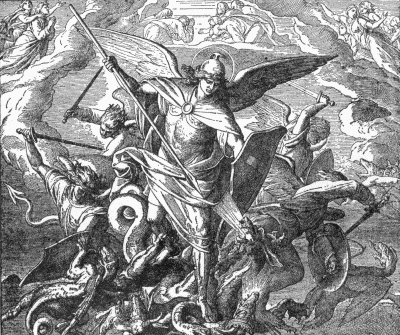
Saint Michael the Archangel

Saint Michael the Archangel
defend us in battle;
be our protection
against the wickedness and snares of the devil.
May God rebuke him, we humbly pray:
and do thou, O Prince of the heavenly host,
by the power of God, thrust into hell
Satan and all the evil spirits
who prowl about the world
seeking the ruin of souls.
Amen.

Leo XIII

Sancte Michael Archangele,
defende nos in proelio;
contra nequitiam et insidias diaboli
esto praesidium.
Imperet illi Deus, supplices deprecamur:
tuque, Princeps militiae Caelestis,
satanam aliosque spiritus malignos,
qui ad perditionem animarum
pervagantur in mundo,
divina virtute in infernum detrude.
Amen.

(adapted from a previous post)

Catholic Carnival

This week's Catholic Carnival - a collection of posts from various Catholic blogs - is online at The Scratching Post.

Walking weakly on a hard road

Our Lord has challenging words for us in today’s Gospel (Luke 13:22-30):

Strive to enter through the narrow gate,
for many, I tell you, will attempt to enter
but will not be strong enough.

These words can be especially discouraging for us, especially at those times when we do not feel strong enough, spiritually or otherwise.

But our Lord is not calling us to despair, but to deeper faith.

Indeed, the strength to enter through the gate of the Kingdom of Heaven is beyond the strength of men.

What we need is God’s grace.

St. Paul’s words in today’s first reading (Romans 8:26-30) remind us of the greatness of God’s grace, even in spite of our weakness and all our struggles.

The Spirit comes to the aid of our weakness;
for we do not know how to pray as we ought,
but the Spirit himself intercedes

with inexpressible groanings.
And the one who searches hearts
knows what is the intention of the Spirit,
because he intercedes for the holy ones
according to God’s will.

We know that all things work for good
for those who love God,
who are called according to his purpose.

May we strive to continue on the hard road and to enter through the narrow gate by opening ourselves more and more to the grace of our Lord and Savior Jesus Christ.

No matter what our weaknesses or how hard the road, with the strength of his grace, we will succeed.

Tuesday, October 30, 2007

This is NOTHING!

Context is everything, they say.

Many of us can recall enduring some hardship or difficulty that directly led to something that was so good that it made the bad experience worthwhile, or at least tolerable.

Still, there are some experiences and some calamities that seem so bad that there seem to be no “upside”.

In today’s first reading (Romans 8:18-25), St. Paul reminds us of the ultimate “upside”: eternity and infinity.

I consider that the sufferings of this present time
are as nothing
compared with the glory to be revealed for us.
For creation awaits with eager expectation
the revelation of the children of God....

It may be difficult for us to imagine (after all, infinity and eternity are beyond the full grasp of the human mind), but no matter what we are suffering, the glory that awaits us will be infinitely greater and this present suffering will be nothing in comparison.

But this is not just a “pie in the sky” thing. By the grace of God we are to be witnesses of this hope of future glory NOW.

For creation awaits with eager expectation
the revelation of the children of God....

He returns again to Milwaukee... as a Bishop

His first assignment was as an Assistant Pastor there. Then he was assigned to a job for his Province and later to parish work in Peoria.

Over a decade later he was back at the same parish in Milwaukee, this time as Rector. He served there for another decade before he was sent to counsel young men studying for the priesthood in Rome.

And now, he's coming back to Milwaukee...

The Holy Father has named Father William Patrick Callahan, O.F.M Conv., to be Auxiliary Bishop of Milwaukee. He had been serving as a Spiritual Director at the Pontifical North American College in Rome.

Bishop-elect Callahan was born in June, 1950 in Chicago, where he would attend St. Mary of Perpetual Help elementary school. From 1964 to 1968 he studies at St. Mary Minor Seminary in Crystal Lake, Illinois and then entered the Novitiate for the Conventual Franciscans’ Province of St. Bonaventure in Lake Forest, Illinois. He made his first profession August 11, 1970. From 1970 to 1973 he took courses at Chicago’s Loyola University where he obtained a Bachelor’s degree in Radio and Television Communication. From 1973 to 1976 he studied at the University of St. Michael’s College at the University of Toronto where he obtained a Master of Theology degree.

Bishop-elect Callahan was ordained a priest on April 30, 1977. He then served in the following positions: Parochial Vicar at the Basilica of Saint Josaphat in Milwaukee from 1977 to 1978; Director of Vocations for the Province of St. Bonaventure from 1978 to 1984; Parochial Vicar of Holy Family parish in Peoria, Illinois from 1984 to 1987 and then Pastor of that same parish from 1987 to 1994. In 1994 he returned to Milwaukee’s Basilica of St. Josaphat, this time as Rector, serving until 2005 when he was named to be a Spiritual Director at the Pontifical North American College in Rome.

Ad multos annos.

Monday, October 29, 2007

Flesh, slavery, and fear

Isn’t ironic?

Those who relish a life of fleshy pleasures are actually locking themselves into a downward spiral into dusty death.

Those who consider themselves free of moral constraints are instead enslaved to their impulses, whims, and desires.

And those who say they do not fear God or anything else are desperately afraid of many things they try to ignore.

In the face of these ironies and all the many challenges of this world, the words of St. Paul in today’s first reading (Romans 8:12-17) truly are words to live by.

We are not debtors to the flesh,
to live according to the flesh.


For if you live according to the flesh,

you will die,
but if by the spirit

you put to death the deeds of the body,
you will live.

For those who are led by the Spirit of God

are sons of God.

For you did not receive a spirit of slavery

to fall back into fear,
but you received a spirit of adoption,
through which we cry, “Abba, Father!”


The Spirit himself bears witness with our spirit
that we are children of God,
and if children, then heirs,
heirs of God and joint heirs with Christ,
if only we suffer with him
so that we may also be glorified with him.

Sunday, October 28, 2007

The truth, the whole truth...

Today’s Gospel (Luke 18:9-14) is the familiar parable of the Pharisee and the Publican.

Two people went up to the temple area to pray;
one was a Pharisee and the other was a tax collector.

The Pharisee took up his position
and spoke this prayer to himself,
'O God, I thank you
that I am not like the rest of humanity --
greedy, dishonest, adulterous
-- or even like this tax collector.
I fast twice a week,
and I pay tithes on my whole income.’

But the tax collector stood off at a distance
and would not even raise his eyes to heaven
but beat his breast and prayed,
'O God, be merciful to me a sinner.'

I tell you, the latter went home justified,
not the former;
for whoever exalts himself will be humbled,
and the one who humbles himself will be exalted.


But in today’s second reading (2 Timothy 4:6-8, 16-18) St. Paul seems to be quite eloquent in exalting himself.

I have competed well; I have finished the race;
I have kept the faith.
From now on the crown of righteousness awaits me,
which the Lord, the just judge,
will award to me on that day...


As for us, although we know that the repentant tax collector was justified and the boastful Pharisee was not, those of us who have been taking our faith seriously might find much in common with the Pharisee: he gives thanks to God, he avoids some common sins (although he still wallows in pride and other sins), he fasts twice a week, and he gives away 10 percent of his income for religious and charitable causes.

Indeed, in many ways, the Pharisee is better than many of us are!

So is it better for us to be sinners who feel bad about sinning or good people who feel good about being good?

Today’s first reading (Sirach 35:12-14, 16-18) gives us a good reminder:

The LORD is a God of justice,
who knows no favorites.
Though not unduly partial toward the weak,
yet he hears the cry of the oppressed.


God is all-just and all-knowing. We should therefore come before him with complete and total honesty: neither with false modesty nor with misplaced pride, but rather thankful for the good we have done, repentant for the evil we do and for the good we should have done, and most of all intensely aware of our absolutely dependence on the Lord’s grace.

But the Lord stood by me
and gave me strength,
so that through me

the proclamation might be completed
and all the Gentiles might hear it.
And I was rescued from the lion's mouth.
The Lord will rescue me from every evil threat
and will bring me safe to his heavenly kingdom.
To him be glory forever and ever.

Amen

Priesthood Sunday


"Priesthood Sunday, October 28, 2007, is a special day set aside to honor priesthood in the United States. It is a day to reflect upon and affirm the role of the priesthood in the life of the Church as a central one.

"In the wake of the clergy sex abuse scandal, there has been concern that the image of all priests has been tainted by the actions of a few. Priesthood Sunday sends a message to all that the sins of a few do not reflect the innocent majority, and that the parish priest, as the instrument of Christ's ministry on earth, is loved and respected by those in the parish community.

"This nationwide event is coordinated by the USA Council of Serra International. It is sponsored by the USA Council of Serra International and the Serra International Foundation."

from the website www.priesthoodsunday.org.

Saturday, October 27, 2007

God and sinners

When disasters strike, there are often religious people who say the disaster is God’s punishment for the sins of those afflicted by the disaster.

Our Lord and Savior Jesus Christ speaks against this idea in the first part of today’s Gospel (Luke 13:1-9):

Those eighteen people who were killed
when the tower at Siloam fell on them—
do you think they were more guilty
than everyone else who lived in Jerusalem?
By no means!
But I tell you, if you do not repent,
you will all perish as they did!


God gives blessings to his faithful and the ways of sin end in death, but God does not always mete out punishments and blessings within this world in the simplistic ways that we human beings might think.

Indeed, as our Lord tells us in the second part of today’s Gospel, God is very patient with sinners, like a gardener with an unproductive fig tree.

We need to heed the warnings of death and destruction in the world around us. We may find ourselves before the Judgment Seat of God at any time, whether by disaster, accident, or illness.

(Lord Jesus Christ, Son of the Living God, be merciful to me – a sinner.)

Moreover, we must never despair, even if we have long accustomed ourselves to particular sins or walked long down sinful paths.

No matter what, at this moment God gives us the opportunity to turn to him and open ourselves more fully to his grace so that we may bear the fruit of repentance, forgiveness, and eternal life.

We need to let God cultivate us (as well as the ground around us – our lifestyle) so that we may bear the fruit of his grace in truth, love, and joy.

Friday, October 26, 2007

I know what is right, but...

Most of the time, you and I know what is right and what is wrong, but sometimes it really doesn’t matter: we fail to do what is right and we end up doing things that are wrong.

We are not alone in this: even one of the greatest of Apostles had the same problem, as we hear in today’s first reading (Romans 7:18-25a):

For I do not do the good I want,
but I do the evil I do not want.

St. Paul goes on to talk about how, in his inner self, he delights in the law of God, but that in the rest of his body, it is a different story.

Yes, we know what that’s like.

Miserable one that I am!

But if we share in St. Paul’s frustration, we can also share in his hope and faith.

Who will deliver me from this mortal body?
Thanks be to God through Jesus Christ our Lord.

Thursday, October 25, 2007

Set the earth on fire

Our Lord’s first words in today’s Gospel (Luke 12:49-53) may be a little startling for some in the United States, with the national news being filled with the tragedy of the fires in California.

I have come to set the earth on fire,
and how I wish it were already blazing!


Our Lord, of course, is no pyromaniac: the fire of which he speaks is a fire within the heart of believers.

How I wish it were already blazing!

Today’s Gospel also ends on a startling note, especially for those who think of Christ primarily as the Prince of Peace.

Do you think that I have come
to establish peace on the earth?

No, I tell you, but rather division.

From now on a household of five will be divided,
three against two and two against three;
a father will be divided against his son
and a son against his father,
a mother against her daughter
and a daughter against her mother,
a mother-in-law against her daughter-in-law
and a daughter-in-law against her mother-in-law.

On the other hand, this passage could also give fuel to the fire of atheists and others who denounce religion as a dangerous force in the world: fueling divisions among people that so often end in the shedding of blood.

That is nonsense, of course.

While it is true that religion has been involved in some of the blood and oppression in human history, most of the time it has only been used by ambitious men as pious propaganda to build or defend their own power and advance their own agendas.

It is also true that atheistic tyrants have systematically murdered more people, especially in the twentieth century, than tyrants who feigned piety.

The reality is that there is evil within the hearts of men that can use anything for its dark and selfish purposes.

True religion stands against evil, darkness, and selfishness. Therein lies the division of which our Lord speaks.

In a world of selfishness and evil, we as Christians must stand up for what is right and good, even if other people may disagree.

If we just sit back and mind our own business, we let the world slide further into darkness and destruction and we ignore the command of the Lord.

We must stand up, speak up, and take action with the truth and love of our Lord and Savior Jesus Christ.

Wednesday, October 24, 2007

Much will be required

As a rule, those of us who read and write blogs have access to computers and the Internet. This generally correlates with a degree of prosperity (no matter what our particular financial woes) much greater than enjoyed by billions of others in this world.

Furthermore, as Christians, we are extraordinarily blessed: entrusted with faith and graces that billions of others are not blessed with.

Our Lord’s final words in today’s Gospel (Luke 12:39-48) should therefore give us pause.

Much will be required
of the person entrusted with much,
and still more will be demanded
of the person entrusted with more.

Tragically, many of us blessed with prosperity and Christian revelation let sin reign over our mortal bodies (as St. Paul says in today’s first reading – Romans 6:12-18) and follow the desires of the flesh.

We have been entrusted with much.

We need to fulfill God’s expectations of us.

Now.

(Lord Jesus Christ, Son of the Living God, be merciful to me – a sinner.)

Uncontainable

He started working at the age of twelve as a weaver in his native village.

A little over 30 years later, he would be an Archbishop and the founder of a religious order. He would go on to be an advisor to a Queen and a trusted ally of the Pope.

Throughout the many phases of his ministry, his zeal was uncontainable, even though it earned him so much opposition that he was the object of rumor-mongering and even assassination attempts. But it did not deter him.

"The love of Christ arouses us, urges us to run, and to fly, lifted on the wings of holy zeal.

"The man who truly loves God also loves his neighbor. The truly zealous man is also one who loves, but he stands on a higher plane of love so that the more he is inflamed by love, the more urgently zeal drives him on. But if anyone lacks this zeal, then it is evident that love and charity have been extinguished in his heart.

"The zealous man desires and achieves all great things and he labors strenuously so that God may always be better known, loved and served in this world and in the life to come, for this holy love is without end....

"For myself, I say this to you: The man who burns with the fire of divine love is a son of the Immaculate Heart of Mary, and wherever he goes, he enkindles that flame; he desires and works with all his strength to inflame all men with the fire of God’s love.


"Nothing deters him:
he rejoices in poverty;
he labors strenuously;
he welcomes hardships;
he laughs off false accusations;
he rejoices in anguish.
He thinks only
of how he might follow Jesus Christ
and imitate him by his prayers,
his labors,
his sufferings,
and by caring always and only
for the glory of God
and the salvation of souls."


St. Anthony Claret, Archbishop of Santiago de Cuba and founder of the Claretians, died 137 years ago today.

(from an earlier post)

Tuesday, October 23, 2007

Catholic Carnival

This week's Catholic Carnival - a collection of posts from various Catholic blogs - is online at Play the Dad? No, be the Dad!

Be ready

In today’s Gospel (Luke 12:35-38), our Lord warns us to be vigilant.

Gird your loins and light your lamps
and be like servants

who await their master’s return from a wedding,
ready to open immediately

when he comes and knocks.

Blessed are those servants
whom the master finds vigilant on his arrival.

Amen, I say to you, he will gird himself,
have them recline at table,
and proceed to wait on them.

And should he come in the second or third watch
and find them prepared in this way,
blessed are those servants.

On one level, of course, he is warning us to be ready for his coming: either at the end of time or at the hour of our death (whichever comes first).

(May the Lord Jesus have mercy on us all.)

There is another level to this advice that we should also keep in mind.

Our Lord tells us to be ready for work (“gird your loins”), to be watchful (“light your lamps”), and to be “ready to open immediately when he comes and knocks.”

Our Lord does not come and knock only at the hour of our death or at the end of the world. He also comes and knocks many times in our lives: moments when he wants us to do something, even if it is something relatively small.

Are we ready to respond? Are we watching? Are we ready to open ourselves to him? Are we ready to do his will, to share his love, and to proclaim his truth?

Are we always ready to respond to the Lord? Day or night?

And should he come in the second or third watch
and find them prepared in this way,
blessed are those servants.

Impressive

John was so successful as a lawyer, he became a governor.

He was so impressive as a governor that he was chosen to carry out a critical diplomatic assignment in a time of war.

That particular assignment didn't go well: John ended up in prison.

While in prison, John decided to dedicate his life to Christ. He joined the Franciscans and became a traveling preacher.

John was so successful as a preacher, that when he came to preach in a town, all the stores would close and the people would come to hear him.

When he was 70, he was called to rally the people to repel a massive invasion. The invaders were turned back, but John died of natural causes near the field of battle 551 years ago today. St. John Capistrano was canonized in 1724.

A little over fifty years later, another Franciscan friar would name a new Mission Church after John, calling it in Spanish "San Juan Capistrano."

(from an earlier post)

Monday, October 22, 2007

What we need

A famous singer once satirized people who ask God for material goods they do not really need (a Mercedes-Benz was the featured item). Within a few days of recording this song, she died of a drug overdose, reputedly upset that her current boyfriend did not show up for a date.

In today’s Gospel (Luke 12:13-21), somebody in the crowd asks our Lord and Savior Jesus Christ, the Messiah and the Eternal Word of the Father, to take his side in a family squabble about an inheritance.

In our day-to-day lives, it is very easy for us to become focused on things that are truly unimportant. We may think they are important and they might be really nice things (e.g., a Mercedes, a date, a windfall) but in the big picture we know that they are not important.

As our Lord says in the parable later in today’s Gospel, we can be materially prosperous and prudent, but we could still die tomorrow and all of these material things will slip from our grasp forever.

As we begin this new week, may we try to keep focused on what is truly important, what we truly need: most especially, becoming better disciples of our Lord and Savior Jesus Christ, by his grace.

Sunday, October 21, 2007

Persistence

Persistence is not always easy, especially today. Despite good intentions and even promises, people fail to be persistent in their diets, their exercise regimens, and even their life commitments.

(God have mercy on us all.)

Persistence is the common theme of all three of today’s readings, from the first reading's account of Moses keeping his hands raised in prayer during a long battle (Exodus 17:8-13) to our Lord’s parable of the persistent widow (Luke 18:1-8).

No matter what battles you and I may face or what issues we may have in our lives, the Lord can give us the graces of persistence and perseverance that we need.

Even if we have previously failed in our commitments or have not been persistent, God’s grace of repentance and his power of renewal are all-powerful.

The first thing, of course, is persistence in prayer, which makes all else possible.

The second thing is persistence in faithful action. It is this kind of persistence of which St. Paul speaks in today’s second reading (2 Timothy 3:14-4:2).

What St. Paul said to St. Timothy, he also says to us:

I charge you
in the presence of God
and of Christ Jesus,
who will judge the living and the dead,
and by his appearing and his kingly power:

proclaim the word;
be persistent
whether it is convenient or inconvenient;
convince,
reprimand,
encourage
through all patience and teaching.

Saturday, October 20, 2007

Acknowledgment

In too many circles today, it is politically incorrect to acknowledge belief in Christ and too many of us consequently slink around in fear: not wanting to let people know that we believe in Jesus Christ as the only Savior and Lord.

The words of today’s Gospel (Luke 12:8-12) thus may strike us hard.

Jesus said to his disciples:
“I tell you,
everyone who acknowledges me before others
the Son of Man will acknowledge before the angels of God.
But whoever denies me before others
will be denied before the angels of God."


Of course, we should be prudent, especially in giving witness to our faith in the most effective ways possible rather than just spieling pious boilerplate indiscriminately.

We need to pray continually for the grace of discernment, that we may know when and how to speak.

When they take you before synagogues
and before rulers and authorities,
do not worry about how or what your defense will be
or about what you are to say.


For the Holy Spirit will teach you

at that moment
what you should say.

Eyes

In his father's eyes, Paul was bright and devout and would make a good businessman - like himself.

In his uncle's eyes, Paul was bright and devout and would make a good priest - like himself.

In the eyes of a certain young lady, Paul was bright and devout and would make a good husband for some lucky girl - like herself.

But Paul's eyes were fixed elsewhere.

From the time he was a young boy, he had always been amazed by and attracted to the image of Christ on the crucifix. He was overwhelmed by the great love of God he saw there: love for the world and love even for a small boy like himself, love in Christ’s eyes and love in Christ’s heart, love even in every drop of blood and in every moment of pain.

"The world lives unmindful of the sufferings of Jesus which are the miracle of miracles of the love of God. We must arouse the world from its slumber," he would write.

A community of like-minded souls would gather around Paul and his quest to proclaim the Passsion of Christ to the world. They would become known as the Passionists and Paul would become known as Paul of the Cross.

St. Paul of the Cross died 232 years ago this week and his memory is celebrated on this day.

More than two thousand Passionists in 52 nations remind people to keep their eyes fixed on Christ and the love of his cross.

(adapted from an earlier post)

Friday, October 19, 2007

Secrets to be revealed

We all have secrets: you do and I do.

Sometimes these secrets are secrets of the heart and mind: places within ourselves where we may nurture and hold onto prejudices, fantasies, and heterodoxies.

Sometimes these secrets are secret words and deeds: bad things we may do and say, hoping no one will ever find out.

In today’s Gospel (Luke 12:1-7), our Lord reminds us that all of these secrets – and more – will be revealed.

There is nothing concealed that will not be revealed,
nor secret that will not be known.
Therefore whatever you have said in the darkness
will be heard in the light,
and what you have whispered behind closed doors
will be proclaimed on the housetops.


No matter what our secrets are, may we open ourselves more fully to the grace of our Lord and Savior Jesus Christ, so that any dark corners in our lives may be cleansed and may shine with his love and truth.

(Lord Jesus Christ, Son of the Living God, be merciful to me - a sinner)

There is a valley

that runs from the northwest down to the Hudson River just above Albany, New York. It is wide and deep and green in the summer and glows with brilliant colors of red and orange in the fall.

Isaac loved looking out over that valley. Even more, he loved the people there, but it was a never-ending pain in his heart that so many of them did not have a personal relationship with Jesus Christ. Indeed, there were some men whose hatred of Christ was terrifying. These men kidnapped Isaac and tortured him, going so far as to bite and burn off some of his fingers. His comrade Rene was killed before his eyes.

Isaac was held captive for over a year and was about to be killed when he was rescued. He made his way home and was acclaimed as a living martyr for Christ.

But Isaac could not forget the people of the valley. Disregarding all warnings, he returned there less than three years later. He was stripped naked, beaten, slashed, and finally killed in October 1646.

Isaac Jogues, Rene Goupil, and other members of the Society of Jesus who came to be known as the North American Martyrs were canonized in 1930 and are celebrated on this day.

(from an earlier post)

Thursday, October 18, 2007

Archbishops for the Far East (of Canada)

The Holy Father has named the most Reverend Anthony Mancini, up to now Auxiliary Bishop of Montreal, as Archbishop of Halifax, Nova Scotia and Apostolic Administrator of Yarmouth, Nova Scotia. He was born in Italy in 1945 and his family relocated to Canada in 1947. He entered the major seminary in Montreal in 1966 where he pursued a Doctorate in Pastoral Theology. He was ordained May 23, 1970 for the Archdiocese of Montreal and worked two years in a parish before going to Switzerland to study ecumenism. Returning to Montreal in 1973, he was made Assistant Director at the Diocesan Ecumenism center as well as Chaplain and Professor at Marianapolis College. He worked in parishes from 1977 to 1984 and then in various Archdiocesan positions. He was named and consecrated Auxiliary Bishop in 1999.

The Holy Father has named the Bishop of Grand Falls, Newfoundland, to be Archbishop of St. John’s, Newfoundland: the governance of both jurisdictions to be united “in the person of the bishop.” He was born near Halifax, Nova Scotia, in 1943, was ordained a priest for the Archdiocese of Halifax in 1968, and served in several parishes before being named Vicar General in 1992. He was given the additional office of Chancellor from 1994 to 1998, rector of the Cathedral from 1995 to 1999, administrator of another parish from 1997 to 1999, and pastor of yet another parish from 1999 until 2000. On top of all that, he was named Apostolic Administrator of the Archdiocese in 1998. He was named Bishop of Grand Falls in December 2000 and consecrated the following month.

Luke alone is with me

(silence)

Did you get that, Luke?

Yes, Paul, I wrote it down just as you dictated: "Luke alone is with me."

No, I mean, did you GET that?

Yes.

And... you have nothing to say?

Nope.

Nothing?

No.

Fine! Let's continue... Get Mark and bring him with you...

(silence)

Luke, I just can't believe you're not bothered by this.

Why should I be bothered?

Well, some people might hear this and take it in a bad way.

How so?

They might think I'm not happy to have you as the only other person around.

Why would that be?

I don't know... maybe it's because you don't have much of a personality.

No, that's right. I don't.

Arrrrgh!

Did you want me to write that down?

I'm sorry. Look, Luke, you work hard, and you're incredibly loyal, and you and I have gone through a lot together. I really didn't mean anything bad.

Paul, it's okay. I'm really just thrilled to be a part of this. I mean, you're doing the work that the Lord Jesus himself gave you. It's the work of God: it's bringing the Gospel to the world. I know I'm not the most exciting person in the world, but I do what I can: I write, I gather things together. I just do my little part in helping people learn about the good news of the Lord Jesus.

You do a lot, Luke... and you do it well. Thank you. And again, I'm sorry.

Not a problem. Shall we continue?

Yes... for he is very useful in serving me.

* * * * *

Today the Church celebrates the Feast of Saint Luke, Evangelist

(from an earlier post)

Wednesday, October 17, 2007

Judgmental

“They are so judgmental!” some people say (often referring to churchgoers).

Of course, by making such a statement, they could easily be accused of being judgmental themselves!

Whoever we are, we should seriously and carefully take to heart St. Paul’s words in today’s first reading (Romans 2:1-11): words directed not just to the ancient Roman Christians, but to me and to you.

You, O man, are without excuse,
every one of you who passes judgment.

For by the standard by which you judge another
you condemn yourself,
since you, the judge,
do the very same things.

We know
that the judgment of God on those who do such things
is true.

Do you suppose, then,
you who judge those who engage in such things
and yet do them yourself,
that you will escape the judgment of God?

Or do you hold
his priceless kindness, forbearance, and patience
in low esteem,
unaware that the kindness of God
would lead you to repentance?

By your stubbornness and impenitent heart,
you are storing up wrath for yourself
for the day of wrath and revelation
of the just judgment of God,
who will repay everyone according to his works,
eternal life to those
who seek glory, honor, and immortality
through perseverance in good works,
but wrath and fury to those
who selfishly disobey the truth
and obey wickedness.

St. Paul is not saying that we should stop trying to speak about what is right and what is wrong in the world, but he is telling us desperately to keep an eye on our own imperfections and to be urgent in our own repentance and continuing conversion.

Lord Jesus Christ, son of the living God, be merciful to me – a sinner.

New Cardinals

"Following today's general audience, the Holy Father announced the names of 23 prelates who will be created cardinals in a consistory due to be held on November 24, the eve of the Feast of Christ the King. The consistory will be the second of his pontificate.

"Following the November 24 consistory, the College of Cardinals will number 202 members of whom 121, under the age of 80, will be electors.

"Given below is a list of the new cardinal electors:

- Archbishop Leonardo Sandri, prefect of the Congregation for the Oriental Churches.

- Archbishop John Patrick Foley, pro-grand master of the Equestrian Order of the Knights of the Holy Sepulchre of Jerusalem. (ed - born in the U.S.A.)

- Archbishop Giovanni Lajolo, president of the Pontifical Commission for Vatican City State and of the Governorate of Vatican City State.

- Archbishop Paul Josef Cordes, president of the Pontifical Council "Cor Unum."

- Archbishop Angelo Comastri, archpriest of the papal basilica of St.Peter's in the Vatican, vicar general of His Holiness for Vatican City and president of the Fabric of St. Peter's.

- Archbishop Stanislaw Rylko, president of the Pontifical Council for the Laity.

- Archbishop Raffaele Farina S.D.B., archivist and librarian of Holy Roman Church.

- Archbishop Agustin Garcia-Gasco Vicente of Valencia, Spain.

- Archbishop Sean Baptist Brady of Armagh, Ireland.

- Archbishop Lluis Martinez Sistach of Barcelona, Spain.

- Archbishop Andre Vingt-Trois of Paris, France.

- Archbishop Angelo Bagnasco of Genoa, Italy.

- Archbishop Theodore-Adrien Sarr of Dakar, Senegal.

- Archbishop Oswald Gracias of Bombay, India.

- Archbishop Francisco Robles Ortega of Monterrey, Mexico.

- Archbishop Daniel N. DiNardo of Galveston-Houston, U.S.A.

- Archbishop Odilio Pedro Scherer of Sao Paulo, Brazil.

- Archbishop John Njue of Nairobi, Kenya.

"Having pronounced the names of the new cardinal electors, the Pope then indicated that he had also decided to elevate to the dignity of cardinal 'three venerable prelates and two worthy priests,' all over the age of 80 and hence non-electors, for their 'commitment and service to the Church.' Their names are:

- His Beatitude Emmanuel III Delly, patriarch of Babylon of the Chaldeans, Iraq.

- Archbishop Giovanni Coppa, apostolic nuncio.

- Archbishop Estanislao Esteban Karlic, emeritus of Parana, Argentina.

- Fr. Urbano Navarrete S.J., former rector of the Pontifical Gregorian University.

- Fr. Umberto Betti O.F.M., former rector of the Pontifical Lateran University.

The Holy Father "added: 'Among these, I had also intended to confer the dignity of cardinal upon the elderly Bishop Ignacy Jez of Koszalin-Kolobrzeg, Poland, a worthy prelate who died suddenly yesterday. We offer a prayer for the repose of his soul.'

"'The new cardinals come from various parts of the world,' said the Holy Father. 'And the universality of the Church, with the multiplicity of her
ministries, is clearly reflected in them. Alongside deserving prelates who work for the Holy See are pastors who dedicate their energies to direct contact with the faithful.'

"He went on: 'There are other persons, very dear to me who, for their dedication to the service of the Church, well deserve promotion to the dignity of cardinal. In the future I hope to have the opportunity to express, also in this way, my esteem and affection to them and to their countries of origin.'

Pope "Benedict entrusted the future cardinals 'to the protection of Mary Most Holy asking her to help each of them in their new tasks, that they may know
how to bear courageous witness in all circumstances to their love for Christ and for the Church.'"

Source: Vatican Information Service
He wanted to die

But he was not going to commit suicide.

Actually, he didn't really want to die: his goal was eternal life with Christ and faithfulness was the path.

The problem was that he was going to be forced to choose between faithfulness and death.

Needless to say, he was more than a little nervous.

In fact, he was afraid that he would fail, that he would deny his faith in order to save himself from a horrible death.

So, he prayed incessantly and also psyched himself up to stand firm. He wrote to the people he knew, telling them about the path he was on and asking them not to try to save him even if he should momentarily crack and beg them to intervene on his behalf.

As it turned out, he kept the faith and was strong to the end, even when he was fed alive to wild animals.

Ignatius, bishop of Antioch and faithful martyr for Christ, died horribly at the beginning of the second century A.D. and his memory is celebrated on this day.

(from an earlier post)

Tuesday, October 16, 2007

Catholic Carnival

This week's Catholic Carnival - a collection of posts from various Catholic blogs - is online at 50 Days After.

Not ashamed of the Gospel

The first words of today’s first reading (Romans 1:16-25) may sound strange to some.

I am not ashamed of the Gospel.

Some Christians, especially those raised in a thoroughly Christian environment, may wonder why anyone could be made to feel ashamed of the Gospel – the truth and reality of salvation in and through our Lord and Savior Jesus Christ.

Sadly, all too many of us understand something of what St. Paul is talking about. In his day, Christianity was widely ridiculed and so it is today.

Ridicule and denigration of the Gospel is generally more subtle than it was in St. Paul’s day, but it is increasing.

Glib and angry atheists throw stones at religious belief and believers. People of faith are lumped together with murderous terrorists and with perceived excesses of the “religious right”. “Spirituality” is associated by celebrities and elites with neo-paganism or watered-down Eastern religions instead of the Christian faith which they associate with bad things.

We know our faith and we know the power, peace, love, and joy of Christ. We also know that these attacks and denigrations are really much more about the attackers than the true faith being attacked.

In the face of all this, it is more than appropriate for us to stand firmly with St. Paul and say with him:

I am not ashamed of the Gospel.
It is the power of God
for the salvation of everyone who believes.

While we should always be prudent, we dare not let ourselves as Christians be intimidated by the mocking, denigrating, or oppressive voices of today’s world.

We need to immerse ourselves even more fully in the Gospel, pray even more earnestly for God’s grace, stand up proudly in the public square and the marketplace of ideas, and say with conviction and charity:

I am not ashamed of the Gospel.
It is the power of God
for the salvation of everyone who believes.

Vision of Jesus

"The sacred heart of Christ is an inexhaustible fountain and its sole desire is to pour itself out into the hearts of the humble so as to free them and prepare them to lead lives according to his good pleasure.
"From this divine heart three streams flow endlessly.

"The first is the stream of mercy for sinners; it pours into their hearts sentiments of contrition and repentance.

"The second is the stream of charity which helps all in need and especially aids those seeking perfection in order to find the means of surmounting their difficulties.

"From the third stream flow love and light for the benefit of his friends who have attained perfection; these he wishes to unit to himself so that they may share his knowledge and commandments and, in their individual ways, devote themselves wholly to advancing his glory."

from Saint Margaret Mary Alacoque's vision of Jesus

(from an earlier post)

A loving God?

Few things cause more people to doubt the existence of a loving God more than a child who is chronically, critically ill.

Yet little Margaret knew that there was a God and that He loved her. Even as she lay in her sickbed, unable to move, year after year after year, she know that Jesus loved her.

Then, according to the mysterious plan of God, the moment came when Margaret was miraculously cured. She resolved to dedicate her life to God and, as soon as she was old enough, she became a nun: a Sister of the Visitation, consecrated to life of a loving, prayerful union with Jesus her Savior.

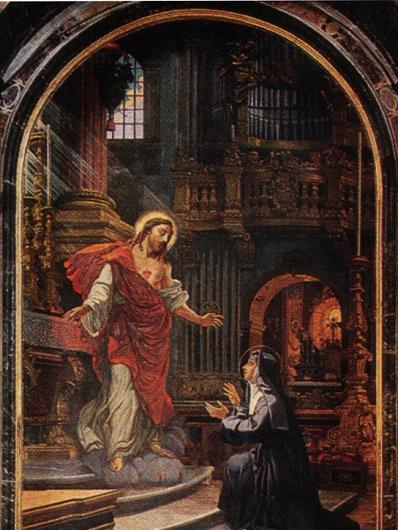
One day as she was praying in the chapel on the steps of the altar she saw the Lord Jesus with her own eyes. He was robed in light and she saw a great beautiful light streaming from his chest and she knew that that was his Most Sacred Heart, overflowing with love for her and for all humanity.

Margaret learned much from the Lord that day and she shared this wondrous knowledge with others.

In time, millions throughout the world would enjoy a deeper relationship with God through a better understanding of and devotion to the Sacred Heart of Jesus.

The tragically sick child had become a woman who would help people reconnect with the reality of our loving God.

St. Margaret Mary Alacoque died at the age of 43 in 1690. She was canonized in 1920. Her memory is celebrated on this day.

(from an earlier post)

Busy wife and mother

Henry's wife was wonderful. She helped him with the family business, took care of the children (they had 7), and even found time (as did he) to help the church and various charitable institutions.

When they were in middle age, they decided to dedicate themselves more closely to God, embracing chastity and as much of a monastic lifestyle as their family obligations would permit. After Henry died, she began to live in a convent fulltime, while continuing her outside charity work.

Hedwig, mother, philanthropist, duchess of Silesia (present-day Poland) and wife of Henry the Duke, died in her late sixties in October 1243. St. Hedwig was canonized 24 years later.

Her memory is celebrated on this day.

(from an earlier post)

Monday, October 15, 2007

Greater than Solomon

In today’s Gospel (Luke 11:29-32), our Lord takes his unbelieving listeners to task.

At the judgment
the queen of the south will rise

with the men of this generation
and she will condemn them,
because she came from the ends of the earth
to hear the wisdom of Solomon,
and there is something greater than Solomon here.
At the judgment the men of Nineveh will arise

with this generation
and condemn it,
because at the preaching of Jonah they repented,
and there is something greater than Jonah here.

That “something greater” is Christ himself: the Eternal Word, true God and true Man, the only Son of the Father.

These words of reproach extend to our present generation as well and not only because Christ has come and has been preached to the world.

Indeed, in the millennia since Christ walked among us in the flesh, Christ has raised up among his followers many, many people who, as imitators of Christ, have become individuals greater than Solomon and Jonah. These individuals are the saints and the blessed, both the famous and the virtually unknown.

To be sure, none of these saints were perfect in all respects (who is?) and there have been too many people at even the highest levels of Christendom whose tragic flaws resulted in terrible things.

Human beings, Christian or otherwise, are finite and flawed creatures.

None of this, however, takes away from the greatness and the goodness that has been revealed among the greatest followers of Christ: from the perseverance and the wisdom of Saint Teresa of Avila whose memory we celebrate today to the perseverance and the selflessness of her namesake Blessed Teresa of Calcutta, from the intellectual heft and spiritual insights of Saint Thomas Aquinas to the fervent charity and sacrificial service of the young Saint Aloysius Gonzaga.

The examples of the Saints and all the Blessed speak to all the world, calling all men to turn from evil and to follow Christ.

The examples of the Saints and all the Blessed speak also to us, calling us not only to further repentance and conversion but also to open ourselves even more to the grace of God: a grace that enables his faithful followers to be greater than Solomon, to be greater than Jonah, and to be instruments of that grace in healing a broken world and bringing all people into the fullness of beatitude in and through our Lord and Savior Jesus Christ.

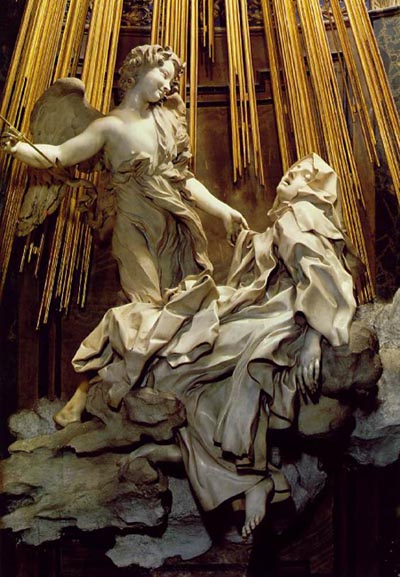
The Ecstasy of St. Teresa of Avila

Cornaro Chapel, Church of Santa Maria della Vittoria - Rome (Click picture for more info)

Bernini’s masterpiece depicts one of St. Teresa’s spiritual experiences, in which she feels the love of God pierce her heart like an arrow.

(from a previous post)

She didn’t feel God’s presence

She was the most famous nun in the world, but there were times when she did not feel the presence of God: “during which the soul feels as if it has never known God and never will know Him, and as if to hear His Majesty spoken of is like hearing of a person from a great distance away.”

But she persevered and brought new spiritual life to her order and to the Church.

She would also have one of the most famous experiences of ecstatic union with God.

St. Teresa of Jesus, born in Avila, founder of the Discalced Carmelites and Doctor of the Church, died in October of 1582 and was canonized forty years later.

Sunday, October 14, 2007

Learning the right thing from the “wrong” people

Today’s Gospel and first reading (Luke 17:11-19 and 2 Kings 5:14-17) both involve non-Jews who are cured of leprosy and who are exemplary in giving thanks to God.

In the Gospel, the Samaritan is the only one of the ten cured lepers to return to Christ and give thanks.

In the first reading, the commander of a foreign army responds to his healing by resolving to worship only Israel’s God, taking actual earth from the Holy Land as a symbolic connection.

In both cases, foreigners with strange religious backgrounds exemplify particular aspects of the right worship of the true God: reminding God’s chosen people of things that they should already be remembering and doing themselves.

These readings remind us of the universalism of God’s action in the world, without taking anything away from the unique role of the Jewish people, the uniquely inspired truth of Judeo-Christian revelation, the unique instrumentality of Christ’s Church, or Christ himself as being the sole source of salvation and the one mediator between God and men.

These readings also remind us of how we ourselves sometimes need to be reminded of the truths we embraced in our baptism, even if those reminders come from unusual people and sources.

This is not to open the doors to relativism: there is only one truth, one Lord and Savior, and one God.

Also, we must be very, very careful not to learn the wrong lessons from other religions, but we should not be afraid to let the faithful of other religions – in whatever good things they may do or say - remind us of the truth we already believe and should already be living in our Lord and Savior Jesus Christ.

Saturday, October 13, 2007

Be like Mary

Saturdays in Ordinary Time, when not impeded by a Feast or Solemnity, are traditionally devoted to the Blessed Virgin Mary.

Today's Gospel (Luke 11:27-28) is simply the passage that follows yesterday's Gospel, but coincidentally it refers to Mary.

While Jesus was speaking,
a woman from the crowd called out and said to him,
“Blessed is the womb that carried you
and the breasts at which you nursed.”
He replied, “Rather, blessed are those
who hear the word of God and observe it.”


Our Lord knew well, of course, that his mother was preeminent in hearing the word of God and observing it, as she exemplified in her response to the angel Gabriel (Luke 1:38):

Behold, I am the handmaid of the Lord.
May it be done to me according to your word.


May we be like Mary.

May we hear the word of God continuously and observe it faithfully and lovingly.

Friday, October 12, 2007

Whoever is not with me is against me

A famous politician once said that “Every nation has to either be with us, or against us.”

Another politician shortly thereafter said pretty much the same thing. To this day, he is derided in many circles for being so simplistic (if not paranoid) in making such a statement. As for the first politician, she seems to be increasingly popular, even in some of the same circles that continue to lampoon and denounce the latter one.

With this as a background, one might wonder if some people would take our Lord’s statement in today’s Gospel (Luke 11:15-28) as simplistic and paranoid:

Whoever is not with me is against me.

Of course, in Mark 9:40, our Lord says, “Whoever is not against us is for us.”

If he were a politician, some might accuse our Lord of being a “flip-flopper”.

Of course, context is everything.

In today’s Gospel, our Lord is speaking of struggles against powerful forces of evil: struggles that can be permanently won only by the power of one stronger than the strong man of evil.

Our Lord, of course, is that stronger One (indeed, infinitely strong) and our fate is grim if we are not aligned with him.

If it is by the finger of God that I drive out demons,
then the Kingdom of God has come upon you.
When a strong man fully armed guards his palace,
his possessions are safe.
But when one stronger than he attacks and overcomes him,
he takes away the armor on which he relied
and distributes the spoils.
Whoever is not with me is against me,
and whoever does n