A Penitent Blogger

Mindful of my imperfections, seeking to know Truth more deeply and to live Love more fully.

Quid sum miser tunc dicturus? Quem patronum rogaturus? Cum vix iustus sit securus?
Recordare, Iesu pie, Quod sum causa tuae viae: Ne me perdas illa die...

Monday, April 30, 2007

We few?

Yesterday was the annual World Day of Prayer for Vocations.

Yesterday many priests (too many) talked about how there were fewer vocations today and how we needed more.

This kind of talk drives me crazy.

For one thing, as I once heard a vocation director say, focusing too much on the need for vocations in this way sounds like, “Come to my party. No one else is.”

For another thing, too much focus on numbers of vocations can be dangerously misleading.

Don’t get me wrong: it would be wonderful to have our seminaries, convents and rectories overflowing with holy servants of God. May God let it be so.

But we don’t need herds of “vocations” interested in a well-regarded, comfortable, and perhaps altruistic career and little more.

We need heroes: men and women who are focused on their individual call by Christ in the Church.

This is not simply a matter of making a virtue of necessity, glorifying quality over quantity simply because quantity is lacking, but it is rather the simple reality of God’s power.

Our Lord’s parables about mustard seeds, about yeast, and about salt remind us that the power of God’s grace does incredible wonders with small quantities.

If the number of vocations is large, that’s great, but ultimately what is important is that you and I – yes, you and I – respond fully and intensely and heroically to the particular call that Jesus Christ has given to me and the particular call that he has given to YOU.

For some of us (more of us than we think), that call is to priesthood, with all of its challenges and bad press.

For some of us, that call is to the consecrated life, despite all of its challenges and the discouraging words of some.

For some of us, that call is to Christian marriage: not a typical marriage with a Christian veneer, but a marriage that is full and intensely and heroically Christian – faithful to the true good of the family and to the truths of eternity, rather than focused on comfort and “the latest thing.”

For the rest of us, it is desperately important that we be living our Christian commitment fully, intensely and heroically each and every day, while we continue actively to discern the Lord’s call.

Whatever our particular call by Christ may be, we must answer it faithfully and fervently by his grace.

Not only does our eternal salvation in Christ require it, but also the good of the Church and indeed the entire world.

We cannot let ourselves coast.

The people of God need heroes.

We need heroic priests, heroic religious, heroic spouses, heroic parents, and very heroic single people.

You and I must be among these heroes.

Think not that we are few.

Remember only that Jesus Christ calls.

Those other people

Today’s first reading (Acts 11:1-18) recounts a milestone in spread of the Gospel by the early Church: not just that the Gospel is spread successfully to non-Jews, but that this sharing of grace with non-Jews is accepted even by skeptical members of the Church.

It fits together well with what our Lord says in today’s Gospel (John 10:1-10):

I am the gate.
Whoever enters through me
will be saved,
and will come in and go out
and find pasture.

Our Lord becomes even more explicit shortly after this passage (verse 16):

I have other sheep that do not belong to this fold.
These also I must lead,
and they will hear my voice,
and there will be one flock, one shepherd.

It is well known that like-minded people tend to “flock” together. Even the age of mass communications and the World Wide Web has encouraged many people to isolate themselves, often unconsciously, within an increasingly narrow circle (even if the circle is geographically global).

This social and intellectual balkanization cannot stop the Gospel of Christ nor should we let ourselves be trapped by these walls.

That is not to say that we must compromise on the Truth, cast our pearls before swine, or neglect the encouragement of our brethren, but as Christians we must step up to the task given to us by Christ and help everyone we can to enter fully into his one flock so that we and they “might have life and have it more abundantly.”

Curriculum vitae

He was a brilliant professor of theology during the time of the Council.

He was made a bishop, then a Cardinal, and finally the chief enforcer of the faith, showing a great zeal against heresy.

And then he was elected Pope.

During his pontificate, his personal holiness shone brightly even as he was involved in great and sometimes controversial endeavors to help build up the Church and its people in an age that was violently opposed to it.

Pope Pius V died early in the seventh year of his pontificate 435 years ago tomorrow. He was canonized in 1712. His memory is celebrated on this day.

Since the Mass commonly referred to as Tridentine was issued under his authority, today was rumored as a possible release date for Pope Benedict's long-expected motu proprio concerning that Mass.

(partly adapted from an earlier post)

Auxiliaries down under

The Holy Father today has named two new Auxiliary Bishops for the Archdiocese of Melbourne: Reverend Don Timothy Costelloe, S.D.B, Rector of Melbourne’s Salesian Theological College; and Reverend Monsignor Peter John Elliott, a priest and Episcopal Vicar for the Archdiocese.

Bishop-elect Costelloe was born in 1954 in East Melbourne, entered the Salesian order in 1977 and was ordained in 1986. He obtained a License in Theology from Rome’s Salesian University and a Doctorate in Theology from the University of Melbourne. He has served as Religious Education Coordinator, Spiritual Director at the Salesian College, Professor at the Catholic Theological College, Assistant Director for the Pre-Novitiate, Pastor of St. Joseph’s Parish in Victoria Park, Rector and Formation Director for the Salesian House for Studies and Pastor in Clifton Hill, Member of the Provincial Council, and Consultant as well as General Secretary for the Synod of Bishops for Oceania that took place in Rome in 1998.

Bishop-elect Elliott was born in 1943 in Melbourne, attended the Melbourne Church of England Grammar School, obtained Bachelor and Master degrees at the University of Melbourne. He then went to Oxford where he obtained a Masters degree in Theology and entered the Catholic Church. A little later, he entered the seminary, studying at Corpus Christi College in Melbourne and then at the Pontifical Lateran University in Rome. He was ordained in 1973. He has served in several parochial and diocesan positions. He is currently Episcopal Vicar for Religious Education, Director of Melbourne’s John Paul II Institute for Marriage and Family, a Consultor for the Congregation for Divine Worship and the Discipline of the Sacraments, and a member of the Congregation for the Clergy’s International Council for Catechesis.

World Day of Prayer for Vocations

'Venerable Brothers
in the Episcopate,
'Dear brothers and sisters!

'The annual World Day of Prayer for Vocations is an appropriate occasion for highlighting the importance of vocations in the life and mission of the Church, as well as for intensifying our prayer that they may increase in number and quality. For the coming celebration, I would like to draw the attention of the whole people of God to the following theme, which is more topical than ever:
the vocation
to the service
of the Church
as communion
.

'Last year, in the Wednesday general audiences, I began a new series of catechesis dedicated to the relationship between Christ and the Church. I pointed out that the first Christian community was built, in its original core, when some fishermen of Galilee, having met Jesus, let themselves be conquered by his gaze and his voice, and accepted his pressing invitation: "Follow me and I will make you become fishers of men! " (Mk 1: 17; cf. Mt 4: 19).

'In fact, God has always chosen some individuals to work with him in a more direct way, in order to accomplish his plan of salvation. In the Old Testament, in the beginning, he called Abraham to form a "great nation" (Gn 12: 2); afterwards, he called Moses to free Israel from the slavery of Egypt (cf. Ex 3: 10). Subsequently, he designated other persons, especially the prophets, to defend and keep alive the covenant with his people. In the New Testament, Jesus, the promised Messiah, invited each of the Apostles to be with him (cf. Mk 3: 14) and to share his mission.

'At the Last Supper, while entrusting them with the duty of perpetuating the memorial of his death and resurrection until his glorious return at the end of time, he offered for them to his Father this heart-broken prayer: "I made known to them your name, and I will make it known, that the love with which you have loved me may be in them, and I in them" (Jn 17: 26). The mission of the Church, therefore, is founded on an intimate and faithful communion with God.

'The Second Vatican Council’s Constitution Lumen gentium describes the Church as "a people made one with the unity of the Father, the Son and the Holy Spirit" (n. 4), in which is reflected the very mystery of God. This means that the love of the Trinity is reflected in her. Moreover, thanks to the work of the Holy Spirit, all the members of the Church form "one body and one spirit" in Christ.

'This people, organically structured under the guidance of its Pastors, lives the mystery of communion with God and with the brethren, especially when it gathers for the Eucharist. The Eucharist is the source of that ecclesial unity for which Jesus prayed on the eve of his passion: "Father…that they also may be one in us, so that the world may believe that you have sent me" (Jn 17: 21). This intense communion favours the growth of generous vocations at the service of the Church: the heart of the believer, filled with divine love, is moved to dedicate itself wholly to the cause of the Kingdom.

'In order to foster vocations, therefore, it is important that pastoral activity be attentive to the mystery of the Church as communion; because whoever lives in an ecclesial community that is harmonious, co-responsible and conscientious, certainly learns more easily to discern the call of the Lord.

'The care of vocations, therefore, demands a constant "education" for listening to the voice of God. This is what Eli did, when he helped the young Samuel to understand what God was asking of him and to put it immediately into action (cf. 1 Sam 3: 9).

Now, docile and faithful listening can only take place in a climate of intimate communion with God which is realized principally in prayer. According to the explicit command of the Lord, we must implore the gift of vocations, in the first place by praying untiringly and together to the "Lord of the harvest". The invitation is in the plural: "Therefore pray the Lord of the harvest to send out labourers into his harvest" (Mt 9: 38). This invitation of the Lord corresponds well with the style of the "Our Father" (Mt 6: 9), the prayer that he taught us and that constitutes a "synthesis of the whole Gospel" according to the well-known expression of Tertullian (cf. De Oratione, 1,6: CCL I, 258). In this perspective, yet another expression of Jesus is instructive: "If two of you agree on earth about anything they ask, it will be done for them by my Father in heaven (Mt 18: 19). The Good Shepherd, therefore, invites us to pray to the heavenly Father, to pray unitedly and insistently, that he may send vocations for the service of the Church as communion.


'Harvesting the pastoral experience of past centuries, the Second Vatican Council highlighted the importance of educating future priests to an authentic ecclesial communion.


'In this regard, we read in Presbyterorum ordinis: "Exercising the office of Christ, the shepherd and head, according to their share of his authority, the priests, in the name of the Bishop, gather the family of God together as a brotherhood enlivened by one spirit. Through Christ they lead them in the Holy Spirit to God the Father" (n. 6).


'The post-synodal Apostolic Exhortation Pastores dabo vobis echoes this statement of the Council, when it underlines that the priest is "the servant of the Church as communion because – in union with the Bishop and closely related to the presbyterate – he builds up the unity of the Church community in harmony of diverse vocations, charisms and services" (n. 16). It is indispensable that, within the Christian people, every ministry and charism be directed to full communion; and it is the duty of the Bishop and priests to promote this communion in harmony with every other Church vocation and service.


'The consecrated life, too, of its very nature, is at the service of this communion, as highlighted by my venerable predecessor John Paul II in the post-synodal Apostolic Exhortation Vita consecrata: "The consecrated life can certainly be credited with having effectively helped to keep alive in the Church the obligation of fraternity as a form of witness to the Trinity. By constantly promoting fraternal love, also in the form of common life, the consecrated life has shown that sharing in the Trinitarian communion can change human relationships and create a new type of solidarity" (n. 41).


'At the centre of every Christian community is the Eucharist, the source and summit of the life of the Church. Whoever places himself at the service of the Gospel, if he lives the Eucharist, makes progress in love of God and neighbour and thus contributes to building the Church as communion.


'We can affirm that the "Eucharistic love" motivates and founds the vocational activity of the whole Church, because, as I wrote in the Encyclical Deus caritas est, vocations to the priesthood and to other ministries and services flourish within the people of God wherever there are those in whom Christ can be seen through his Word, in the sacraments and especially in the Eucharist. This is so because "in the Church’s Liturgy, in her prayer, in the living community of believers, we experience the love of God, we perceive his presence and we thus learn to recognize that presence in our daily lives. He loved us first and he continues to do so; we too, then, can respond with love" (n. 17).

'Lastly, we turn to Mary, who supported the first community where "all these with one accord devoted themselves to prayer" (Acts 1: 14), so that she may help the Church in today’s world to be an icon of the Trinity, an eloquent sign of divine love for all people. May the Virgin, who promptly answered the call of the Father saying, "Behold, I am the handmaid of the Lord" (Lc 1: 38), intercede so that the Christian people will not lack servants of divine joy: priests who, in communion with their Bishops, announce the Gospel faithfully and celebrate the sacraments, take care of the people of God, and are ready to evangelize all humanity. May she ensure, also in our times, an increase in the number of consecrated persons, who go against the current, living the evangelical counsels of poverty, chastity and obedience, and give witness in a prophetic way to Christ and his liberating message of salvation.


'Dear brothers and sisters whom the Lord calls to particular vocations in the Church: I would like to entrust you in a special way to Mary, so that she, who more than anyone else understood the meaning of the words of Jesus, "My mother and my brethren are those who hear the word of God and do it" (Lk 8: 21), may teach you to listen to her divine Son. May she help you to say with your lives: "Lo, I have come to do thy will, O God" (cf. Heb 10: 7).


'With these wishes, I assure each one of you a special remembrance in prayer and from my heart I bless you all.'

From the Vatican, 10 February 2007.

BENEDICT XVI

Sunday, April 29, 2007

Shake that dust

Not everything we do always goes well.

Sometimes (if not many times) we fail.

Afterwards, we often may think about those failures again and again, going over then in our minds and trying to think: if only…

In today’s first reading (Acts 13:14, 43-52), the preaching of Paul and Barnabas fails with their target audience. Not only does the target audience reject their preaching, they respond with verbal abuse and violence.

Paul and Barnabas respond clearly and briefly, and then they move on, shaking the dust from their feet as Christ commanded his disciples to do (Luke 9:5).

The shaking of the dust from their feet signifies, among other things, that they will go forth focusing on the tasks ahead, for that is what God has called them to do.

They truly can do no more for the ones who have rejected them and so they must leave them in the hands of God.

This reading reminds us that we must not let the past keep us from focusing on what we must do in the present and in the future.

If we sin, we must repent and seek forgiveness.

And we must remain faithful to our journey, serving God and his people as best we can, now and in the time ahead.

Saturday, April 28, 2007

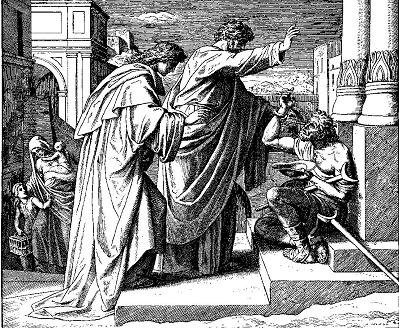
Get up and make your bed

It is perhaps the mundane request in the Bible: something said by millions and millions of parents every morning.

Get up and make your bed.

But the context of this most mundane of requests in today’s first reading (Acts 9:31-42) is extraordinary.

There he found a man named Aeneas,
who had been confined to bed for eight years,
for he was paralyzed.

Peter said to him,
“Aeneas, Jesus Christ heals you.
Get up and make your bed.”

He got up at once.

You and I may not experience such a spectacular miracle any time soon (or perhaps we may), but by the grace of the Lord Jesus Christ, even the most mundane things in everyday life can become extraordinary.

We can begin by remembering this every morning when we first open our eyes and by right then and there asking the Lord to make our day an extraordinary occasion of grace for ourselves and all those we meet.

And having prayed thus, we can get up at once, make our beds, and go forth in the Lord.

"If I were to look at these setbacks...

...from a human standpoint,
I would be tempted,
like the foolish people of this corrupt world,
to complain and be anxious and worried,
but that is not how I look at things.
Let me tell you that I expect more serious setbacks,
more painful ones to test your faith and confidence."

Very soon after he wrote these words, this devout and hardworking priest died.

But the religious communities he had barely begun would flourish and his devotional works become widely read, benefiting the humble and the great alike. One of the Great, for example, would later write this:

“At one point I began to question any devotion to Mary, believing that, if it became too great, it might end up compromising the supremacy of the worship owed Christ. At that time, I was greatly helped by a book by Saint Louis Marie Grignion de Montfort entitled 'Treatise of True Devotion to the Blessed Virgin.' There I found the answers to my questions. Yes, Mary does bring us closer to Christ; she does lead us to him, provided that we live her mystery in Christ.”

Pope John Paul II, “Gift and Mystery”
quoted on www.montfortmissionaries.com


Louis Marie Grignion de Montfort died on this very day in 1716 and was canonized in 1947.

(from an earlier post)

The foreigner

was an educated young man who spoke gently and showed great care for people. Everyone who knew him said he had a kind heart.

Nonetheless, the government saw him as a threat and the Prime Minister decided to take dramatic action. Early one morning, they swept through the compound where the young man was, catching him and his associates off guard.

The Prime Minister came to the scene and personally split open the skull of the kind young man.

St. Peter Chanel, French-born missionary and parish priest, was thus martyred on this very day 166 years ago in an island kingdom of Oceania. He was canonized in 1954.

(from an earlier post)

Friday, April 27, 2007

The evildoer becomes God’s chosen

In today’s first reading (Acts 9:1-20) we hear the rather familiar account of the conversion of Saul. This account tells us of miracles and wonders and yet this brief exchange captures the most amazing aspect of the event:

But Ananias replied,
“Lord, I have heard from many sources
about this man,
what evil things he has done
to your holy ones in Jerusalem.
And here he has authority from the chief priests
to imprison all who call upon your name.”

But the Lord said to him,
“Go, for this man is a chosen instrument of mine
to carry my name before Gentiles,
kings, and children of Israel,
and I will show him
what he will have to suffer
for my name.”

The evildoer has become God’s “chosen instrument”, not as an instrument of wrath or earthly liberation (functions exercised by certain nonbelievers in the Old Testament), but as a messenger of God’s holy name.


By the grace of God he has turned from his evil way and seeks that which is good.

That, of course, is what conversion is all about: what the power of God’s grace can do to even the most despicable of people.

You and I might not be despicable. Perhaps we have committed terrible sins or perhaps we are just well-meaning people wallowing in spiritual mediocrity.

God’s grace is there for us, through his merciful will, as a juggernaut for our conversion: conversion from evildoers to Gospel witnesses, conversion from milquetoast churchgoers to champions of Christian truth and love.

Thursday, April 26, 2007

Somebody has to do it

In the United States and other places in the Free World, young people are told that they can do anything they put their mind to do.

This is true, to some extent, although as Ecclesiastes famously observed (9:11):

I returned, and saw under the sun,
that the race is not to the swift,
nor the battle to the strong,
neither yet bread to the wise,
nor yet riches to men of understanding,
nor yet favour to men of skill;
but time and chance happeneth to them all.


Many people try to transfer this “self-made man” mentality to spirituality: building what they think to be their own path to God or their own heaven on earth.

Today’s readings remind us that, when it comes to the Infinite, we have our limitations.

In today’s first reading (Acts 8:26-40), the deacon Philip has this exchange with a royal official.

“Do you understand what you are reading?”

He replied,
“How can I, unless someone instructs me?”


The royal official is not stupid. No simple palace flunky, he has been raised and educated for positions of responsibility and currently manages the funds of a national government, yet he understands his human limitations in the realm of the divine.

In today’s Gospel (John 6:44-51), our Lord is very clear that knowing God and being united with Christ are not do-it-yourself projects.

No one can come to me
unless the Father who sent me
draw him,
and I will raise him on the last day.

It is written in the prophets:

They shall all be taught by God.

Everyone who listens to my Father
and learns from him
comes to me.

Not that anyone has seen the Father
except the one who is from God…

This does not mean that we should just sit back and do nothing except wallow in our sins.

We must continually open ourselves to the grace of God and our Lord Jesus Christ. Of course, even the desire to open ourselves to God is itself the work of grace, yet this does not absolve us of our responsibility and purposeful involvement with the grace of God.

We may sometimes be very frustrated with our perceived lack of spiritual progress. We may even despair if (God forbid) we backslide into our old habits of sin.

We should not let ourselves become frustrated and we must never despair.

We need to remember that we can do nothing by ourselves: conversion and growth in the Spirit is the work of the Spirit.

We cannot do it: God has to do it.

All we can do
– indeed, what we MUST do –
is keep ourselves open to God’s grace
and the movement of his Holy Spirit:
not just giving God a narrow window
(as if he were a trained seal
ordered to hop through a hoop),
but keeping ourselves continually open,
day in and day out,
so that the grace of God
may continue to flow into us,
build within us,
and - according to his will -
flow through us
to those we meet.

Wednesday, April 25, 2007

The chosen one at Babylon

Near the end of today’s first reading (1 Peter 5:5b-14) we find the reason for its selection on the Feast of Saint Mark: Peter refers to “Mark, my son.” This Mark has been traditionally identified as a special assistant to Peter and as the writer of the Gospel that today bears his name.

In that same sentence is this cryptic reference:

The chosen one at Babylon sends you greeting…

In the early Church, especially during New Testament times, “Babylon” (the capital of the evil empire that had oppressed the Jewish people) was a code word for “Rome” (the capital of the evil empire that was oppressing the Christian people). [Some anti-papal scholars, imagining that Peter was never Bishop of Rome, opine that while “Babylon” may mean Rome in some New Testament books, it does not mean Rome here. Yeah, right.]

Likewise, “the chosen one” or “the elect woman” is traditionally understood in New Testament writings to mean “the church” (and was often translated as such). [A few commentators try to twist this into a reference to Peter’s wife. Give me a break.]

The traditional New Testament meaning of this cryptic reference also has meaning for us in the global village which we call the modern world, for by the grace of God we are the elect lady, the chosen one, the church in the heart of today’s evil empire: a culture of death, perversion and despair that in varying ways oppresses Christians and indeed all people of faith and good will.

Yet just as many of the church of Rome stayed in Rome, despite its corrupting influences and physical dangers, so do we: striving by the grace of God to shine the light of faith, truth and love amid a gathering gloom and deepening decadence.

Although many would fall and many would perish, in time and by the grace of God the Christians of Rome would enable the heart of the evil empire to become the center of Christendom.

So too we should not be discouraged or fearful, no matter what we see around us. Rather, we must be faithful and strong in the Lord Jesus Christ, in whom we have been chosen – even in Babylon.

Administrative Professionals Day

is celebrated today.

We especially remember today one particular Assistant who was proficient in state-of-the-art word processing and thus a valuable asset to the CEO.

The CEO was under tremendous pressure, trying to stay at least one step ahead of the law (sometimes, they said, the way the CEO escaped the clutches of the authorities was a miracle).

The Assistant facilitated some of the CEO's most critical correspondence as well as supporting him (and sometimes the number two guy) on travels.

No mere cog in the great corporate machine, the Assistant aspired to write a book.

The book turned out to be a best seller: the first in what would be a famous genre of very specialized biographies.

The Assistant eventually was promoted to head a major branch and would be well thought of by the people there.

In the end, however, the Assistant was probably caught in the same government sweep that finally destroyed the CEO, the number two, and many others.

The Feast of Saint Mark - assistant and traveling companion to the Holy Apostles Peter and Paul, author of the earliest Gospel, and Bishop of Alexandria - is celebrated on this day.

(adapted from an earlier post)

Tuesday, April 24, 2007

Persecuting the prophets

Some people say that the Church persecutes saints while they are alive and canonizes them after they are dead.

As a rule, those who say such things feel that they themselves are unwelcome and unappreciated by Church authorities – or worse.

Those who say such things, hearing today’s first reading (Acts 7:51-8:1) might also cast themselves in the role of Stephen (speaking the truth to power) and their ecclesiastical opponents as the hypocritical, murderous Sanhedrin (using power to suppress the truth).

This anti-hierarchical, self-righteous view is simplistic to the point of inaccuracy (if not delusion).

Have holy people been persecuted by religious authorities over the millennia? Yes, but so were heretics (in much greater number).

Persecution is no guarantee of orthodoxy, nor is holding religious office a guarantee of personal sanctity.

Sometimes the conflicts between living saints and religious authorities were problems of communication (a common problem, especially in the non-wired past).

Sometimes the conflicts arose because the words and lifestyle of the saint implicitly or explicitly challenged the imperfections of particular religious officeholders.

The bottom line for us is first to be diligent in continually examining our own consciences.

All of us fall short of perfection in some way. Have we rationalized our ongoing moral failures? Have we rationalized our unwillingness to progress further in our personal sanctity and knowledge of God? Do we resist or resent anyone who might implicitly or explicitly remind us of our rationalizations and our failures?

May we turn more fully to the Lord
and open ourselves more and more to his grace.

Secondly, insofar as we are faithful to the Lord, we too will be opposed: subtly or otherwise.

May we cling to the Lord
– or rather –
allow ourselves to be grasped
fully and firmly by his mighty hand:
living our lives in this world
not according to our own comfort and desire
nor according to the slippery winds of popularity,
but living our lives in this world
according to the eternal will and truth
of our loving God.

Catholic Carnival

This week's Catholic Carnival - a collection of posts from various Catholic blogs - is online at cause of our joy.

Ashamed to be a lawyer

Mark's fellow lawyers disgusted him: they were interested in money, not justice.

So Mark left the practice of law behind and focused on the practice of the faith.

He gave away his money and became a Capuchin, taking the name Brother Fidelis.

He would be a powerful advocate for the faith and was soon famous for his preaching.

He was sent to preach missions in places where nearly all the people had left the Church to follow a different direction.

He would be very successful – too successful.

One day he was preaching in a church when a mob stormed in, killing several guards and striking Fidelis.

A friendly man in the crowd offered to take Fidelis to safety. Fidelis thanked him but said he was in God's hands.

When he walked outside the church, the mob's leaders gave Fidelis one last chance to give up the faith.

Fidelis refused and was beaten to death right then and there - 385 years ago today in Seewis, Switzerland.

The memory of St. Fidelis of Sigmaringen is celebrated on this day.

(from an earlier post)

Coadjutor for the Twin Cities

The Holy Father has named the Bishop of New Ulm (Minnesota, USA), the Most Reverend John Clayton Nienstedt, as Coadjutor Archbishop of Minneapolis-St. Paul.

He was born in 1947 in Detroit and would study philosophy there at Sacred Heart Seminary. He studied theology at the Pontifical Gregorian University while a student at the Pontifical North American College in Rome. Later he would get a Doctorate in Theology at the “Alfonsiana.”

He was ordained a priest for the Archdiocese of Detroit in 1974. He served as Assistant Pastor for two years at Guardian Angels Parish in Clawson, Michigan, before returning to Rome for studies. From 1977 to 1980 he served as Secretary to the Archbishop of Detroit, John Francis Cardinal Dearden. From 1980 to 1986 he worked at the Secretariat of State in the Vatican. In 1986 he was named to be Assistant Pastor of Saint Regis Parish in Birmingham, Michigan, while also teaching at Saints Cyril and Methodius Seminary in Orchard Lake. He was then named Pastor of St. Patrick’s Parish in Union Lake. From 1987 to 1988 he was called to reorganize Sacred Heart Seminary in Detroit and served there as Rector until 1994 when he was named Pastor of the Shrine of the Little Flower in Royal Oak.

He was named Auxiliary Bishop for Detroit and consecrated in 1996. He became Bishop of New Ulm in 2001. He has served on the following committees within the Bishops’ Conference: Administrative Committee, Priestly Formation, Ad hoc Committee on Catholic Health Care Issues, Committee on Science and Human Values, and Ad hoc Committee Special Assembly 2007.


Today the Holy Father also named Monsignor Konrad Zdarsa, up to now the Vicar General of Dresden-Meißen, as the new Bishop of Görlitz, Germany.

Monday, April 23, 2007

Endurance and change

Some people fight change.

In today’s first reading (Acts 6:8-15), people work to have Stephen executed on the charge of claiming that Jesus “will change the customs that Moses handed down to us.”

They would succeed in having Stephen killed, but they would fail in their objective: terrible changes would be forced upon them at the hands of the pagan Romans, while the faith of Jesus would spread across the world.

Change, of course, is part of life.

Some people fight change, while other people wallow in it: seeking always after the latest fad or newest trend and shedding all their yesterdays like a snake shedding its skin.

At the end, nothing is left: they have no life.

They sought only change and they are left with no substance: no meaning, nothing that will last.

In today’s Gospel (John 6:22-29), the Lord Jesus himself says,

Do not work for food that perishes
but for the food that endures for eternal life,
which the Son of Man will give you.

In our own lives, many things may seem uncertain and unstable, except perhaps the dark things of life which may seem to hang over us forever.

We should neither fear change nor lust for it.

Rather, we should always keep our focus on the Lord Jesus and on that which he gives us for eternal life: his love, his grace, his truth, and his presence – in word and in Sacrament.

Change happens.

But God is.

A bishop before he was 30

He was intelligent, pious, and an energetic young priest.

He also had connections and the diocese needed a bishop very badly.

So, while still in his mid-twenties, he was made bishop.

It was not an easy diocese: polygamy, idolatry, and even slavery were popular in some circles.

The young bishop, on the other hand, was not popular: especially not among the powerful.

After several years, he escaped to Rome and became a Benedictine hermit.

Four years later, the Pope sent him back. He accomplished some things, but the enmity of the powerful proved deadly: his brothers were murdered and the young bishop fled again to Rome.

He then turned to evangelizing neighboring countries, meeting with considerable success in two of them, but once again running afoul of violent men in a third.

He cut down a tree sacred to pagans.

The pagans cut him down one thousand and ten years ago today near the Baltic sea, but the ministry of Adalbert, who had been born with the name of Vojtěch and was for a time bishop of Prague, would bear abundant fruit and the Christian faith would be embraced by all the lands in which he had preached the Gospel.

The unknown soldier

We know his name was George.

We know he was a soldier.

We know that he believed in Christ and that they killed him for it.

That’s really all we know.

But people remembered the name of George, the warrior who died for Christ, and long after the details of his life were forgotten, tales about him were told... and retold... and grew in the telling (the most famous of which – in which he slays a dragon - was encompassed in a collection known as “The Golden Legend”).

Thus, Saint George is famous, and yet also unknown.

But we know that he was a soldier who died for Christ and that is a more wonderful accomplishment than anything.

The feast of Saint George is celebrated on this day.

(adapted from an earlier post)

Sunday, April 22, 2007

It will all fall into place

For some of us, it has been a chaotic week.

For those affected by the terrible events such as the massacre at Virginia Tech, it has been a devastating week, dominated by obliterating senselessness.

We are reminded that we do not possess the mind of God in its infinite fullness. We cannot make sense of everything and so we have faith.

Today’s readings tell us in faith that in God’s own way and in God’s own time, everything will indeed fall into place.

We hear this most majestically in today’s second reading (Revelation 5:11-14):

Then I heard every creature
in heaven
and on earth
and under the earth
and in the sea,
everything in the universe,
cry out:
“To the one who sits on the throne
and to the Lamb
be blessing and honor,
glory and might,
forever and ever.”


Everything will fall into its place, recognizing the Lordship of God in all things, even those who are “under the earth.”

It may be very hard for us to see or to understand how this could come about, but God will set everything in its place in his own time and his own way, in his infinite justice and mercy.

In the meantime,
we must seek the gift of grace and the eyes of faith,
so that like the Apostle in today’s Gospel (John 21:1-19),
no matter what may happen
or where we may be,
we may look and recognize the presence
of the One whom others do not yet recognize.

It is the Lord.

Saturday, April 21, 2007

Comfort in the dark

In today’s Gospel (John 6:16-21), the disciples are besieged by wind, waves, and darkness.

Suddenly they see Christ and hear his voice as he says,

It is I.
Do not be afraid
.”

And then they are safe.

We all have rough times in our lives: when the winds of fortune seem against us, when waves of troubles batter us, when a famine of love afflicts our hearts, and there seems to be nothing around us but darkness.

May we never give in to despair, but may we always seek the light and the voice of our Lord and Savior Jesus Christ, to comfort us and guide us through the troubles of this world.

As we hear in today’s Psalm (33:1-2, 4-5, 18-19):

See,
the eyes of the LORD
are upon those who fear him,
upon those who hope for his kindness,
To deliver them from death
and preserve them in spite of famine.

Young wanderer becomes mighty defender

When he was a young boy, he loved God and before he was fifteen tried (unsuccessfully) to become a monk.

Then the temptations of life caught his attention and he wandered.

Years later, he found himself again at the doors of a monastery and he committed his life to God.

However, it was not yet clear what God wanted to do with him.

He felt called to the contemplative life of a hermit. On the other hand, his father had left him an estate with which might do great good for the poor. In the end, he submitted to the will of his superiors and committed himself to the monastic life.

Now committed to the service of God, the young man blossomed. He was blessed with a pious spirit, abundant energy, and a phenomenal intellect. He would quickly be called to greater and greater levels of responsibility (within three years he would be the number two man in the monastery), but his mind and his spirit soared further and in between his daily administrative tasks he wrote philosophical and theological works of great skill and insight.

He continued to write even after he was almost literally dragged into becoming a Bishop.

It was not just humility that made him reluctant to accept that office. Powerful political forces sought to dominate the Church and make it a tool of the State. He would rise to the challenge and defended the autonomy of the Church and the Gospel, sometimes with bold action, sometimes with careful nuance.

Anselm, Archbishop of Canterbury, died on this very day in 1109. His truly classic theological works include the Proslogium and Cur Deus Homo. His thought would be admired by diverse philosophers such as Descartes and Hegel.

St. Anselm of Canterbury was canonized in 1492.

(adapted from an earlier post)

Friday, April 20, 2007

Worthy to suffer dishonor

So (the Apostles) left the presence of the Sanhedrin,
rejoicing that they had been found
worthy to suffer dishonor
for the sake of the Name.


There are many whose motto is “death before dishonor.”

Based on today’s first reading (Acts 5:34-42), it would seem that the Apostles are not among them.

As usual, there are some very important distinctions to be made.

One important distinction is the source of the dishonor: whether one dishonors oneself or is dishonored by others.

In the case of the Apostles, of course, they are dishonored by their being beaten like dogs by the Sanhedrin: they do not dishonor themselves by their own words, actions or failures.

A second important distinction is that they have subordinated their honor to the honor of Christ. If their embarrassment, dishonor, or pain brings greater honor and glory to Christ, then so be it. Indeed, as St. Paul would later write (2 Corinthians 1:5):

For as we share abundantly in Christ's sufferings,
so through Christ we share abundantly in comfort too.

Indeed, our Lord and Savior Jesus Christ was himself publicly displayed as a criminal, spit upon and hung up by the side of the road where people could continue to ridicule him as he died a slow death of pain.

No dishonor could be worse, yet this was the path of our salvation, leading to resurrected glory.

That is why the Apostles were able to rejoice “that they had been found worthy to suffer dishonor for the sake of the Name.”

That is why we should never fear any dishonor, humiliation, or embarrassment that the world may inflict upon us for being faithful to Christ.

It is better to be faithful to Christ than to be honored by this world.

It is better to be faithful to Christ than to be respected by our neighbors.

It is better to be faithful to Christ than to be comfortable.

As we hear in today’s Psalm (27:1, 4, 13-14):

I believe that I shall see the bounty of the LORD
in the land of the living.

Wait for the LORD with courage;
be stouthearted,
and wait for the LORD.

Thursday, April 19, 2007

Two years ago today


Joseph Cardinal Ratzinger was elected Supreme Pontiff
and took the name Benedict XVI

Ad multos annos!

Words of homicidal rage

“...they were enraged and wanted to kill them.”

These words end today’s first reading (Acts 5:27-33 – RSV translation).

These words resonate for many today, coming in the wake of the mass murder at Virginia Tech three days ago.

These words resonate even more nauseously because of a news network’s decision yesterday to disseminate broadly some of the murderous images and hate-filled rantings furnished to them by the deranged perpetrator of this evil and because of the energetic complicity of nearly every media outlet in this dissemination. (With all due respect, I fear that the media’s specious justifications are gainsaid by the prominence and the repetition they themselves give to these execrable words and images.)

This is not what we should be doing as a society: giving mega-celebrity to an evildoing fool while heaping salt in the wounds of mourners and frightening children.

It would be better for us to follow to path of the Lord as laid out for us in today’s Responsorial Psalm (Psalm 34:2, 9, 17-18, 29-20):

The LORD'S face is against evildoers
to wipe out their memory from the earth….

The LORD is close to the brokenhearted,
saves those whose spirit is crushed.


Save us, O Lord.

Be close to those who mourn.

In the name of Jesus. Amen.

Wednesday, April 18, 2007

The police could do nothing

In today’s first reading (Acts 5:17-26), the authorities use police power in an attempt to stop the spread of the Gospel.

The attempt is spectacularly unsuccessful: an angel of the Lord springs the Apostles from jail and the people rally around them.

In today’s world, cultural elites and sometimes even governments often try to impede the dissemination of the Christian faith or even the right of Christians to express their opinions or to do good deeds.

We cannot let the forces of suppression and censorship succeed.

We cannot give in to the totalitarianism of political correctness.

No matter what opposition we may face,
we must be faithful, in what we do and in what we say,
to the truth and to the love of our Lord Jesus Christ.

SCOTUS upholds abortion ban

The Supreme Court of the United States, in a 5-4 decision written by Justice Anthony Kennedy and issued today, has upheld the Partial Birth Abortion Ban Act (source: AP and the Washington Post)

UPDATE: Text of majority opinion, concurrence and dissent here (hat tip: Mirror of Justice).

Tuesday, April 17, 2007

Catholic Carnival

This week's Catholic Carnival - a collection of posts from various Catholic blogs - is online at To Jesus Through Mary.

Remember the hero

He survived the holocaust, but the Nazis got his father.

He himself ended up in a Soviet labor camp.

When he returned home to Romania, he was forced to work under a brutal dictator.

But he was dedicated to his science and to his Jewish people.

It ended up costing him his job.

He was eventually able to go to Israel where he raised his family.

Then he had an opportunity to teach in America.

He was still there a decade later, teaching his students, when the sound of gunfire could be heard outside the classroom.

He threw his 76 year-old body against the door, holding the gunman back and ordering his students to escape out the windows.

They got out, but he did not.

The authorities found the body of Professor Liviu Librescu in his classroom at Virginia Tech yesterday, where on Holocaust Remembrance Day a holocaust survivor gave his life so that his students might survive the worst shooting by a lone gunman in American history.

Too often too much attention is paid to the perpetrators of evils such as yesterday’s massacre (may the God of Infinite Justice have mercy on their souls).

We should give much more attention to people such as Liviu Librescu (may the Lord of Infinite Mercy grant him eternal rest).

We should remember the hero.

Professor Liviu Librescu


(Information from the Jerusalem Post and other sources. Picture from Virginia Tech)

“How can this happen?”

Nicodemus’ question from today’s Gospel (John 3:7b-15) has a very different resonance today, for it has been repeated many, many times in the 24 hours since the massacre of 32 people at Virginia Tech yesterday.

“How can this happen?”

At that time, Nicodemus was trying to understand particularly mysterious things being said by Christ.

Right now, we are trying to understand the most deadly mass shooting in American history.

“How can this happen?”

Our Lord gently puts Nicodemus in his place.

Jesus answered and said to him,
“You are the teacher of Israel
and you do not understand this?
Amen, amen, I say to you,
we speak of what we know
and we testify to what we have seen,
but you people do not accept our testimony.
If I tell you about earthly things
and you do not believe,
how will you believe
if I tell you about heavenly things?”

Nicodemus was not stupid - he was well-educated and well-connected – and yet there were limits to his knowledge and his understanding.

Likewise we today – gifted with amazing tools of information gathering and transmission – in situations such as yesterday’s atrocity are often greatly frustrated by the limits of our knowledge and understanding.

Yesterday many students at Virginia Tech – as well as their families and friends – were frustrated and indeed terrified by what they did not yet know. Where was the threat? Who is dead? Whose life still hangs in the balance?

Now many of us are frustrated at a lack of answer to another question: How can this happen?

Why did the killer do it? Why could authorities have not done more to stop this?

And how could “a loving God” (whom the President called upon yesterday to comfort those suffering in the massacre’s wake) let this happen?

Human investigation may never determine all of what was in the killer’s mind and no “blue ribbon commission” will be able to devise a perfectly safe environment anywhere on this planet (not that we shouldn’t keep trying to do the best we can).

And, to paraphrase very loosely our Lord’s words to Nicodemus, if we cannot completely figure out earthly things, how can we figure out heavenly things?

We can indeed learn and understand many, many things in this world and we can even come to learn and understand much about God, especially with the help of his grace, yet we are only finite beings. We are not God. Our knowledge and understanding will never be complete until we come to be filled with the light of his mind in the beatific vision.

In the meantime, we will keep learning more and understanding more, while continually tripping upon the shifting limits of our knowledge and our capacity to understand.

Yet, even despite this tragedy – this horrendous evil – we know that God loves us and can bring an even greater good out of the present nightmare.

We know this because he sent his Son to us, who out of the horror of the cross brought us God’s love and salvation.

So must the Son of Man be lifted up,
so that everyone who believes in him
may have eternal life.


How can this happen?

We can and should seek all the answers we can in this world
while keeping our minds and hearts open
to the unfathomable wisdom of the infinite God
and the ever-deepening comfort of his Holy Spirit.

The wind blows where it wills,
and you can hear the sound it makes,
but you do not know where it comes from
or where it goes;
so it is with everyone who is born of the Spirit.

Monday, April 16, 2007

Mass murder at Virginia Tech

Over thirty people were murdered today at Virginia Tech.


Pray for the victims and their families.


Pray also for all those affected and threatened by violence.


"Angel of God,
my guardian dear,
To whom his love commits me here;
Ever this day be at my side,
To light and guard, to rule and guide.
Amen."

Angele Dei,
qui custos es mei,
Me tibi commissum pietate superna;
Hodie illumina, custodi, rege, et guberna.
Amen.


UPDATE:
Telegram from the Holy Father:

THE MOST REVEREND FRANCIS X. DILORENZO
BISHOP OF RICHMOND (U.S.A)

DEEPLY SADDENED BY NEWS OF THE SHOOTING AT VIRGINIA TECH, HIS HOLINESS POPE BENEDICT XVI HAS ASKED ME TO CONVEY THE ASSURANCE OF HIS HEARTFELT PRAYERS FOR THE VICTIMS, THEIR FAMILIES AND FOR THE ENTIRE SCHOOL COMMUNITY. IN THE AFTERMATH OF THIS SENSELESS TRAGEDY HE ASKS GOD OUR FATHER TO CONSOLE ALL THOSE WHO MOURN AND TO GRANT THEM THAT SPIRITUAL STRENGTH WHICH TRIUMPHS OVER VIOLENCE BY THE POWER OF FORGIVENESS, HOPE AND RECONCILING LOVE.

CARDINAL TARCISIO BERTONE
SECRETARY OF STATE.

Rock your world

How powerful can prayer be?

Today’s first reading (Acts 4:23-31) gives us a great example.

As they prayed,
the place where they were gathered shook,
and they were all filled with the Holy Spirit
and continued to speak the word of God with boldness.


The power of worship, of course, is not always measurable on the Richter scale, but good worship should always be earthshaking.

Good worship knocks us out of the rut of our mundane, materialistic existence.

Good worship pulls us away from the quagmire of the sensual and launches us toward the ecstasy of the spiritual.

Good worship empties us of ourselves and our obsessions and fills us with the Holy Spirit of God.

Good worship empowers us to go forth and “speak the word of God with boldness”, to bear witness to the resurrection of the Lord Jesus with mighty deeds (cf v. 33), and to share with those in need (cf v.34).

As we begin another work week, perhaps even as the glow of Easter begins to fade, may we find new joy, wonder, and strength by the grace of the Holy Spirit through focusing not on ourselves and our “world” but on the treasures of prayer.

Come then, let us bow down and worship...

Happy birthday!!


Today is the Holy Father's 80th birthday.

Ad multos annos

Sunday, April 15, 2007