A Penitent Blogger

Mindful of my imperfections, seeking to know Truth more deeply and to live Love more fully.

Quid sum miser tunc dicturus? Quem patronum rogaturus? Cum vix iustus sit securus?
Recordare, Iesu pie, Quod sum causa tuae viae: Ne me perdas illa die...

Monday, July 31, 2006

Uncomfortably close

Today's first reading (Jeremiah 13:1-11) may not be for the squeamish.

For, as close as the loincloth clings to a man’s loins,
so had I made the whole house of Israel
and the whole house of Judah cling to me, says the LORD.

Wow! That is uncomfortably close!

(For some of us, this imagery provokes particular discomfort because of our own dirty or prudish minds. That, of course, is our problem, not a problem in the text or the truth being taught.)

But the most uncomfortable closeness is not physical closeness, but emotional and cognitive closeness in a relationship. This is a serious problem for many and is the bane of many relationships.

It is also a common problem in our personal relationship with God.


Emotional closeness involves emotional vulnerability: closeness so great that anything in the relationship or in the other affects us deeply and powerfully – sometimes exaltation and sometimes devastation. And so we often build up an emotional buffer zone that puts distance between the other and ourselves.

We do this in our human relationships and we do it in our relationship with God.

Sometimes this happens the first time we are disappointed in our prayer: we opened our heart to the Lord and asked for something, it did not happen and we do not open up our hearts to the Lord quite as much again.

Cognitive closeness involves complete, thorough and intimate knowledge of ourselves by the other: that person knows our quirks, our habits, our tricks, our evasions, our canned expressions, our vulnerabilities, our hot buttons, our weaknesses, etc. Sometimes this frightens us and so we try to protect our sense of self with impulsive actions, playacting and creative stratagems, hiding and distancing ourselves from the other.

We know objectively, of course, that while we can fool other people, we cannot fool God, so what we do is try to fool ourselves, most often through our rationalizations and sometimes even by denying God's existence.

But God sees through it all: he still remains close to us, loves us, and calls us to let ourselves be drawn ever closer to him.

May God give us the grace to be perfectly at peace and comfortable in his closeness.

O LORD, thou hast searched me and known me!

Thou knowest when I sit down and when I rise up;
thou discernest my thoughts from afar.

Thou searchest out my path and my lying down,
and art acquainted with all my ways.

Even before a word is on my tongue,
lo, O LORD, thou knowest it altogether.

Thou dost beset me behind and before,
and layest thy hand upon me.

Such knowledge is too wonderful for me;
it is high, I cannot attain it.

Whither shall I go from thy Spirit?
Or whither shall I flee from thy presence?
If I ascend to heaven, thou art there!
If I make my bed in Sheol, thou art there!

If I take the wings of the morning
and dwell in the uttermost parts of the sea,
even there thy hand shall lead me,
and thy right hand shall hold me.

If I say, "Let only darkness cover me,
and the light about me be night,"
even the darkness is not dark to thee,
the night is bright as the day;
for darkness is as light with thee.

For thou didst form my inward parts,
thou didst knit me together in my mother's womb.

I praise thee, for thou art fearful and wonderful.
Wonderful are thy works!

Thou knowest me right well;
my frame was not hidden from thee,
when I was being made in secret,
intricately wrought in the depths of the earth.
Thy eyes beheld my unformed substance;
in thy book were written, every one of them,
the days that were formed for me,
when as yet there was none of them.

How precious to me are thy thoughts, O God!
How vast is the sum of them!
If I would count them, they are more than the sand.
When I awake, I am still with thee.

Psalm 139:1-18

Turnaround

Iñigo had been religious as a small boy, but he was soon sucked into the sordid lifestyle that surrounded him.

In his twenties, he turned his life around: joining the army and embracing its discipline and stoicism.

Then Iñigo was severely wounded in battle and captured. The medical treatment he received was primitive to the point of brutality and he was confined to bed for months.

Bored and seeking distraction from his pain, Iñigo asked his caregivers for adventure books to read, but all they had to loan him were books about religious people. He decided to work with what he had and read the books as if they were adventure stories.

In those months of reading and thinking, Iñigo came to understand how a life of faith could be the greatest adventure, the greatest heroism, and the greatest glory. It proved to be an intense conversion experience, in which he learned much about himself, about God, and about the spiritual life.

It was the greatest turnaround of his life.

When he was finally able to get up and around, Iñigo spent some time alone, and then made a difficult pilgrimage to the Holy Land before devoting himself to study and to helping others reform their lives. His efforts were often met with opposition that sometimes turned violent. Eventually he left the country.

As Iñigo continued his studies, a small group of followers gathered around him. He began to see them as a company of soldiers: a company belonging to Jesus. They soon became known as the Jesuits.

Iñigo, also known as Ignatius of Loyola, came to be one of the great figures in the renewal of the Church. He also developed a book of Spiritual Exercises that remains not only a guide for life-changing spiritual retreats, but also for spiritual discernment and growth. He died in his mid sixties in Rome 450 years ago today.

(adapted from a previous post)

Sunday, July 30, 2006

Against such reckless hate

"What can men do against such reckless hate?"

This is what a character in a film once asked.

In reality, reckless hate seems on the rise throughout the world today and sometimes threatens to overwhelm us.

We ourselves therefore might ask the same question, "What can we do against such reckless hate?"

Diplomacy and legitimate self-defense do not seem to be enough.

What can we do?

Today's readings give us, as members of the Church, an answer - a path to follow - beginning with the words of St. Paul (Ephesians 4:1-6).

I, a prisoner for the Lord,
urge you to live
in a manner worthy of the call you have received,
with all humility and gentleness,
with patience,
bearing with one another through love,
striving to preserve the unity of the spirit
through the bond of peace:
one body and one Spirit,
as you were also called
to the one hope of your call;
one Lord, one faith, one baptism;
one God and Father of all,
who is over all and through all and in all.

But how does this really help? How can this path of peace that begins among ourselves in the Church lead to anything of consequence in a world awash in violence and hate?

How can the efforts of individuals, of small communities, or even one particular religion make a difference against such reckless hate and deadly weaponry?

These questions find their echo and their answer in today's other readings, beginning with the first reading (2 Kings 4:42-44):

Elisha said, "Give it to the people to eat."

But his servant objected,
"How can I set this before a hundred people?"

Elisha insisted, "Give it to the people to eat."
"For thus says the LORD,
‘They shall eat and there shall be some left over.'"

And when they had eaten, there was some left over,
as the LORD had said.

And the Gospel (John 6:1-15):

When Jesus raised his eyes
and saw that a large crowd was coming to him,
he said to Philip,
"Where can we buy enough food for them to eat?..."

Philip answered him,
"Two hundred days' wages worth of food

would not be enough
for each of them to have a little."

One of his disciples,
Andrew, the brother of Simon Peter, said to him,
"There is a boy here
who has five barley loaves and two fish;
but what good are these for so many?"

You and I cannot solve the problems of the world.

Our hands and voices alone can do little against the reckless hate that surges around us.

But just as the Lord multiplied a few loaves and fishes to feed multitudes, so too will the Lord multiply our efforts for peace and reconciliation, if we remain faithful.

We may not see peace and reconciliation roll across the face of the planet like a flood of goodness according to our own expectations and timetables, but the will of the Lord – who wishes all men to be saved and to come to the knowledge of the truth – will be done.

May we be instruments of that will.

May we put our efforts forward, like the boy who offered the loaves and fishes.

May we be instruments of God's peace.

Saturday, July 29, 2006

Going to Church will not save you...

...if that is all you do.

This message from today' first reading (Jeremiah 7:1-11) could not be more blunt:

Thus says the LORD of hosts, the God of Israel:
Reform your ways and your deeds,
so that I may remain with you in this place.

Put not your trust in the deceitful words:
"This is the temple of the LORD!
The temple of the LORD!
The temple of the LORD!"

Only if you thoroughly reform your ways and your deeds;
if each of you deals justly with his neighbor;
if you no longer oppress the resident alien,
the orphan, and the widow;
if you no longer shed innocent blood in this place,
or follow strange gods to your own harm,
will I remain with you in this place,
in the land I gave your fathers long ago and forever.

But here you are,
putting your trust in deceitful words
to your own loss!

Are you to steal and murder,
commit adultery and perjury,
burn incense to Baal,
go after strange gods that you know not,
and yet come to stand before me
in this house which bears my name, and say:
"We are safe;
we can commit all these abominations again"?

Has this house which bears my name
become in your eyes a den of thieves?

I too see what is being done, says the LORD.

Of course, we need to go to Church - attendance and participation in the worship of Christ’s faithful is a requirement - but great is our peril if we do not repent of our immorality, of our injustice, or of our worship of other gods (secular and otherwise).

May we always come to Church with hearts fully open to the Lord.

Sisters

The sisters were very different and yet they were also much alike.

One way in which they were different was in that one was practical, while the other was not.

One way in which they were very much alike was attentiveness.

Martha was attentive to Christ in the practical details of hospitality.

Mary was attentive to Christ in the words he spoke.

May you and I be always attentive to Christ both in the practical details of our lives and also in our prayerful reflection on his word.
'Christ in the House of Martha and Mary' by Johannes Vermeer - National Gallery of Scotland, EdinburghOn this day the Church celebrates the memory of St. Martha.

(adapted from a previous post)

Friday, July 28, 2006

Christian Carnival

This week's Christian Carnival - an ecumenical collection of posts from various Christian blogs - is online at Faith at Work Blog.

Lovable shepherds

There are pastors, priests, and other ministers whom we just LOVE: they are truly people after our own hearts.

Today's first reading reminds us that what we need are shepherds after the Lord's heart.

I will appoint over you shepherds after my own heart,
who will shepherd you wisely and prudently.


Shepherds after the Lord's heart are focused on the Lord, not on human popularity.

Shepherds after the Lord's heart are servants of the Lord's truth, the Lord's grace, and the Lord's love.

These are the shepherds we should love

Each according to our own vocations, these are the shepherds we should be for others.

Thursday, July 27, 2006

Preferring the full

The Lectionary many times trims verses within readings: often to make a focus of a particular passage clearer to the casual listener.

While I have tremendous respect for those who worked on this Lectionary, I very much appreciate the full Scripture passage from which today's first reading comes: Jeremiah 2:1-13.

It is a stern yet poetic reminder to us who live in a world that chases after experiences and exalts concepts that are ultimately and utterly empty:

This word of the LORD came to me:

Go, cry out this message for Jerusalem to hear!

I remember the devotion of your youth,
how you loved me as a bride,
Following me in the desert, in a land unsown.

Sacred to the LORD was Israel,
the first fruits of his harvest;
Should anyone presume to partake of them,
evil would befall him, says the LORD.

Listen to the word of the LORD, O house of Jacob!
All you clans of the house of Israel,
thus says the LORD:

What fault did your fathers find in me
that they withdrew from me,
Went after empty idols,
and became empty themselves?

They did not ask,
"Where is the LORD
who brought us up from the land of Egypt,
Who led us through the desert,
through a land of wastes and gullies,
Through a land of drought and darkness,
through a land which no one crosses,
where no man dwells?"

When I brought you into the garden land
to eat its goodly fruits,
You entered and defiled my land,
you made my heritage loathsome.

The priests asked not, "Where is the LORD?"

Those who dealt with the law knew me not:
the shepherds rebelled against me.
The prophets prophesied by Baal,
and went after useless idols.

Therefore will I yet accuse you, says the LORD,
and even your children's children I will accuse.

Pass over to the coast of the Kittim and see,
send to Kedar and carefully inquire:
Where has the like of this been done?

Does any other nation change its gods?
-- yet they are not gods at all!

But my people have changed their glory
for useless things.

Be amazed at this, O heavens,
and shudder with sheer horror, says the LORD.

Two evils have my people done:
they have forsaken me, the source of living waters;
They have dug themselves cisterns,
broken cisterns, that hold no water.


May we not be distracted by empty experiences and concepts.

May we settle for nothing less than the fullness which is God.

Wednesday, July 26, 2006

Say not that you cannot

Many of us are often reluctant to speak out or to share our faith.

We may think we are too young or uneducated.

We may think that our small voice will be lost amid the noise and haste of the world.

Today's readings tell us otherwise, beginning with the first reading (Jeremiah 1:1, 4-10):

"Ah, Lord GOD!" I said,
"I know not how to speak; I am too young."

But the LORD answered me,
Say not, "I am too young."
To whomever I send you, you shall go;
whatever I command you, you shall speak.
Have no fear before them,
because I am with you to deliver you,

says the LORD.

Then the LORD extended his hand
and touched my mouth, saying,

See, I place my words in your mouth!
This day I set you
over nations and over kingdoms,
To root up and to tear down,
to destroy and to demolish,
to build and to plant.


Nor should we be discouraged by the smallness of our voice amid the rough and tumble of the world. Listen to what our Lord says in today's Gospel (Matthew 13:1-9) about the small seed that is sown into seemingly hopeless places.

A sower went out to sow.

And as he sowed, some seed fell on the path,
and birds came and ate it up.

Some fell on rocky ground,
where it had little soil.
It sprang up at once

because the soil was not deep,
and when the sun rose it was scorched,
and it withered for lack of roots.

Some seed fell among thorns,
and the thorns grew up and choked it.

But some seed fell on rich soil,
and produced fruit,
a hundred or sixty or thirtyfold.

Whoever has ears ought to hear.

We must be prudent, yet we must never be discouraged or intimidated.

To whomever I send you, you shall go;
whatever I command you, you shall speak.
Have no fear before them,
because I am with you to deliver you,

says the LORD.

Then the LORD extended his hand

and touched my mouth, saying,

See, I place my words in your mouth!

Before I formed you in the womb

I knew you,
before you were born
I dedicated you.
*

...says the Lord.

Abortionists and embryo-killers say otherwise.

We should pray for the victims of these crimes.

We should pray and speak out and work for a society that heals without murder.

We should pray and speak out work for a society that welcomes life.

We should pray and work to help the sick and the impaired as well as childless couples who are tempted to use immoral means.

We should pray and work to help pregnant women tempted by abortion as well as parents lacking the means to care for their children.

We should pray and work to help the children

(* = from Jeremiah 1:5 in today's first reading)

He was a very rich man

who would come before the Lord with double the required offerings.

Joachim said, that which is the offering to the Lord for my forgiveness shall be a mercy offering for me, and that which is over and above shall be for the whole people.

As the great feast of the Lord drew near and the men of Israel were bringing their offerings, a particular man confronted Joachim and said, It is not right for you to bring your offerings first, because you have produced no children for Israel.

Joachim learned that all the righteous men of Israel had children.

He was heartbroken. He refused to go near his wife, but went out into the desert and fasted there for forty days and forty nights.

His wife Anna mourned doubly and lamented doubly, saying: I shall grieve my childlessness and now I shall grieve my widowhood.

She then saw a laurel tree, and sat under it, and prayed to the Lord, saying:
O God of our fathers,
bless me and hear my prayer,
as you blessed the womb of Sarah
and gave her a son, Isaac.

Gazing upward, she saw a sparrow's nest in the tree and wept to herself:

Alas! Who fathered me? And what womb bore me? I have been reproached and have become a curse in Israel, and in derision they have driven me out of the temple of the Lord.

Alas! To what have I been likened? I am not like the birds of the sky, because even they are fruitful before you, O Lord.

Alas! To what have I been likened? I am not like the beasts of the earth, because even the beasts of the earth are fruitful before you, O Lord.

Alas! To what have I been likened? I am not like these waters, because even these waters are fruitful before you, O Lord.

Alas! To what have I been likened? I am not like this earth, because even the earth brings forth its fruits in season, and blesses you, O Lord.

Suddenly Anna saw an angel of the Lord standing there and saying:

Anna, Anna,
the Lord has heard your prayer.
You shall conceive and give birth
and your offspring shall be spoken of
throughout the world.

Anna said: As the Lord my God lives, whether I have either a boy or a girl, I will bring that child as a gift to the Lord my God; and that child shall minister to Him all the days of its life.

Then she saw two angels who said: Look! Joachim, your husband, is approaching.

For an angel of the Lord had gone to Joachim in the desert, saying:
Joachim, Joachim,
the Lord God has heard your prayer.
Go down from here,

for your wife Anna shall conceive.

Anna was standing by the gate and saw Joachim approaching with his flocks. She ran to him and hung upon his neck, saying:
Now I know that the Lord God has blessed me exceedingly;
Look! The widow is no longer a widow,

and I the childless shall conceive.

And Joachim rested the first day in his house.

And in the ninth month Anna gave birth. She asked the midwife whether it was a boy or a girl. A girl, said the midwife.

My soul has been magnified this day, said Anna.

And when the time came, Anna nursed the child and named her Mary.

(Adapted in a previous post from the apocryphal Protoevangelium of James.)


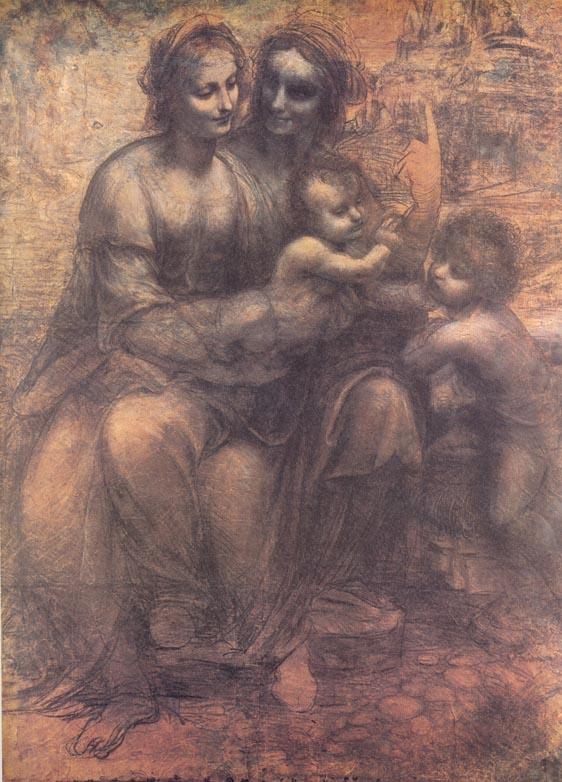
On this day the Church celebrates Saint Joachim and Anne, parents of Mary and grandparents of Jesus. 'The Virgin and Child with St Anne' by Leonardo da Vinci - National Gallery, London

Tuesday, July 25, 2006

Ministry with an attitude

For some ministers, it is all about them: their personality, their ego, their gratification.

For some ministers, it is all about being accepted: by their congregation, by fellow clergy, by the intelligentsia, etc - being careful to say and do nothing that will offend anyone

For ministers of Christ, it should be all about Christ and about the truth.

Different ministers often approach ministry with different attitudes. Today's readings remind us of the attitude that ministers - ordained and lay - should have.

Today's Gospel (Matthew 20:20-28) begins with examples of ambition and resentment: attitudes too common in our communities today.

Then the mother of the sons of Zeb'edee came up to him, with her sons, and kneeling before him she asked him for something. And he said to her, "What do you want?" She said to him, "Command that these two sons of mine may sit, one at your right hand and one at your left, in your kingdom." ...and when the ten heard it, they were indignant at the two brothers.

Our Lord quickly sets everyone straight

You know that the rulers of the Gentiles lord it over them,
and their great men exercise authority over them.

It shall not be so among you;
but whoever would be great among you
must be your servant,
and whoever would be first among you
must be your slave;
even as the Son of man came
not to be served
but to serve,
and to give his life as a ransom for many.

The attitude of anyone who aspires to prominence or greatness as a Christian must therefore be an attitude of service.

Those in leadership positions within the Body of Christ must act as servants.

Likewise, any one of us - lay or ordained, you or I - who may aspire to greatness as a Christian, even private greatness, must also have the attitude of service.

…even as the Son of man came
not to be served
but to serve,
and to give his life as a ransom for many.

This attitude is not simply functional: it is not the simply the function of doing things for other people (although it includes that).

Our Lord hints strongly at this in what he says to the disciples: by referring to his own sacrificial death and in what he says to James and John.

“Are you able to drink the cup that I am to drink?"

They said to him, "We are able."

He said to them, "You will drink my cup...”

Our attitude is not just the simple function of service or service for its own sake.

Our service and our attitude must be bound with the suffering and death of Christ.

The nitty-gritty reality of this is made brutally clear by the Apostle Paul in today's first reading (2 Corinthians 4:7-15):

We are troubled on every side,
yet not distressed;

we are perplexed,
but not in despair;

Persecuted,
but not forsaken;

cast down,
but not destroyed;

Always bearing about in the body

the dying of the Lord Jesus,
that the life also of Jesus

might be made manifest in our body.

For we which live

are always delivered unto death for Jesus' sake,
that the life also of Jesus

might be made manifest in our mortal flesh.

This must be our attitude of service, whether we are exalted leaders or simple congregants within the Body of Christ.

We have this treasure in earthen vessels,
that the excellency of the power
may be of God,
and not of us.

Such must be our attitude: the attitude of ministry, the attitude of anyone who follows Christ.

Embarrassed by Mom

Their mother walked right up to the teacher, in front of all their friends, her sons sheepishly following behind her.

She was straightforward in saying what she wanted: special treatment for her boys.

Her sons looked at the ground, their friends grumbled, but the teacher smiled: a gentle smile with the barest hint of a shadow.

The teacher spoke directly to the sons. There was a serious misunderstanding here. He asked them if they could do something and they said they could.

The teacher now spoke quite solemnly. The specific request was off-limits, but they would get very special treatment.

“The cup that I drink,
you will drink,
and with the baptism with which I am baptized,
you will be baptized.”


On this day we remember St. James the Apostle (a.k.a. James the Greater), the eldest of these two sons, who shared in the suffering of Christ through martyrdom just over a decade after his teacher and Lord.

(from a previous post)

Catholic Carnival

This week's Catholic Carnival - a collection of posts from various Catholic blogs - is online at the rather colorful blog Alabama Improper.

Monday, July 24, 2006

Walk humbly with thy God

The last verse of today's first reading (Micah 6:1-4, 6-8) is perhaps the most beautiful, succinct and comprehensive expression of Old Testament prophecy:

He hath shewed thee, O man,
what is good;
and what doth the LORD require of thee,
but to do justly,
and to love mercy,
and to walk humbly with thy God?

The phrases are elegantly simple.

The requirements are inescapable.

Our relationship with God cannot be something purely ethereal: doing justice is a fundamental requirement. As God is just, so must we be just.

Nor is simple, arithmetic justice enough: we are required to "love mercy". The word translated here as "mercy" is the wonderful Hebrew word "hesed" - God's own mercy, which is tender, kind, and loving. We must be more than just: we must share with others the mercy and loving-kindness God gives to us.

The last phrase of this verse is also simple and yet awe-inspiring:

Walk humbly with thy God.

Like the exhortations to justice and mercy, these are words that we should carry with us every moment of our day: so that we may realize that God is always with us and that we may be humble before him in all we say and do.

Walk humbly with thy God.

They are words that also speak to our lives of meditation and prayer: to keep firmly in mind at every step of our spiritual journey that God is with us and that we must be lowly before him.

Walk humbly with thy God.

They are words that speak to us powerfully as we walk to and from Holy Communion.

Walk humbly with thy God.

But this verse does not stand by itself. Earlier in today's first reading, we hear these challenging words

O my people, what have I done to you,
or how have I wearied you? Answer me!
For I brought you up from the land of Egypt...

Many of us will remember these words being echoed in the Reproaches during the Good Friday Liturgy:

O my people, what have I done to thee?
or wherein have I afflicted thee? Answer me.
Because I led thee out of the land of Egypt,
thou hast prepared a cross for thy Savior.

These reproaches are addressed to each one of us,
for God has done so much for us
and yet we have too often responded to that goodness with sin
- and God's response to our sin is the Cross.

And so, we remember with love,
as well as with grief and repentance for our sins,
the suffering of our Lord and Savior Jesus Christ, the Son of God.

We remember his agony in the garden and his awful scourging.

And we remember Simon of Cyrene
who helped carry the cross of Christ,
walking with the Son of God on the Way of Sorrows.

How blessed indeed Simon of Cyrene was:
to walk humbly with God in such a special way .

Yet you and I are called to this as well.

Then Jesus said to his disciples,
"Whoever wishes to come after me
must deny himself,
take up his cross,
and follow me."
(Matthew 16:24)

In the justice we do
and in the mercy we show,
in the depths of our prayer
and in every moment of our day,
and most of all as we share in the sufferings of Christ,
may we always walk humbly with our God.

Man of Lebanon

He was born in a village high in the mountains of Lebanon.

When he was only three, his father died, having been captured by imperialistic infidels.

As he grew older, his uncle worried about the young man's growing religious fanaticism.

When he was 23, he secretly joined a band of men who were holed up in a mountain stronghold. He would take a Syrian name.

This mysterious man in the black robes would travel little, but people from all over Lebanon and beyond would come to him for direction.

He would suffer a stroke while celebrating Mass and died on Christmas eve in 1898.

He would be beatified at the end of the Second Vatican Council and canonized in 1977.

The memory of Saint Charbel Makhlouf, Maronite priest and hermit, is celebrated by many on this day.

Sunday, July 23, 2006

Praying for Middle East peace

"(G)iven the worsening situation in the Middle East, I convoked a day of prayer and penance for this Sunday, inviting pastors, faithful and all believers to implore from God the gift of peace.

"I strongly renew the appeal to the parties in conflict to adopt a cease-fire immediately and allow the sending of humanitarian aid, so that, with the support of the international community, ways will be found to begin negotiations.

"I take advantage of the opportunity to reaffirm the right of the Lebanese to the integrity and sovereignty of their country, the right of Israelis to live in peace in their state, and the right of Palestinians to a free and sovereign homeland.

"I feel, moreover, especially close to defenseless civilian populations, unjustly stricken in a conflict in which they are no more than victims: both those of Galilee, obliged to live in shelters, as well as the great multitude of Lebanese, who once more, see their country destroyed, and have to leave everything behind to try to save themselves in another place.

"I raise to God a sorrowful prayer so that the aspiration to peace of the great majority of peoples may soon be realized, thanks to the common commitment of those responsible. I also renew my appeal to all charitable organizations to manifest in a practical manner common solidarity with those populations.

"Yesterday we celebrated the feast of St. Mary Magdalene, disciple of the Lord, who plays a principal role in the Gospel. St. Luke presents her among the women who followed Jesus, after having 'been healed of evil spirits and infirmities,' specifying that from her "seven demons had gone out" (Luke 8:2).

"Magdalene would be present under the cross, together with the mother of Jesus and other women. She would discover, on the morning of the first day after the Sabbath, the empty sepulcher, next to which she remained weeping until the risen Jesus appeared to her (cf. John 20:11).

"The story of Mary Magdalene reminds everyone of a fundamental truth: She is a disciple of Christ who, in the experience of human weakness, has had the humility to ask for his help, has been healed by him, and has followed him closely, becoming a witness of the power of his merciful love, which is stronger than sin and death.

"Today we celebrate the feast of St. Bridget, one of the patronesses of Europe, native of Sweden, who lived in Rome and went on pilgrimage to the Holy Land. In this way, she invites us to help humanity to find a great area of peace precisely also in the Holy Land.

"I entrust the whole of humanity to the power of divine love, while I invite all to pray so that the beloved peoples of the Middle East are able to abandon the path of armed confrontation and build, with the boldness of dialogue, a just and lasting peace. May Mary, queen of peace, pray for us!"

Pope Benedict XVI
from today's
Angelus

(translation by Zenit)

Shepherds

I often hesitate when I go to write these reflections. I am so painfully aware of my own imperfections, my own sinfulness, and my own reluctance to do the right thing and put my life on a better track. Who am I to write of godly things?

I am particularly hesitant in writing anything that may be perceived as critical of anyone who serves Christ in the shepherding of his flock

Today's readings, however, can not be ignored: not by me, nor by any shepherd nor by any member of the flock.

Yet, each one of us – you and I – must be careful not to interpret passages of Scripture as only pertaining to other people: in this case, priests, bishops, or other ministers of whom we may think ill – rightly or wrongly.

Each one of us – in ways proper to our respective vocations – are somehow involved in the work of shepherding and therefore each one of us needs to be aware of our own opportunities for improvement.

Each of one of us, therefore, need to hear these prophetic challenges being directed at ourselves, not just "those" shepherds who first pop into our minds.

The first reading (Jeremiah 23:1-6) is particularly blunt:

Woe to the shepherds
who mislead
and scatter the flock of my pasture,
says the LORD.

Therefore, thus says the LORD, the God of Israel,
against the shepherds who shepherd my people:

You have scattered my sheep and driven them away.

You have not cared for them,
but I will take care to punish your evil deeds.

I myself will gather the remnant of my flock
from all the lands to which I have driven them
and bring them back to their meadow;
there they shall increase and multiply.

I will appoint shepherds for them who will shepherd them
so that they need no longer fear and tremble;
and none shall be missing, says the LORD.

Do we - distracted by our own personal issues or preferences (liberal or conservative) - mislead, scatter, or fail to care for God's sheep around us?

Thanks be to God that we have the grace and the great example of the Good Shepherd: our Lord and Savior Jesus Christ, as prophesized by Jeremiah and as described in both today's second reading (Ephesians 2:13-18) and Gospel (Mark 6:30-34).

Whenever we feel angry or frustrated or alienated, thanks be to God that you and I have this wonderful grace and example in Christ:

For he is our peace,
he who made both one
and broke down the dividing wall of enmity,
through his flesh,
abolishing the law
with its commandments and legal claims,
that he might create in himself

one new person in place of the two,
thus establishing peace,
and might reconcile both with God,
in one body, through the cross,
putting that enmity to death by it.

He came and preached
peace to you who were far off
and peace to those who were near,
for through him we both have access
in one Spirit
to the Father.


Whenever we feel overwhelmed, thanks be to God that you and I have this wonderful grace and example in Christ:

He said to them,
"Come away by yourselves to a deserted place
and rest a while."

People were coming and going in great numbers,
and they had no opportunity even to eat.
So they went off in the boat by themselves

to a deserted place.
People saw them leaving

and many came to know about it.
They hastened there on foot from all the towns
and arrived at the place before them.

When he disembarked and saw the vast crowd,
his heart was moved with pity for them,
for they were like sheep without a shepherd;
and he began to teach them many things.


Jesus, loving shepherd, teach us.
Jesus, loving shepherd, calm us.
Jesus, loving shepherd, strengthen us.
Jesus, loving shepherd, draw us close together with you.

Saturday, July 22, 2006

Plots and purpose

In devising reflections on the readings of the day, it is often helpful to try to draw some inspiration from their juxtaposition.

Today's first reading (Micah 2:1-5) deals with evil plots.

The Gospel (John 20:1-2, 11-18) involves Mary Magdalene.

Hmmmm.

I'd have to be a genius like da Vinci to unravel that code.

Seriously, there is at least one simple thread that ties together these readings (and the Responsorial Psalm - 10:1-4, 7-8, 14).

As we hear in the first reading and the Psalm (as well as today's news), the world is often not a safe place. There are evil people who wish to harm others and even to harm us.

But as Mary Magdalene did in today's Gospel, no matter what surprises – good or bad – we may encounter in life, we should hold fast to our purpose: carrying out the command of the Lord.

Mary Magdalene went and announced to the disciples,
"I have seen the Lord,"
and then reported what he told her.

There was something about Mary

something very wrong.

The very best medical care available seemed unable to help her and she went from place to place with no relief.

Finally, she found someone who was able to cure her. She was so grateful that she went to work for him, learning everything she could from him.

Then, in a terrible turn of events, the man who had cured her was arrested on trumped-up charges, found guilty, and executed.

Mary watched him die, one of the few who stayed by him to the end.

Two days later, still overcome with grief, she went to visit his grave, but the body was gone.

Mary ran in panic to her coworkers, but they just came, looked, and left.

Grief now totally overwhelmed Mary and she sobbed uncontrollably.

Through her tears, she saw people around her and she heard them ask why she was crying. One of them seemed to be a landscaper. She hardly knew what to say to them.

Then the "landscaper" called her by her name, "Mary."

Now she saw clearly.

It was him.

It was Jesus.

It was the Lord. He was risen as he had said.

Mary Magdalene was thus the first to see the risen Lord and would be the one to bring the news to the Apostles.

Much later, many strange stories would be told about Mary, but what always remains clear is that she was faithful to the Lord even in the most horrible of circumstances and that she was the first to tell the news of Christ’s resurrection.

The Feast of St. Mary Magdalene is celebrated on this day.

(from an earlier post)

Friday, July 21, 2006

Monastery

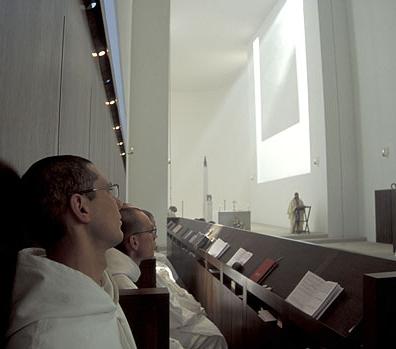
"The monk is a man like all others but that a call of God had torn away from normal life to turn him to the Christ Jesus. Following this supernatural call, he accepts to renounce everything to consecrate himself completely to the Lord Jesus: 'If you want..., go, sell all you possess, then come and follow me.' (Matt. 19, 21)

"This calling is a great mystery, first of all for the monk himself."

from the website of the Cistercian Monastery of Nový Dvùr - a new monastery in the Czech Republic.

(Hat tip: Sed Contra)

How has your day been?

King Hezekiah has about as bad a day as you can get in today's first reading (from Isaiah 38):

In those days,
when Hezekiah was mortally ill,
the prophet Isaiah, son of Amoz,
came and said to him:

"Thus says the LORD:
Put your house in order,
for you are about to die;
you shall not recover."


(At this point, if this were a hit television show, a goofy song would suddenly start playing:

"You had a bad day
You're taking one down
You sing a sad song
just to turn it around")


Hezekiah's bad day, of course, is very bad and the grief of his heart is practically inexpressible, but he does not fatalistically give up or try to ignore his situation: instead, he confronts everything with deep, emotional honesty and – most importantly – with faith.

By the grace of our Lord and Savior Jesus Christ, may you and I confront all of our days – good and bad – with the same emotional honesty in our prayer and with the same unconquerable faith.

"O LORD,
remember how faithfully and wholeheartedly
I conducted myself in your presence,
doing what was pleasing to you!"

And Hezekiah wept bitterly....

"You have folded up my life,
like a weaver who severs the last thread.

"Day and night you give me over to torment;
I cry out until the dawn.

"Like a lion he breaks all my bones;
(day and night you give me over to torment).

"Like a swallow I utter shrill cries;
I moan like a dove.

"My eyes grow weak,
gazing heavenward:
O Lord, I am in straits;
be my surety!

* * * * * * *

"You have preserved my life
from the pit of destruction,
When you cast behind your back all my sins.

"For it is not the nether world that gives you thanks,
nor death that praises you;
Neither do those who go down into the pit
await your kindness.

"The living, the living give you thanks,
as I do today.

"Fathers declare to their sons, O God,
your faithfulness.

"The LORD is our savior;
we shall sing to stringed instruments
In the house of the LORD
all the days of our life."

The Preacher

Lawrence was a famous preacher, with a deep knowledge of Scripture in its original languages, who performed miracles and was often (as popularly described today) "slain in the Spirit."

He was so well respected that he was invited to speak at churches and great events even before he was ordained a priest. He converted many.

Not just a "talker," he was a capable administrator and would serve in the highest offices of his Capuchin order. He was also skilled in diplomacy and geopolitics.

Perhaps the most cinematic moment of his career was when he personally led an army against a host of invaders, riding in his Capuchin habit on horseback and armed with only a crucifix.

He was also a deep contemplative, falling regularly into ecstasy during the celebration of Mass.

When he was old and sick, he was begged to leave his monastery in his native Italy for an important diplomatic mission. He performed the mission, but was too sick to return. St. Lawrence of Brindisi died in Lisbon July 22, 1619 and his memory is celebated on this day.

(adapted from an earlier post)

Thursday, July 20, 2006

Over-thinking

Sometimes we do not think deeply or carefully enough about things.

Sometimes we "over-think," especially when we come before the Lord in prayer.

Perhaps today is one of those times when we should come before the Lord in prayer and simply let his words from today's Gospel (Matthew 11:28-30) wash over us, again and again:

"Come to me,
all you who labor
and are burdened,
and I will give you rest.

"Take my yoke upon you
and learn from me,
for I am meek
and humble of heart;
and you will find rest for yourselves.

"For my yoke is easy,
and my burden light."

The bishop was not popular

Several times he was physically attacked, coming close to death more than once, and thrown out of town.

This went on for nearly 25 years, but the bishop always came back.

So they killed him.

Just as they had killed his old friend, the bishop who had sent him to that city.

Just as they had killed the one who had personally sent his old friend: the Lord Jesus Christ.

The memory of St. Apollinaris - martyr, bishop of Ravenna, and friend of St. Peter the Apostle - is celebrated on this day.

(adapted from an earlier post)

Wednesday, July 19, 2006

Christian Carnival

This week's Christian Carnival - an ecumenical collection of posts from various Christian blogs - is online at The Evangelical Ecologist.

Scientist speaks out

A renowned scientist, whose work has been under fire from politicians and religious groups, defended himself and his work.

Scientists should be guided by science, not theology, he said.

While no actual cures have yet resulted from his research, it held great promise and would certainly benefit society in the long run, he insisted.

These things are not fully human anyway and are already slated for destruction, he remarked. Why not put them to good use?

Dr. Mengele then returned to his work.


(May we all pray for those tempted by easy paths and may we pray and work to help all those who suffer.)

Who would we rather be?

Today's readings offer quite a contrast.

In the first reading (Isaiah 10:5-7, 13b-16), we have a flagrant display of arrogance and power.

For he says:
"By my own power I have done it,
and by my wisdom, for I am shrewd.
I have moved the boundaries of peoples,
their treasures I have pillaged,
and, like a giant, I have put down the enthroned.
My hand has seized like a nest
the riches of nations."

But in the Gospel (Matthew 11:25-27), our Lord says,

I give praise to you, Father, Lord of heaven and earth,
for although you have hidden these things
from the wise and the learned
you have revealed them to the childlike.


Yes, Father, such has been your gracious will.

All things have been handed over to me by my Father.
No one knows the Son except the Father,
and no one knows the Father except the Son
and anyone to whom the Son wishes to reveal him.

This contrast is repeated by our Lord's blessed mother in her Magnificat (Luke 1:50-52):

He has mercy on those who fear him
in every generation.

He has shown the strength of his arm,
he has scattered the proud in their conceit.

He has cast down the mighty from their thrones,
and has lifted up the lowly.

Who would we rather be?

How should we live?

How should we pray?

Tuesday, July 18, 2006

Catholic Carnival

This week's Catholic Carnival - a collection of posts from various Catholic blogs - is online at A Song Not Scored For Breathing.

The Outsiders

It is amazing how the readings set by a Lectionary cycle for a particular day can sometimes resonate so well with the news that day.

Today's news is dominated by a bloody conflict between the Jerusalem-based Jewish government and Syrian-backed forces based in Lebanon.

In today's first reading (Isaiah 7:1-9), the Jerusalem-based Jewish government is being attacked by Syria ("Aram" in some translations) and its allies.

In today's Gospel (Matthew 11:20-24), our Lord compares the Lebanese cities of Tyre and Sidon favorably to the Galilean towns of Chorazin and Bethsaida.

Woe unto thee, Chorazin!
woe unto thee, Bethsaida!
for if the mighty works, which were done in you,
had been done in Tyre and Sidon,
they would have repented long ago
in sackcloth and ashes.
But I say unto you,
It shall be more tolerable for Tyre and Sidon
at the day of judgment,
than for you.

These readings, of course, provide much more than just coincidences of history and geography, they also offer us opportunities for reflection about ourselves and "outsiders."

First, we can sometimes be quite fearful of outsiders. In the passage from Isaiah, news of the alliance against them disturbs the leaders and people of Jerusalem "as the trees of the wood are moved with the wind."

The word of the Lord in response to this threat is comforting:

Take heed, and be quiet;
fear not, neither be fainthearted...

But the word of the Lord is also challenging:

If ye will not believe,
surely ye shall not be established.


We must be prudent and careful in this dangerous world, but ultimately nothing can save us if we are not firm in our faith. Threats from outside are ultimately not as dangerous as weaknesses in our relationship with God.

(Sidebar: The matter of external versus internal threats was famously addressed by a young Abraham Lincoln: "At what point shall we expect the approach of danger? By what means shall we fortify against it? Shall we expect some transatlantic military giant, to step the Ocean, and crush us at a blow? Never! All the armies of Europe, Asia and Africa combined, with all the treasure of the earth (our own excepted) in their military chest; with a Buonaparte for a commander, could not by force, take a drink from the Ohio, or make a track on the Blue Ridge, in a Trial of a thousand years. At what point then is the approach of danger to be expected? I answer, if it ever reach us, it must spring up amongst us." Address to the Young Men’s Lyceum of Springfield, Illinois - January 27, 1838)

Again, we must be prudent and careful in this dangerous world, but ultimately nothing can save us if we are not firm in God.

Second, we as Christians dare not be haughty when it comes to outsiders.

We may have been chosen in Christ and given the gift of the Holy Spirit, but we can easily take for granted what God in his grace has given us. Moreover, as our Lord says in Luke 12:28, "For unto whomsoever much is given, of him shall be much required."

I say unto you,
It shall be more tolerable for Tyre and Sidon
at the day of judgment,
than for you.

No matter what happens, within our lives or in the world outside, we should be neither haughty nor fearful, but rather we must be always repentant and always drawing nearer to our Lord and Savior Jesus Christ.

Monday, July 17, 2006

God will not listen to you

The words of the Lord in today's first reading (Isaiah 1:10-17) can hit us like a kick in the chest.

When you spread out your hands,
I close my eyes to you;
Though you pray the more,
I will not listen.


This seems to strike particularly at those of us who focus our efforts on perfection in worship, either through Charismatic Renewal ("When you spread out your hands, I close my eyes to you") or through restoration of traditional worship ("your incense is loathsome to me").

God, of course, is not discouraging prayer: the problem is not attentiveness to matters of worship but rather inattention to matters of morality.

If our prayer life is not as good as we would like it (God knows that mine is not), perhaps we need to do more than just devote more time or try new techniques: perhaps we need to reexamine our consciences more deeply, get rid of our sinful or slothful habits, be more concerned about justice for others, and beg for the grace of the Lord.

When you spread out your hands,
I close my eyes to you;
Though you pray the more,
I will not listen.

Your hands are full of blood!
Wash yourselves clean!
Put away your misdeeds from before my eyes;
cease doing evil; learn to do good.
Make justice your aim: redress the wronged,
hear the orphan's plea, defend the widow.

Come now, let us set things right, says the LORD:
Though your sins be like scarlet,
they may become white as snow;
Though they be crimson red,
they may become white as wool.

If you are willing, and obey,
you shall eat the good things of the land;
But if you refuse and resist,
the sword shall consume you:
for the mouth of the LORD has spoken!


Let us pray and let us do.

Sunday, July 16, 2006

This was not my idea

In today's first reading (Amos 7:12-15), Amos is persecuted for being a prophet.

Amos responds frankly (and with a hint of exasperation), essentially telling the king, "Look, this wasn't MY idea."

"I was no prophet,
nor have I belonged to a company of prophets;
I was a shepherd and a dresser of sycamores.
The LORD took me from following the flock, and said to me,
Go, prophesy to my people Israel."

Amos did not chose himself, God chose him.

It was not Amos' idea nor his own effort, it was the grace of God.

So also has God chosen us, as we hear in today's glorious second reading (Ephesians 1:3-14):

Blessed be the God and Father
of our Lord Jesus Christ,
who has blessed us in Christ
with every spiritual blessing in the heavens,
as he chose us in him,
before the foundation of the world,
to be holy and without blemish before him.

In love he destined us
for adoption to himself through Jesus Christ,
in accord with the favor of his will,
for the praise of the glory of his grace
that he granted us in the beloved.

In him we have redemption by his blood,
the forgiveness of transgressions,
in accord with the riches
of his grace that he lavished upon us.

In all wisdom and insight,
he has made known to us
the mystery of his will
in accord with his favor
that he set forth in him
as a plan for the fullness of times,
to sum up all things in Christ,
in heaven and on earth.

In him we were also chosen,
destined in accord with the purpose
of the One who accomplishes all things
according to the intention of his will,
so that we might exist for the praise of his glory,
we who first hoped in Christ.

In him you also,
who have heard the word of truth,
the gospel of your salvation,
and have believed in him,
were sealed with the promised holy Spirit,
which is the first installment of our inheritance
toward redemption as God's possession,
to the praise of his glory.

As we strive to live out our vocations as Christians and express our faith, we may often be challenged by others, "Who are you to say what is right and wrong? Why can't you just change your ideas to fit in with the rest of us?"

We did not invent right and wrong. These are not our ideas. We did not make them up and we did not chose ourselves to be messengers.

The LORD took us from following the world's flock of sheep, and he said to us,
Go, prophesy...

As we hear in today's Psalm (Psalm 85:9-14):

I will hear what God proclaims;
the LORD - for he proclaims peace.
Near indeed is his salvation to those who fear him,
glory dwelling in our land.

Kindness and truth shall meet;
justice and peace shall kiss.
Truth shall spring out of the earth,
and justice shall look down from heaven.

The LORD himself will give his benefits;
our land shall yield its increase.
Justice shall walk before him,
and prepare the way of his steps.

Saturday, July 15, 2006

Compendium ONLINE

The full text of the English translation of the Compendium of the Catechism of the Catholic Church is now available online at the Vatican website.

An excellent resource indeed.

(Hat tip: Pontifications)