A Penitent Blogger

Mindful of my imperfections, seeking to know Truth more deeply and to live Love more fully.

Quid sum miser tunc dicturus? Quem patronum rogaturus? Cum vix iustus sit securus?
Recordare, Iesu pie, Quod sum causa tuae viae: Ne me perdas illa die...

Wednesday, May 31, 2006

Hang out with the losers

Quite often in our lives - at school, at work or in other social situations - we often fear to be seen with people who are not popular or generally thought to be "losers."

In one of the passages provided for today’s first reading (Romans 12:9-16), St. Paul exhorts us to do just that: to "associate with the lowly."

Worldly people push and scheme to associate themselves with people who are seen as successful, rich and/or powerful in the things of this passing world.

Followers of Christ strive to associate themselves with people who may be losers in the eyes of the world but who aspire to be successful, rich and powerful in the love of God and the everlasting beatitude of the world without end.

Ut veniat mater Domini mei ad me

When Elizabeth heard Mary's greeting,
the infant leaped in her womb,
and Elizabeth, filled with the Holy Spirit,
cried out in a loud voice and said,
"Most blessed are you among women,
and blessed is the fruit of your womb.
And how does this happen to me,
that the mother of my Lord should come to me?"
(Luke 1:41-43)

Et factum est,
ut audivit salutationem Mariae Elisabeth,
exsultavit infans in utero eius,
et repleta est Spiritu Sancto Elisabeth
et exclamavit voce magna et dixit:
"Benedicta tu inter mulieres,
et benedictus fructus ventris tui.
Et unde hoc mihi,
ut veniat mater Domini mei ad me?"


Today the Church celebrates
the Feast of the Visitation of the Blessed Virgin Mary.

Catholic Carnival

This week's Catholic Carnival - a collection of posts from various Catholic blogs - is online at Living Catholicism.

Tuesday, May 30, 2006

Hating goodbyes

In today's first reading (Acts 20:17-27), St. Paul bids farewell to the elders (presbyters) of the church in the area of Ephesus.

It is a dramatic leave-taking, centered on Paul's frank statement that they would not see him again. The reaction of the elders would be severely emotional (as recounted at the end of the chapter - verses 37-38b).

And they all wept sore,
and fell on Paul's neck, and kissed him,

Sorrowing most of all
for the words which he spake,
that they should see his face no more.

Most of us do not want to have goodbyes like this. "I hate goodbyes," some say. We do not want to experience the pain of parting, of loss, and the knowledge that a special loved one will never be physically in our lives again.

Yet there are worse pains to dread and infinitely worse goodbyes to avoid.

Paul knows this and so he stands before his friends clear-eyed and totally focused on the path Christ has laid before him in this world.

Paul looks back at the path behind him, at his ministry among the people of Ephesus, secure in his faithfulness to the Lord. Paul also looks at the path ahead and the afflictions that abide there for him, secure in the Lord's faithfulness to him.

We need to pray always for the grace of that security, the security of our Lord and Jesus Christ by the power of the Holy Spirit, so that we may fear neither goodbyes nor afflictions, but may always be faithful in serving Christ, his truth, and our brothers and sisters in the Lord.

Monday, May 29, 2006

Isolation

The world sometimes seems an increasingly hostile place for people who take their Christian faith seriously and feel ever more isolated: governments try to force people to do or pay for things that are immoral, movies tell vicious lies about Christ and Christians, and enticements to hedonism surge higher and higher around us.

Sometimes we even feel isolated from our brothers and sisters in the Lord. In our parishes and in cyberspace we too often tend to scatter to our own home (to borrow a phrase from today's GospelJohn 16:29-33): staying within the liturgical, theological, and devotional niche we have situated ourselves.

Our Lord's subtle reproach to his fleeing followers should remind us on the need for us not to let ourselves be scattered, but to unite as closely as possible to strengthen each other and to accomplish great things in the name of Jesus amid a darkening world.

Our Lord also gives us words of comfort: words that pierce the gloom of even the deepest isolation or most intimidating environments:

But I am not alone,
because the Father is with me.

I have told you this
so that you might have peace in me.

In the world you will have trouble,
but take courage,
I have conquered the world.

Sunday, May 28, 2006

The three things

Today's Gospel (John 17:11b-19) and second reading (1 John 4:11-16) tell us wonderful things for our Christian lives, most especially as our Lord prays over his followers:

Consecrate them in the truth.
Your word is truth.

As you sent me into the world,
so I sent them into the world.

And I consecrate myself for them,
so that they also may be consecrated in truth.

St. John speaks more of what this means in the second reading:

Whoever acknowledges
that Jesus is the Son of God,
God remains in him
and he in God.

We have come to know
and to believe
in the love God has for us.

God is love,
and whoever remains in love
remains in God
and God in him.

There are three things for us to remember especially from these readings about our lives as Christians, about living in God while still in this world:

  • Consecration: living as people set apart and dedicated to God, whatever our walk of life.
  • Love: living as much as we can the same self-sacrificial love God has shown us in Christ.
  • Truth: living explicitly as Christians, living the commandments and standing up for the truth about Christ.

These are truly good things to keep firmly in our minds as we go through all of the events and challenges of our life this week, guidelines for every moment of our lives:

Consecration

Love

Truth

Saturday, May 27, 2006

Having a talk with the preacher

Today's first reading (Acts 18:23-28) features a man named Apollos, a gifted and highly motivated speaker who knows Scripture well and who speaks "accurately about Jesus."

But then, a man and his wife in the crowd "took him aside and explained to him the Way of God more accurately."

This reminds us of the value of dialogue among ourselves as brothers and sisters in the Lord.

Apollos was not wrong in what he was saying, only incomplete. Priscilla and Aquila approached and spoke with him with courtesy and charity.

So too should each of us should have the humility and charity to accept input about the things of the Lord from our sisters and brothers in the Lord.

Likewise each of us should have the care to offer input to our brothers and sisters in the Lord about the things of the Lord - always with extreme charity, courtesy and humility.

In the name of Jesus

(Adapted from an earlier post)

In today's Gospel (John 16:23b-28), our Lord says

"Amen, amen, I say to you,
whatever you ask the Father in my name
he will give you."


That is an exhilarating promise.

For many of us, however, this verse (and others like it) may have seemed to set us up for disappointment, because we thought it was magic: just use his name and - ZAP - it happens... except when it doesn't.

Make no mistake: the holy name of our Lord and Savior Jesus Christ is all-powerful, we need to pray in the name of Jesus, and the Lord is true to his promises.

But this is not magic - it is far greater.

"I have told you this in figures of speech.

"The hour is coming
when I will no longer speak to you in figures
but I will tell you clearly about the Father.

"On that day you will ask in my name,
and I do not tell you that I will ask the Father for you.

"For the Father himself loves you,
because you have loved me
and have come to believe that I came from God."

Praying in the name of Jesus means something far greater than just pronouncing particular syllables: it involves an ever-deepening relationship with God - Father, Son, and Holy Spirit.

"Ask and you will receive,
so that your joy may be complete."

He did what the Pope could not

He was not a missionary, he was the Pope, but there was a missionary endeavor that called to his heart.

He was not a missionary, he was a monk, but when the Pope chose him to lead this missionary endeavor in his place, he could not refuse.

In the end, after many adventures and challenges, the missionary effort was successful and this monk became the first bishop of what would become a one of the world’s most famous archbishoprics.

St. Augustine of Canterbury, sent by Pope St. Gregory the Great to be Apostle of England, died 1401 years ago yesterday and his memory is celebrated on this day.

(adapted from an earlier post)

Friday, May 26, 2006

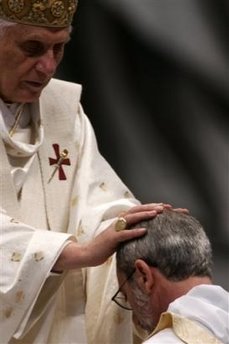
Words from the Pope to Priests

"Today I am meeting you, priests called by Christ to serve him in the new millennium. You have been chosen from among the people, appointed to act in relation to God, to offer gifts and sacrifices for sins.

"Believe in the power of your priesthood! By virtue of the sacrament, you have received all that you are.

"When you utter the words 'I' and 'my' ('I absolve you ... This is my body ...'), you do it not in your own name, but in the name of Christ, 'in persona Christi', who wants to use your lips and your hands, your spirit of sacrifice and your talent.

"At the moment of your ordination, through the liturgical sign of the imposition of hands, Christ took you under his special protection; you are concealed under his hands and in his Heart.

"Immerse yourselves in his love, and give him your love!

"When your hands were anointed with oil, the sign of the Holy Spirit, they were destined to serve the Lord as his own hands in today's world. They can no longer serve selfish purposes, but must continue in the world the witness of his love.

"The greatness of Christ's priesthood can make us tremble.

"We can be tempted to cry out with Peter: 'Lord, depart from me, for I am a sinful man' (Lk 5:8), because we find it hard to believe that Christ called us specifically.

"Could he not have chosen someone else, more capable, more holy?

"But Jesus has looked lovingly upon each one of us, and in this gaze of his we may have confidence.

"Let us not be consumed with haste, as if time dedicated to Christ in silent prayer were time wasted. On the contrary, it is precisely then that the most wonderful fruits of pastoral service come to birth. There is no need to be discouraged on account of the fact that prayer requires effort, or because of the impression that Jesus remains silent. He is indeed silent, but he is at work.

"In this regard, I am pleased to recall my experience last year in Cologne. I witnessed then a deep, unforgettable silence of a million young people at the moment of the Adoration of the Blessed Sacrament! That prayerful silence united us, it gave us great consolation. In a world where there is so much noise, so much bewilderment, there is a need for silent adoration of Jesus concealed in the Host. Be assiduous in the prayer of adoration and teach it to the faithful. It is a source of comfort and light particularly to those who are suffering.

"The faithful expect only one thing from priests: that they be specialists in promoting the encounter between man and God.

"The priest is not asked to be an expert in economics, construction or politics. He is expected to be an expert in the spiritual life. With this end in view, when a young priest takes his first steps, he needs to be able to refer to an experienced teacher who will help him not to lose his way among the many ideas put forward by the culture of the moment. In the face of the temptations of relativism or the permissive society, there is absolutely no need for the priest to know all the latest, changing currents of thought; what the faithful expect from him is that he be a witness to the eternal wisdom contained in the revealed word.

"Solicitude for the quality of personal prayer and for good theological formation bear fruit in life. Living under the influence of totalitarianism (in Poland) may have given rise to an unconscious tendency to hide under an external mask, and in consequence to become somewhat hypocritical. Clearly this does not promote authentic fraternal relations and may lead to an exaggerated concentration on oneself.

"In reality, we grow in affective maturity when our hearts adhere to God. Christ needs priests who are mature, virile, capable of cultivating an authentic spiritual paternity. For this to happen, priests need to be honest with themselves, open with their spiritual director and trusting in divine mercy.

"On the occasion of the Great Jubilee, Pope John Paul II frequently exhorted Christians to do penance for infidelities of the past. We believe that the Church is holy, but that there are sinners among her members. We need to reject the desire to identify only with those who are sinless. How could the Church have excluded sinners from her ranks? It is for their salvation that Jesus took flesh, died and rose again. We must therefore learn to live Christian penance with sincerity. By practising it, we confess individual sins in union with others, before them and before God.

"Yet we must guard against the arrogant claim of setting ourselves up to judge earlier generations, who lived in different times and different circumstances. Humble sincerity is needed in order not to deny the sins of the past, and at the same time not to indulge in facile accusations in the absence of real evidence or without regard for the different preconceptions of the time.


"Moreover, the confessio peccati, to use an expression of Saint Augustine, must always be accompanied by the confessio laudis - the confession of praise. As we ask pardon for the wrong that was done in the past, we must also remember the good accomplished with the help of divine grace which, even if contained in earthenware vessels, has borne fruit that is often excellent....

*****

"Stand firm in your faith!

"To you too I entrust this motto of my pilgrimage. Be authentic in your life and your ministry.

"Gazing upon Christ, live a modest life, in solidarity with the faithful to whom you have been sent.

"Serve everyone; be accessible in the parishes and in the confessionals, accompany the new movements and associations, support families, do not forget the link with young people, remember the poor and the abandoned.

"If you live by faith, the Holy Spirit will suggest to you what you must say and how you must serve. You will always be able to count on the help of her who goes before the Church in faith. I exhort you to call upon her always in words that you know well: 'We are close to you, we remember you, we watch.'

"My Blessing upon all of you!"


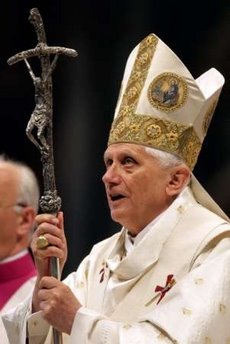
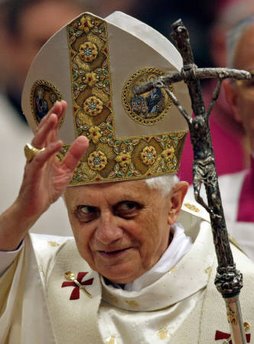
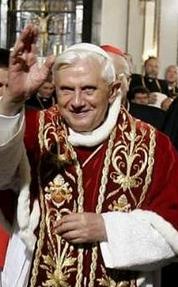
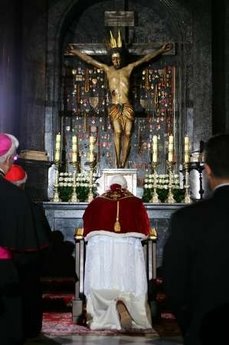
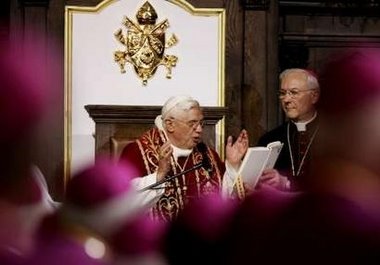
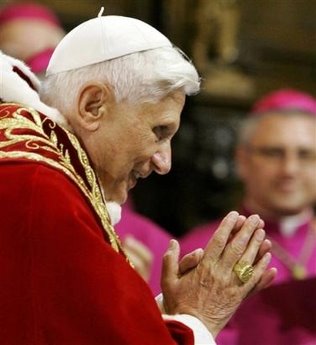
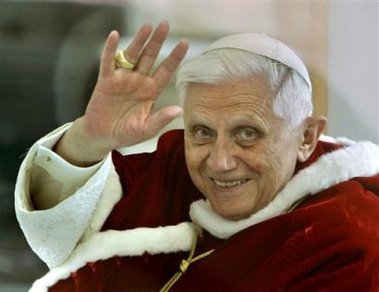
(excerpts and photographs from Pope Benedict XVI's address to clergy in the Warsaw Cathedral yesterday, May 25, 2006)

You will not remember this pain

Physical pain.

The pain of losing someone you love.

The pain of disappointment.

The pain of loneliness.


These are some of the pains we sometimes suffer and may often fear.

To turn aside these pains we may do things even more hurtful to ourselves and others, such as take illegal drugs, abuse medications or alcohol, leap into relationships out of desperation, or even try to destroy God's gift of life.

In today's Gospel (John 16:20-23), our Lord and Savior Jesus Christ, mindful of our pains and sorrows, gives us words of encouragement: that when the Lord comes for us the grief and pain of his faithful ones will become unconquerable joy and that we will have the answers to all our questions and the fulfillment of everything we seek in Christ.

Amen, amen, I say to you,
you will weep and mourn,
while the world rejoices;
you will grieve,
but your grief will become joy.

When a woman is in labor,
she is in anguish
because her hour has arrived;
but when she has given birth to a child,
she no longer remembers the pain
because of her joy
that a child has been born into the world.

So you also are now in anguish.

But I will see you again,
and your hearts will rejoice,
and no one will take your joy away from you.

On that day
you will not question me about anything.
Amen, amen, I say to you,
whatever you ask the Father
in my name
he will give you.

The teenager came to the city with no cash

Philip had left behind his family, his job, and a promising future.

He got a position as a tutor that included room and board. When he was not tutoring, he spent his time praying, reading, and sharing his faith with people on the street.

Many of those he met on the street would also dedicate themselves to the service of God. Some stayed with him, others entered religious orders. Philip sometimes thought about becoming a missionary or a hermit, but he was convinced that the city itself would be for him both mission territory and a hermitage.

In time, he became a priest and gathered a religious community around him that focused on prayer, preaching, and music. His community was known as the Congregation of the Oratory and would be associated with a form of musical presentation known as the "oratorio."

St. Philip Neri died in Rome 411 years ago tomorrow and his memory is celebrated on this day. Congregations of the Oratory can be found in many places, from Pittsburgh to South Africa and most famously the Oratory that Cardinal John Henry Newman founded at Birmingham, England.

(adapted from an earlier post)

Thursday, May 25, 2006

Christian Carnival

This week's Christian Carnival - an ecumenical collection of posts from various Christian blogs - is online at Wittenberg Gate (the originally scheduled "ChristWeb" website had a technical issue).

Unity from above

In one of the selections available for the second reading (Ephesians 4:1-13) on the Solemnity of the Ascension (celebrated in many places today), St. Paul points to the Ascension as he exhorts the Ephesians to be united rather than divided.

"(....he who also ascended far above all the heavens,
that he might fill all things.)

"And his gifts were that some should be apostles,
some prophets, some evangelists,
some pastors and teachers,
to equip the saints for the work of ministry,
for building up the body of Christ,
until we all attain
to the unity
of the faith and of the knowledge of the Son of God,
to mature manhood,
to the measure
of the stature of the fullness of Christ...."

It is easy to get caught up in the natural rivalries and jealousies that affect all human beings, to tear at each other and alienate each other, even those ostensibly bound together in love as members of the body of Christ.

It is important for us to keep our eyes on Christ (far above the pettiness that can entrap us), to be grateful for the often very different gifts he has given to each of us, and for each of us to use well the gifts we have received for the building up of the body of Christ - for the love of God and one another.

Blogging priest killed on vacation

Fr. Todd Reitmeyer, a priest of the Diocese of Sioux Falls and blogger, was killed on a personal watercraft yesterday while on vacation in Texas (news coverage of the accident here).

Eternal rest grant unto him, O Lord.

(Hat tip: Amy Welborn)

Ascension

Ascension - Rembrandt - Alte Pinakothek, Monaco

Wednesday, May 24, 2006

Areopagite Idol

St. Paul the Apostle's voice rose in power and intensity.

"God has overlooked the times of ignorance,
but now he demands
that all people everywhere repent
because he has established
a day on which he will 'judge the world with justice'
through a man he has appointed,
and he has provided confirmation for all
by raising him from the dead."


A man sitting in the front spoke up.

"I dunno, dawg, it was kinda pitchy for me."

A woman seated next to him said, "I think what may be pitchy for you is the essence of who Paul is." (Everyone looked confused for a moment.)

A sour-looking man next to the woman then spoke to Paul brusquely.

"It was ghastly."

An unshaven man with a bright smile then walked to Paul and said, "We should like to hear you on this some other time."

*******

St. Paul's preaching to the pagan intellectuals at the Areopagus of Athens, as recounted in today's first reading (Acts 17:15,22-18:1), is sometimes interpreted as less than a complete success, and yet it bore fruit: one of those converted that day, Dionysius, went on to become the bishop of this prestigious city.

It was a daunting task, standing up to an entrenched intelligentsia on their own hallowed ground, but Paul had the courage, the insight, and the grace to do it.

It encourages us not to be afraid to stand up for the faith against the intelligentsia and de facto pagans of our own day (taking care to seek the insight and the grace needed for such opportunities).

An important point to remember is what underlies St. Paul's words to the Athenians: that even the most highly educated and intellectually gifted people may be, on some deep level, essentially ignorant of the true content of faith.

We need to be careful, to develop all the insight we can, to seek the grace from God we need, and to be unafraid in speaking the truth of our Lord and Savior Jesus Christ.

Tuesday, May 23, 2006

Catholic Carnival

This week's Catholic Carnival - a collection of posts from various Catholic blogs - is online at Musings from a Catholic Bookstore.

The Incarnation and beyond

In the beginning was the Word,
and the Word was with God,
and the Word was God....

And the Word was made flesh,
and dwelt among us....

(John 1:1,14)

The center of our faith is the Incarnation: our Lord and Savior Jesus Christ, true God and true man.

The most perfect and complete revelation of God actually entered human history walked on the earth among us.

That which was from the beginning,
which we have heard,
which we have seen with our eyes,
which we have looked upon,
and our hands have handled,
of the Word of life;

(For the life was manifested,
and we have seen it,
and bear witness,
and shew unto you
that eternal life,
which was with the Father,
and was manifested unto us;)

That which we have seen and heard
declare we unto you...
(1 John 1:1-3a)

And yet in today's Gospel (John 16:5-11), during those truly wondrous days while our Lord was still here - sitting with his disciples, looking them in the eye, and telling them unimaginable things - he says this:

I tell you the truth;
It is expedient for you
that I go away....

The disciples were already quite overwhelmed when our Lord says this ("sorrow hath filled your heart"), so it is not surprising that no immediate reaction to our Lord's words is recorded here, but one can easily imagine their distress and the bewilderment. How could it be "expedient" to have the Lord "go away"?

It is more than just the perspective of distance: the fact that human beings often find it difficult to grasp or appreciate fully people and events while they are still present, that the reality sinks in only when it is past. It is much more than that.

If I go not away,
the Comforter will not come unto you;
but if I depart,
I will send him unto you.

Our Lord makes it clear that his departure is a prerequisite for the coming of the Holy Spirit. Why should this be so? The most fundamental reason is that our Lord's "going away" involves his death and resurrection: the central and pivotal event of history, of revelation and of salvation.

Another reason involves a challenge that human beings have in confronting the mystery of the Incarnation: it is hard for finite sensate creatures such as ourselves to appreciate that a man whom we see walking down the street, whose voice we hear, with whom we shake hands, and who stays pretty close to home in a relatively small country, that this man is God - transcendent, omnipotent, omnipresent, and eternal.

Stupid creatures that we are, Christ's divinity in a sense becomes easier for us to appreciate - without denying or taking away any of his human nature - when he has ascended into heaven to sit at the right hand of the Father.

Even Christ's Ascension, however, is not enough in itself to prove his divinity: ultimately it is the Holy Spirit that enables us to grasp the truth of who Christ is and what Christ has done.

That is one of the reasons St. Paul says in 1 Corinthians 12:3 "that no man can say that Jesus is the Lord, but by the Holy Ghost."

And thus do we come to understand more of what our Lord says in today's Gospel:

Nevertheless I tell you the truth;
It is expedient for you
that I go away:
for if I go not away,
the Comforter will not come unto you;
but if I depart,
I will send him unto you.

And when he is come,
he will reprove the world of sin,
and of righteousness,
and of judgment:
Of sin,
because they believe not on me;
Of righteousness,
because I go to my Father,

and ye see me no more;
Of judgment,
because the prince of this world is judged.

Sometimes you and I may daydream about how wonderful it would have been for us to have seen our Lord and Savior Jesus Christ before his Ascension, to have heard his voice with our own ears, and perhaps even to have touched the hem of his garment.

Yet it is much more expedient for us - indeed, how blessed we are - that Christ has ascended to the Father and has given us of his Holy Spirit, that by his grace we may know more fully who Christ is and what he has done.

As our Lord said after his resurrection:

Thomas,
because thou hast seen me,
thou hast believed:


blessed are they that have not seen,
and yet have believed.

Monday, May 22, 2006

Murdering for God

The hour is coming
when everyone who kills you
will think he is offering worship to God.


These words from today's Gospel (John 15:26-16:4a) are chilling in this post-September 11th world.

We remember too well the audio recording of hijackers shouting the praise of God as they purposefully flew a jetliner full of passengers into the ground.

Some have seized upon September 11th and other horrific instances of terrorism as a way to impugn all those who take religion seriously.

As baseless and tired a canard as this is, enemies of religion hysterically keep repeating it. One character in a newly released movie puts it this way: "As long as there has been one true God, there has been killing in his name."

This trite intellectual laziness overlooks the tens of millions killed by atheists in the twentieth century alone, not to mention the countless massacres perpetrated by polytheists and by irreligious tyrants throughout the history of the world.

People kill people and they will misuse anything they can to do it: even religion.

I have told you this
so that you may not fall away....

I have told you this
so that when their hour comes
you may remember that I told you.

Our Lord's words in today's Gospel are a reminder for us to be prepared for opposition.

This opposition takes many forms. Sometimes it is explicit, murderous persecution (murdering for God in the sense of killing believers for their faith in God).

Sometimes it is the subtle path of manipulation: to make us forsake, dilute, or misuse the true faith (even to the point of leading people to do terrible things - even murder - for God, however falsely).

How do we prepare for this opposition (for persecution or for manipulation)? Christ tells us how in today's Gospel.

First, we prepare for opposition (for persecution or for manipulation) by remembering what our Lord and Savior Jesus Christ has told us, that is, by studying the deposit of faith diligently. Vague memories of catechism classes are often insufficient to prepare us for the specious arguments of the glib.

Most importantly, however, we prepare for opposition (for persecution and for manipulation) by the grace of God, by the gift of the Holy Spirit, and by staying close to the Lord in prayer and Sacrament.

When the Advocate comes
whom I will send you from the Father,
the Spirit of truth
who proceeds from the Father,
he will testify to me.

And you also testify,
because you have been with me
from the beginning.


"Murdering for God" is the battle cry of persecutors and manipulators of the true faith.

May we be prepared against these things by the wisdom and the grace of God.

A battered wife

Rita got married very young and she had two sons, but it was far from a happy marriage.

Rita's husband was an angry, abusive man and she suffered with him for 18 years.

He was also involved in a situation that was a cross between a long-running political feud and gang warfare, which eventually led to his being murdered.

Death followed soon after for Rita's sons as well.

Rita then entered the religious life, at the age of 36.

She would live a life of penance, prayer, charity and peacemaking for 40 years.

St. Rita of Cascia died at the Augustinian convent at Cascia, Italy, on this very day 549 years ago.

Sunday, May 21, 2006

How to remain in love

The spark is gone.

The flame has gone out.

The passion has cooled.

These are the clichés of an ebbing relationship.

This diminishment of feeling happens not only in romantic relationship: it can happen in our relationship with God as well.

Some of us have times in our relationship with God when we really feel the fire of the Holy Spirit: we have the enthusiasm, the energy, the excitement, and the passion for everything that is of God.

We pray all the time; we go to Church and fellowship every chance we get; we read Scripture and the writings of saints constantly; we play religious music loudly in our cars; we keep religious programming on our television constantly; we volunteer for every opportunity for Christian service or witness; and we make plans to enter the seminary or embrace the consecrated life or establish the most powerfully Christian family since Jesus, Mary and Joseph.

And then... somewhere along the line... things grow cool or even cold.

We no longer feel overflowing with love.

In today's Gospel (John 15:9-17), our Lord gives us the simplest and most perfect answers for remaining in love.

The first answer is that love ultimately cannot be sustained by human interest and willpower alone: truly everlasting love comes from God and through Christ.

As the Father loves me,
so I also love you.

Remain in my love.

The second answer is that love is more than just a feeling or a passive gift: it thrives and remains only when it is lived and when it is lived truly – that is, as God meant it to be.

If you keep my commandments,
you will remain in my love,
just as I have kept my Father's commandments
and remain in his love.


Both of these things are important not only in our relationship with God, but even in our human relationships.

If we do not feel the love of God within us, if we do not feel loved by God, then we will find it difficult to love another person fully and selflessly.

If we do not feel the love of God within us, if we do not feel loved by God, there will be a deep deficit in our hearts that cannot be filled on a human level no matter how hard we try (and in trying hard we cause even more problems for ourselves and our relationships).

Secondly, if we do not keep the commandments, if we do not live our lives in accordance with God's will, but rather live only according to our own desires or according to the latest fad of popular culture, we will lack that strong foundation that makes love last. Instead, we will treat "loved ones" like objects of desire, or milestones in our life-plan, or people on a television program.

So too in our relationship with God: it is not something that we can make happen or make deeper by act of will. Rather, we must release ourselves to God and keep ourselves always in his hand: letting him love us and feeling that love totally and fully.

Secondly, that love must become real in our lives. The love of God cannot last in someone who does not live according to the ways of God. Indeed, the more we follow the will and the commandments of God and the more our lives reflect the truth of God's revelation in Jesus Christ, the greater the love in our hearts and in our lives.

As the Father loves me,
so I also love you.

Remain in my love.

If you keep my commandments,
you will remain in my love,
just as I have kept my Father’s commandments
and remain in his love.

I have told you this
so that my joy may be in you
and your joy might be complete.

Saturday, May 20, 2006

Cry out with joy to the LORD, all you lands!


Serve the LORD with gladness!

Come into his presence with singing!

Know that the LORD is God!

It is he that made us, and we are his;
we are his people, and the sheep of his pasture.

Enter his gates with thanksgiving,
and his courts with praise!

Give thanks to him, bless his name!

For the LORD is good;
his steadfast love endures for ever,
and his faithfulness to all generations.
Psalm 100

Priests in the news for bad reasons

In the past couple of weeks, some priests have been in the news for bad reasons.

One, Father Gerald Robinson, was just convicted of murdering a nun over two decades ago.

The other, Father Marcial Maciel, the founder of a large religious order that does great work for Christ, has just been asked by the Holy See to withdraw personally from public ministry, after accusations of abuse.

The crimes of which these men have been accused are terrible indeed – much more so because they are priests: entrusted with the care of souls, the truth of the Gospel, and the holiness of holy things.

Even though both continue to protest their innocence, neither will publicly function as priests again.

Some people will complain about the imperfections of legal processes (criminal, civil and canonical) in these matters. Certainly there is always room for improvement in any human process and we should diligently seek improvement (although complete justice will always be out of human reach and in the hands of God).

Some people will say that these monstrous accusations cast into darkness any good that these men may have said or done in their lives.

To be sure, as a practical matter, the effectiveness of their lives as witnesses to Christ has been diminished if not destroyed.

But what we proclaim as Christians and as members of God's Holy Church is not our own wisdom, but God's wisdom - just as the Church's holiness comes not from its members or leaders but from God.

What we teach is not something church members or leaders have made up; what we teach are truths of God revealed through Christ by the Holy Spirit.

Insofar as what these men said and taught is in accordance with these truths, they remain true: truth relies not on personal morality, but on conformity with reality.

Likewise, any objective good done by these men remains good.

Moreover, the communities served by these men were ultimately centered on Christ, not on these leaders – no matter how charismatic, popular or beloved these men may have been.

This seems most apparent in the case of the religious order founded by the one accused priest: its very name is the Legionaries of Christ.

Their founder may have fallen, but Christ remains forever.

We are all imperfect (some of us more so than others) and we must deal with the imperfect as best we can (taking special care to protect the innocent), yet we must never take our focus off the perfection which is Christ and the graced perfection to which Christ calls us.

Of course, bad news about a relative handful should not be allowed to overwhelm the good news of what is being done by the overwhelming majority of priests, teachers, and ministers, yet we also must not let the good news or bad news about men and women get in the way of the infinitely more important good news of our Lord and Savior Jesus Christ.

Where they can find God

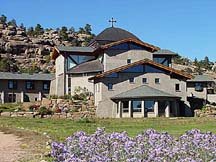
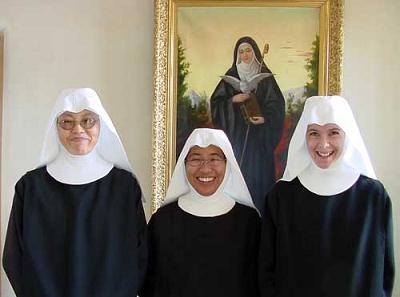
"The Abbey of Saint Walburga is a small community of contemplative Benedictine nuns of the Roman Catholic Church.

"We are located in a valley in northern Colorado, where the high plains meet the foothills of the Rocky Mountains.

"The goal of our life is to seek God in community according to the Gospel and under the inspiration of the Rule of St. Benedict.
Novices 2005"We devote much of our day to the Word of God, through reading and in liturgical prayer. This life of prayer bears fruit in hospitality, providing an opportunity for people to be in an atmosphere where they can find God."

(from the website of the Abbey of St. Walburga)

Why do they hate us?

On the very weekend that Hollywood has released perhaps its biggest anti-Christian movie ever, the Gospel reading in the long-determined cycle for this Saturday is John 15:18-21.

If the world hates you,
realize that it hated me first.

If you belonged to the world,
the world would love its own;
but because you do not belong to the world,
and I have chosen you out of the world,
the world hates you.

Remember the word I spoke to you,
'No slave is greater than his master.'

If they persecuted me,
they will also persecute you.

If they kept my word,
they will also keep yours.

And they will do all these things to you
on account of my name,
because they do not know
the one who sent me.

Our Lord is not paranoid: even as he spoke these words his enemies were already on the move and within 24 hours he would be dead.

Christ is not a lunatic figure summoning his followers to wreak violence upon the world and follow him into the bunker. He did not come into the world to condemn the world, but to bring salvation.

Yet Christ also sees things clearly and knows fully the enmity that the world has for him.

This brings us back to the original question: why do they hate us? Why do they hate Christ?

Answers may be found in these words of Christ:

If you belonged to the world,
the world would love its own;
but because you do not belong to the world,
and I have chosen you out of the world,
the world hates you.

....

And they will do all these things to you
on account of my name,
because they do not know
the one who sent me.

The world of which Christ speaks is not the world as created by God, but rather the self-reinventing world of man that exalts self-image over reality, pleasure over substance, and autonomy over fulfillment.

The source of the world's hate is its obsessive self-love: a love not of its true self, but of the image it tries to make of itself - a self image continuously threatened by reality.

God is the ultimate reality and thus worldly people desperately try to deprive God of any substance or to assert that God does not exist, imagining that they may then persevere in their selfish and delusional pursuits unhindered by any external reality.

This is why the world resents God, why it rejects Jesus Christ as historical and eternal, and why it tries to marginalize those who hold faithfully to God, to the person of our Lord and Savior Jesus Christ, and to the substance of Divine Revelation.

We get in the world's way. We do not accept the world's conceits. We remind the world of the ultimate futility of what it tries to do.

That is why the world hates us.

Yet we must love the people of this world: not the selfish world of human sin, but all the people created by God.

We love the people of the world because we see beyond the layers of pretense and imaginary reinvention to the fundamental truth that people are created by God, that created reality is full of God's purposes, and that people find fulfillment only in God.

And so we love: we disregard the pretenses of the world, we hold to the truth, we speak clearly of what we know, we reach out with true charity, and we remain firmly attached to our Lord and Savior Jesus Christ – the ultimate reality of the universe and the greatest fulfillment of mankind.

Curia change

The Holy Father has accepted the retirement of Cardinal Michele Giordano as Archbishop of Naples.

He has named as the new Archbishop of Naples Cardinal Crescenzio Sepe, 62, who has been Prefect of the Congregation for the Evangelization of Peoples.

He has named as the new prefect of the Congregation, Cardinal Ivan Dias, Archbishop of Bombay. Cardinal Dias, 70, served in the Vatican Diplomatic Corps (including assignments in Ghana, Togo, Benin, South Korea, and Albania) until his appointment as Archbishop of Bombay in 1996.

30,000 gathered to hear him speak

Without a microphone.

He traveled all around the country to preach.

On foot.

Bernadine of Siena, the most powerful preacher of the century, literally wore himself out in the service of God: dropping to the ground and dying on this very day in 1444 (the vigil of the Ascension that year). He was canonized six years later.

(adapted from an earlier post)

Friday, May 19, 2006

A lovely life

She and her husband worked for the same place.

They volunteered at their church.

They had a nice house in the country and two beautiful children: a girl and a boy, ages 7 and 4.

One day, she was in the parking lot at work and saw a coworker who looked like he needed a hand.

She didn't think twice.

Detective Vicky O. Armel, 40, drew her service weapon to shoot at the man who was spraying her fellow officer's car with automatic rifle fire.

The gunman shot her dead.

This happened in Fairfax county, Virginia, a little less than two weeks ago.

No one has greater love than this,
to lay down one's life for one's friends.


How strongly these words from today's Gospel (John 15:12-17) resonate.

How strongly these words challenge us.

Would I step into gunfire to save another person? Would you?

Would I give up nice things I enjoy in this world to live more fully the life I know is right? Would you?

Why don't I?

Dearest Lord Jesus, deepen my love.

(The officer in the car, Michael E. Garbarino, 53, died early Tuesday morning from his injuries. The gunman, a mentally disturbed teenager, died at the scene. Requiescant in pace.)

Thursday, May 18, 2006

Roman Catholic, Russian Orthodox meet

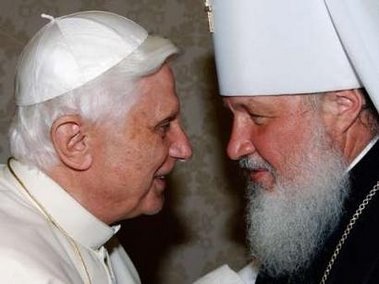
Pope Benedict XVI & Russian Orthodox Metropolitan Kirill - Credit: L'Osservatore RomanoAt the Vatican this afternoon, Pope Benedict XVI met with Russian Orthodox Metropolitan Kirill, head of the Moscow Patriarchate Department for External Church Relations and Metropolitan of Smolensk and Kaliningrad.

What “pollution from idols” means

It does not mean the golden calf had an "accident."

Nor does it mean instances of really bad singing on "American Idol."

At the time of today's first reading (Acts 15:7-21), "pollution from idols" would have meant association with objects of pagan worship.

How to avoid this? For one thing, don't worship in pagan temples or build little pagan shrines in your house.

But there was also a much more subtle issue in play at the time.

Often, after animals were sacrificed to idols, the meat would be sold on the open market. Since ancient Rome lacked today's truth-in-labeling laws, Christians might then unknowingly buy and consume meat that had been sacrificed to a pagan idol (although the meat would be hormone and antibiotic free [that's a joke, son]).

St. Paul addresses this concern about idols in 1 Corinthians 8.

As to the eating of food offered to idols, we know that 'an idol has no real existence,' and that 'there is no God but one.'.... However, not all possess this knowledge. But some, through being hitherto accustomed to idols, eat food as really offered to an idol; and their conscience, being weak, is defiled. .... And so by your knowledge this weak man is destroyed, the brother for whom Christ died.
(1 Corinthians 8:4,7,11)

Pagan idolatry seems to be on the rebound nowadays, especially as inadequately evangelized and catechized people try to "find themselves" in exotic or reinvented non-Christian spiritualities tied to statues and other objects.

The Scriptural warnings against explicit idolatry thus seem quite relevant today.

One must also be on guard against the implicit idolatries that pervade our modern life and culture: materialism, hedonism, intellectualism, and egotism.

Material things, pleasure, intellect, and self-concern all have their place, but they have become the center of existence for too many in the world today.

We as Christians, of course, know that the only God, the only ultimately satisfying reality, is God and so we worship God instead of the idols of this age. Yet even we are not immune to the "pollution" from these idols.

Moreover, we need to be attentive to the same concern Paul expresses to the Corinthians.

Even though we in our hearts may not be idolaters of money, pleasure, etc., perhaps we should give a thought to how others might be led astray by the particular way we are involved in these things.

Take care lest this liberty of yours somehow become a stumbling block to the weak.
(1 Corinthians 8:9)

Little children,
keep yourselves from idols.
(1 John 5:21)

He was not exactly a parishioner

But the powerful man thought the bishop would be a good choice for a diplomatic mission.

When the bishop arrived at his assigned destination, he was greeted with reverent enthusiasm by people at the very highest levels.

The bishop returned the favor by giving strong affirmation to his host and, consistent with his mission and his conscience, passed on a message of peace and kindness (while still upholding truth).

After the bishop returned from his mission, the powerful man went into a rage, threw the bishop into prison, and deprived him of food and water.

John, the first Bishop of Rome to use that name, died there on this very day in the year 526.

(adapted from an earlier post)

Wednesday, May 17, 2006

Christian Carnival

This week's Christian Carnival - an ecumenical collection of posts from various Christian blogs - is online at Pursuing Holiness.

The Da Vinci Code Movie

Advance screenings of the movie have been very tightly controlled: usually a sign that the studio thinks the movie is no good.

Critics were finally allowed to see it yesterday and indeed the reviews are generally poor.

BBC:
"...it is long and it is dull."

Time:
"...it’s not very good - long (2hr.32min.) and mostly inert."

Variety:
"..."a stodgy, grim thing..."

The review from The Daily Mail leads with a spoiler:


"When Tom Hanks's professor of symbols tells Audrey Tautou, French cryptologist, that she's the last living descendant of Jesus Christ, it's not exactly meant to be a funny moment.

"If anything you're meant to gasp, not laugh.

"But as more than 1,000 of the world's movie critics and film writers watched the much-anticipated and much-hyped screen version of Dan Brown's mega-best-selling novel The Da Vinci Code at a special preview at the Cannes Film Festival last night, guffaws could be heard echoing around the auditorium when Hanks utters the momentous words to Miss Tautou."

Hollywood Reporter:
"Bottom line: a jumble of historical myth, religious symbology and international thriller-action makes for an unwieldy, bloated melodrama."

***

Not to mention, of course, that much of the book's information is bogus:

A story of the Easter Message

It is said that some years after Ukraine had come under Soviet control, a famous Communist intellectual (in some accounts, he is identified as Nikolai Ivanovich Bukharin) travelled to Kiev at Eastertime. There the people had been forcibly gathered to hear the very best and brightest of atheistic communism.

The intellectual spoke for an hour, ending with brutal clarity.

"Therefore," he said, "there is no God; Jesus Christ never existed; there is no such thing as the Holy Spirit. The Church is an oppressive institution.... The future belongs to the State, and the State is in the hands of the Party."

As he was sitting down, an old priest near the front stood up and asked if he could say two words. The intellectual contemptuously agreed. The old priest turned back to the crowd and shouted:

"Khrystos Voskres!"
(Christ is risen)

The crowd shouted back:

"Voistynu voskres!"
(Indeed he is risen!)

Individualism

Individualism has its place: each one of us is a unique gift from God and a certain amount of self-sufficiency can facilitate self-giving.

Both of today's readings, however, illustrate that individualism has its limits.

St. Paul was assuredly one of the greatest Apostles: a profound theologian, a powerful speaker, a tireless traveler, and a worker of many miracles. Moreover, he was called to be an Apostle by the extraordinary and direct action of Jesus Christ himself.

And yet even he knew that he was only one person in a wider Church and so in today's first reading (Acts 15:1-6) he and Barnabas touch base with the Apostles in Jerusalem to make sure that his efforts would not be in vain (cf Galatians 2:2).

If even the mighty St. Paul can do this, how much more should shy away from "doing our own (righteous) thing" - how much more should we be diligent in staying on the same page as the rest of the Church.

And then we have that wonderful Gospel (John 15:1-8, repeated from Sunday) - a warning against excessive individualism and a call to deeper communion:

Just as a branch cannot bear fruit on its own
unless it remains on the vine,
so neither can you unless you remain in me.

I am the vine, you are the branches