A Penitent Blogger

Mindful of my imperfections, seeking to know Truth more deeply and to live Love more fully.

Quid sum miser tunc dicturus? Quem patronum rogaturus? Cum vix iustus sit securus?
Recordare, Iesu pie, Quod sum causa tuae viae: Ne me perdas illa die...

Sunday, April 30, 2006

Eat

Today’s Gospel (Luke 24:35-48) reminds us of the importance of eating.

Our risen Lord eats fish in the presence of the disciples, reminding us of the importance of physical food. So, we must be conscientious in what we eat and also in doing what we can to make sure that others are able to receive the physical food they need.

He opens their minds to understand the Scriptures, reminding us that we need to nourish ourselves with the Word of God and also that we, as individuals and as a Church, need to help others understand the teaching of Christ.

And the passage begins with these wonderful words:

The two disciples recounted
what had taken place on the way,
and how Jesus was made known to them
in the breaking of bread.


No greater reminder could there be of the wonder and the power of the real food which is Christ himself, the Eucharist, of which we must partake and to which we must help others appreciate.

You are witnesses of these things.

Saturday, April 29, 2006

Take this book of holy Scripture


and be faithful in handing on the word of God,
so that it may grow strong in the hearts of his people.


(Photo: Institution of Lectors - Pontifical North American College - January 15, 2006 - from the Vocations website of the Diocese of Arlington)

No dissenter he

The Washington Post this morning ran an article about blogs giving dissenters a worldwide voice, but foolishly used Father Jim Tucker as an example.

I respectfully dissent from that characterization.

Father Tucker is one of the most faithful and orthodox priests in cyberspace.

The fine young priest speaks to this himself while tipping his hat to American Papist.

Her parents had made plans for her...

...plans for a "normal" life, but the little girl had something else in mind.

She had already been seeing someone.

Jesus.

Word of her spiritual experiences spread. When she was still in her twenties, even Popes would pay heed to her and not only for pious inspiration.

Her words would thwart the plans of princes and would stir people of faith to dramatic action for the causes of truth, peace, and the freedom of God’s word.

Catherine, the pious little girl from Siena, died in Rome shortly after her 33rd birthday on this very day in 1380. She was canonized in 1461 and declared a Doctor of the Church in 1970.

(adapted from an earlier post)

(Apologies to my readers and to Saints
Peter Chanel and Louis Marie Grignion de Montfort whose memorials I missed yesterday.)

No ice

Today's Gospel (John 6:16-21) contains one of the accounts of our Lord walking on the water.

Someone recently made a media splash by implying that Christ could have been walking on ice that was not visible to the disciples. Even the author of this idea admits it would have involved a very rare phenomenon in that locality and that he cannot prove that this is what happened with Jesus.

The idea is more ludicrous that he admits. The event takes place around the time of the multiplication of the loaves when the grass is green (Mark 6:39) and the weather is described as stormy: hardly suitable meteorological circumstances for floating ice patches that can be walked upon.

We also know that in one instance of our Lord walking on the water (Matthew 14:29), he enables Peter to walk on the water (until Peter is overcome by his own fears).

Such ideas are floated (so to speak) by those who deny the existence of miracles or anything that cannot be explained by science. Of course, most honest scientists will admit that human science is a long way from being able to explain everything.

Human science, of course, reveals to us much about the created world in which we live and it enables humanity to do many good things (as well as some terrible things), but the ultimate mysteries of life, death, and the universe are intrinsically beyond the reach of empirical science.

The fundamental meaning of our Lord walking on the stormy water is that he as God is master of creation and all its mysteries: moving upon the face of the waters and pronouncing his name "I am."

No matter what storms there may be in our lives and what mysteries lie before us, we have unconquerable peace and comfort in our Lord and Savior Jesus Christ and in his words.

It is I. Do not be afraid.

Friday, April 28, 2006

Fighting against God

The words of Gamaliel in today's first reading (Acts 5:34-42) are words of warning not only to the Sanhedrin, but to us as well – whenever our focus is on what WE want to do.

You may even find yourselves fighting against God.

We may be fighting not simply against God’s will or God’s power, but most tragically against that fundamental desire for God himself that lies deep in the soul of every human person.

May we heed the words of Gamaliel and echo the heartfelt prayer of the Psalmist (27:4):

One thing I ask of the LORD
this I seek:
To dwell in the house of the LORD
all the days of my life,
That I may gaze on the loveliness of the LORD...

Thursday, April 27, 2006

Avoiding wrath

In today's first reading (Acts 5:27-33), the Apostles stand against the prevailing culture of their time and place and bring wrath upon themselves.

In the Gospel (John 3:31-36), our Lord warns of a different wrath.

Whoever believes in the Son has eternal life,
but whoever disobeys the Son will not see life,
but the wrath of God remains upon him.


May we never fear the wrath of men, but may we always embrace the love and truth of our Lord Jesus Christ.

Wednesday, April 26, 2006

Prison break

In today's first reading (Acts 5:17-26), an angel of the Lord frees the disciples from prison so that they may continue to preach the Gospel.

Go and take your place in the temple area,
and tell the people everything about this life.


But there are worse prisons than cages of stone and steel: the prison of spiritual emptiness and the insidious trap of a sinful life.

Indeed, as today's Gospel (John 3:16-21) reminds us, our Lord and Savior Jesus Christ frees us from these prisons of the soul, liberating us from the dungeons of despair, doubt, and spiritual squalor to which sin and faithlessness condemn us.

God so loved the world that he gave his only-begotten Son,
so that everyone who believes in him might not perish
but might have eternal life.

For God did not send his Son into the world

to condemn the world,
but that the world might be saved through him.

Whoever believes in him will not be condemned,
but whoever does not believe

has already been condemned,
because he has not believed

in the name of the only-begotten Son of God.

And this is the verdict,
that the light came into the world,
but people preferred darkness to light,
because their works were evil.

For everyone who does wicked things

hates the light
and does not come toward the light,
so that his works might not be exposed.

But whoever lives the truth comes to the light,
so that his works may be clearly seen

as done in God.

Christian Carnival

This week's Christian Carnival - an ecumenical collection of posts from various Christian blogs - is online at Brain Cramps for God.

Tuesday, April 25, 2006

Catholic Carnival

This week's Catholic Carnival - a collection of posts from various Catholic blogs - is online at To Jesus Through Mary.

The Coadjutor of Venice

The Holy Father has named Monsignor Frank J. Dewane to be coadjutor bishop of the Diocese of Venice in Florida. The current bishop, Bishop John Nevins had already announced that he would be retiring next year.

Bishop-elect DeWane was born on March 9, 1950 in Green Bay, Wisconsin. He attended public schools and obtained a BS in Social Science from the University of Wisconsin-Oshkosh. He later obtained a Masters degree in International Affairs from the Catholic University of America in Washington, DC (with further studies at George Washington University, also in DC).

After an interesting career in the secular world, he entered Notre Dame seminary in 1983, studying philosophy, and then was sent to the Pontifical North American College in Rome where he obtained a Bachelor's degree in Sacred Theology from the Gregorian University and a License in Canon Law from the Angelicum.

He was ordained a priest for the Diocese of Green Bay on July 16, 1988 and served as Assistant Pastor at Saints Peter and Paul Church in Green Bay from 1989 to 1991 and Defender of the Bond for the diocesan Tribunal.

He was then called to work for the Holy See, serving at its Permanent Mission to the United Nations in New York from 1991 to 1995, at the Pontifical Council Cor Unum from 1995 to 2001, and as Undersecretary of the Pontifical Council for Justice and Peace since 2002.

Bishop-elect Dewane knows Italian, Russian, French, and Spanish (Venice has a large population of migrant workers).

Ad multos annos.

We are not alone

It is often said that we are living in a post-Christian age.

Every year it seems more and more acceptable (if not required) in our modern society to criticize, marginalize and ridicule people who take their Christian faith seriously.

Being a Christian can sometimes seem very lonely.

Today's first reading (1 Peter 5:5-14) reminds us that our situation is not unique: it is not unique to our corner of the world nor is it unique to our time in history.

We are not alone.

The words of St. Peter ring out in every time and place:

Be sober, be vigilant;
because your adversary the devil,
as a roaring lion, walketh about,
seeking whom he may devour:
Whom resist
stedfast in the faith,
knowing that the same afflictions
are accomplished in your brethren
that are in the world.

We are not alone: we are one with the rest of the body of Christ - suffering throughout the world (often far more brutally than we) - and as we share in the sufferings of our Lord and Savior Jesus Christ, so shall we share in his consolation and in his victory.

We are not alone – we are one in Christ.

Christus vincit
Christus regnat
Christus imperat

Christ conquers
Christ reigns
Christ commands

Administrative Professionals Day

is celebrated tomorrow.

We remember today one particular Assistant who was proficient in state-of-the-art word processing and thus a valuable asset to the CEO.

The CEO was under tremendous pressure, trying to stay at least one step ahead of the law (sometimes, they said, the way the CEO escaped the clutches of the authorities was a miracle).

The Assistant facilitated some of the CEO's most critical correspondence as well as supporting him (and sometimes the number two guy) on travels.

No mere cog in the great corporate machine, the Assistant aspired to write a book.

The book turned out to be a best seller: the first of a famous genre of very specialized biographies.

The Assistant eventually was promoted to head a major branch and would be well thought of by the people there.

In the end, however, the Assistant was probably caught in the same government sweep that finally destroyed the CEO, the number two, and many others.

The Feast of Saint Mark - assistant and traveling companion to the Holy Apostles Peter and Paul, author of the earliest Gospel, and Bishop of Alexandria - is celebrated on this day.

(adapted from an earlier post)

Monday, April 24, 2006

Be BOLD

Very often it is good to be quiet: simply being open to God and drinking in his peace in the midst of a loud and chaotic world.

Very often it is good to be meek: to walk humbly with our God through a world drowning in selfishness.

But sometimes it is not good for us – as Christians and as members of God’s holy Church – to be meek and quiet.

Sometimes we must be bold.

In today's first reading (Acts 4:23-31), the members of the early Church are scarcely meek or quiet.

As they prayed,
the place where they were gathered shook,
and they were all filled with the Holy Spirit
and continued to speak the word of God with boldness.


Not all of us are, nor should we all be, mighty apostles and evangelists (the body is one and has many members), but too many of us - especially Catholics - limit the explicit practice of our faith to slipping off stealthily to a weekend Mass and then doing little more than mumble responses in the pew (and sometimes not even that).

This Easter season can be the opportunity for us to embrace anew what it means to be a Christian, to appreciate more fully the real meaning of Christ's victory over death, to open ourselves more to what we celebrate in every Mass, and to go forth into the world with the power of the Spirit.

This Easter, we can be bold.

Ashamed to be a lawyer

Mark's fellow lawyers disgusted him: they were interested in money, not justice.

So Mark left the practice of law behind and focused on the practice of the faith.

He gave away his money and became a Capuchin, taking the name Brother Fidelis.

He would be a powerful advocate for the faith and was soon famous for his preaching.

He was sent to preach missions in places where nearly all the people had left the Church to follow a different direction.

He would be very successful – too successful.

One day he was preaching in a church when a mob stormed in, killing several guards and striking Fidelis. A friendly man in the crowd offered to take Fidelis to safety. Fidelis thanked him but said he was in God's hands.

When he walked outside the church, the mob's leaders gave Fidelis one last chance to give up the faith.

Fidelis refused and was beaten to death right then and there - 384 years ago today in Seewis, Switzerland.

The memory of St. Fidelis of Sigmaringen is celebrated on this day.

Sunday, April 23, 2006

Keep it real

There is a program on television nowadays, watched by more than a few people, in which a particular record company executive is wont to make comments that come across as very unkind.

When the audience boos him, he often raises his hands and protests that he is simply trying to “keep it real.”

Honest, objective, rational criticism has its place, of course, but unkindness that is deliberate and unnecessary does not.

We do not need to keep unkindness real.

In fact, today’s readings tell us exactly the opposite.

Today, the end of the Octave of Easter (a full week of celebrating the resurrection of our Lord and Savior Jesus Christ), was called Divine Mercy Sunday by the great Pope John Paul II, and each of today’s readings in different ways tell us to “keep real” the divine mercy we celebrate.

Interestingly, depending on the translation used, the only time the word “mercy” is heard in today’s readings (and sometimes not even there) is in the repeated response of the magnificent litany that opens Psalm 118:

His mercy endures forever.

The word translated here as “mercy” is one of the loveliest words of ancient Hebrew: hesed – often translated more fully as “lovingkindness.”

THAT is what we need to keep real – in what we say and in what we do: the mercy, the hesed, the lovingkindness of God – manifested most perfectly and powerfully in the death and resurrection of our Lord and Savior Jesus Christ.

Indeed, in a special sense, we make the risen Christ present when we make mercy real in our lives: mercy that can be felt and touched – as real as the sacred wounds of the risen Christ in today’s Gospel (John 20:19-31).

We see this at the very beginning of the Church, as we hear in today’s first reading (Acts 4:32-35), in the days and months following the resurrection, where everyone cares for the needs of everyone else.

The second reading (1 John 5:1-6) also tells us how to keep mercy real.

In this way we know that we love the children of God
when we love God and obey his commandments.

Finally, we keep the mercy of God real by our forgiveness. It is no accident that the first thing our risen Lord says after saying Shalom in today’s Gospel is to send the Disciples forth for the ministry of forgiveness.

As we continue with this Easter season, as we live out the meaning of Christ’s resurrection in our lives, we need to do everything we can to make our loving and risen Lord present in what we do and what we say.

We need to keep mercy real.

Saturday, April 22, 2006

We are living in exciting times

"We are living in exciting times in the Church right now! Many young women are considering authentic religious life. They are seeking a way of life that is both challenging and joy-filled. With the leadership of Pope Benedict XVI and the witness of the late Holy Father John Paul II, they are following the roadmap for the New Evangelization.

"Are you among them?"

Sister Mary Emily, O.P.
Vocation Director, "The Nashville Dominicans"

Just last year, on August 8, 2005, "ten young women made their perpetual profession of the simple vows of poverty, chastity, and obedience as Dominican Sisters of Saint Cecilia Congregation in Nashville, Tennessee."
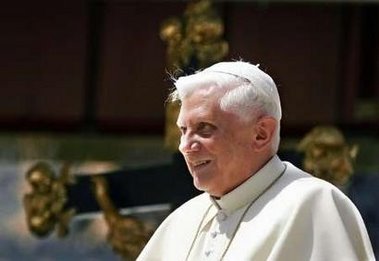
Several times a year The Nashville Dominicans have Vocation Retreats for those discerning their vocation. The next one is May 24-28, 2006.

Free exercise thereof

The First Amendment of the U.S. Constitution says: "Congress shall make no law respecting an establishment of religion, or prohibiting the free exercise thereof..."

That's nice.

That a civil government should permit "the free exercise" of religion is indeed a good thing.

But ultimately, it doesn't matter, as Peter says in today's first reading (Acts 4:13-21):

Whether it is right in the sight of God
for us to obey you rather than God,
you be the judges.

It is impossible for us not to speak about
what we have seen and heard.

Politicians sometimes remind us that freedom is a gift from the Almighty, not from governments.

What St. Peter is saying is that we share our faith with others not because we can, but because we must: because the Lord has commanded it and because freedom from sin and eternal life in Christ is such great news that it simply must be shared.

Give thanks to the LORD, for he is good,
for his mercy endures forever....

My strength and my courage is the LORD,
and he has been my savior.

The joyful shout of victory
in the tents of the just.

"The right hand of the LORD is exalted;
the right hand of the LORD has struck with power."

I shall not die, but live,
and declare the works of the LORD.

(Psalm 118:1,14-15a,16-17)

Friday, April 21, 2006

Let's be clear

In today’s first reading (Acts 4:1-12), Peter pulls no punches in talking about Jesus.

There is no salvation through anyone else,
nor is there any other name under heaven
given to the human race by which we are to be saved.


Nothing else is in the same league as God becoming man, dying and rising from the dead.

This reaffirms the necessity of our efforts as Christians to proclaim Christ and to help lead others to Christ.

Even if we believe that Christ’s saving power is somehow at work in those who - through no fault of their own - do not really know him, we must be diligent in making clear to them and to everyone the truth about our Lord and Savior Jesus Christ.

For there is no other name by which we are to be saved.


That at the name of Jesus
every knee should bend,
of those in heaven and on earth
and under the earth,
and every tongue confess
that Jesus Christ is Lord,
to the glory of God the Father.
(Philippians 2:10-11)

Thursday, April 20, 2006

More stupid than evil

There is evil in the world: horrific malice that most of us can scarcely imagine.

There is also evil in the world that comes from simple selfishness: inevitably and ironically self-destructive.

And then there is the evil that is the fruit of sheer stupidity.

Indeed, in today’s first reading (Acts 3:11-26), St. Peter blames the most horrific of all evil deeds – the crucifixion of our Lord Jesus Christ – on ignorance.

Now I know, brothers and sisters,
that you acted out of ignorance, just as your leaders did...


In this, Peter followed the example of the Lord and the words he spoke from the cross.

Father, forgive them, they know not what they do.
(Luke 23:34)

Of course, we need to be careful, vigilant, and strong in Christ: deadly evil and fierce malice truly stalks the earth and the lure of selfish pleasure draws many to destruction.

(May the Lord Jesus have mercy on us all.)

Yet we must remember that there is also much ignorance even in the “communication age” and that there is much that we can do through the truth and forgiveness of Christ.

They know not what they do.

Forgive them and teach them.

Wednesday, April 19, 2006

"Dear Brothers and Sisters..."

"On this, the first anniversary of my election as the Successor of Saint Peter, I thank the Lord for his unfailing help, and I express my gratitude to all those who have supported me by their prayers. I ask you to continue praying that, by God’s grace, I may always be a gentle and firm Shepherd for Christ’s flock.

"During these days of Easter, the Church proclaims the Good News of Christ's suffering, death and resurrection.

"The Paschal Mystery is the core of our faith! Our yearly celebration of Easter is a foretaste of the eternal joy of heaven. This joy is renewed each Sunday at the celebration of the Eucharist, when we proclaim 'the resurrection of the dead and the life of the world to come,' and celebrate the new life received in Baptism.

"During these days of Easter, all Christians are called to encounter the Risen Lord, to renew their faith in him, to be transformed by the power of his grace, and to share with the men and women of our time the Good News that Christ is truly risen!"
(Pope Benedict XVI - from this morning's General Audience)

***

A Penitent Blogger humbly wishes Pope Benedict XVI a blessed anniversary and more.

AD MULTOS ANNOS
GLORIOSQUE ANNOS
VIVAS

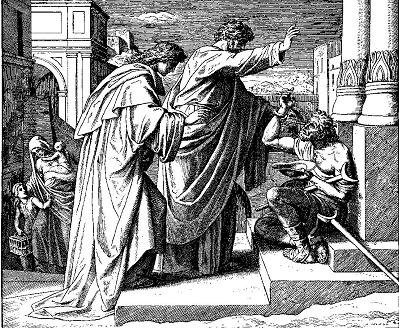
Silver and gold have I none

Now Peter and John went up together into the temple at the hour of prayer, being the ninth hour. And a certain man lame from his mother's womb was carried, whom they laid daily at the gate of the temple which is called Beautiful, to ask alms of them that entered into the temple; Who seeing Peter and John about to go into the temple asked an alms. And Peter, fastening his eyes upon him with John, said, Look on us. And he gave heed unto them, expecting to receive something of them.

Then Peter said,
Silver and gold have I none;
but such as I have

give I thee:
In the name of Jesus Christ of Nazareth
rise up and walk.


(Acts 3:1-6 - from today's first reading)

Were not our hearts burning within us...?

In today's Gospel (Luke 24:13-35) we hear the familiar story of the risen Christ appearing to two disciples on the road to Emmaus.

Only in retrospect do the disciples appreciate or even understand the greatness of what had happened.

"Were not our hearts burning within us
while he spoke to us on the way
and opened the Scriptures to us?"

This passage wonderfully summarizes the Christian life.

May you and I always appreciate the greatness of what God gives to us not just in retrospect but as it happens.

May we always feel the presence of the Lord walking beside us.

May Christ "open the Scriptures" ever more fully to us and enkindle in our hearts the fire of his truth.

And may we recognize the Lord "in the breaking of the bread."

Christian Carnival

This week's Christian Carnival - an ecumenical collections of posts from various Christian blogs - is online at Attention Span.

Tuesday, April 18, 2006

Catholic Carnival

This week's Catholic Carnival - a collection of posts from various Catholic blogs - is online at Universal Call.

Knew not that it was Jesus

We see them all the time, but they are often invisible.

They are the landscapers, working in the dirt on their hands and knees by the sidewalk.

They are the people who quietly empty trashcans and clean up soda spills amid the hubbub of the shopping mall.

They are the cleaning people washing out toilets and scrubbing floors late into the night.

We see them all the time, but we often pay them no attention - as if they were invisible.

In today’s Gospel (John 20:11-18), Mary Magdalene gets involved in a conversation with some she thinks to be a landscaper.

She "knew not that it was Jesus."

This Gospel account is more than just a wonderful anecdote about that blessed day of Christ's resurrection, it also reminds us of something our Lord says in Matthew’s Gospel (25:40).

Inasmuch as ye have done it
unto one of the least of these my brethren,
ye have done it unto me.

We need to treat everyone we meet as if they were Christ: not just our family, friends and fellow churchgoers, but also people in need and people that too many of us treat as invisible.

Likewise, we must remember that we ourselves should live, speak, and act as representatives of Christ to others.

God forbid that people should know us and know not – from the way we live, speak and act - that we are Christians (merely saying that we are Christians doesn't really count – and is often counterproductive).

May we always recognize Jesus in those we meet and may we always proclaim our risen Lord and Savior Jesus Christ by the way we live, speak and act.

Go to my brethren, and say unto them,
I ascend unto my Father and your Father;
and to my God and your God.

Monday, April 17, 2006

"God or the Girl"

A&E Networks is running a short series about young men discerning whether they have vocations to the Priesthood: "God or the Girl."

Persistent lies vs. the Power of Truth

Today's readings on this glorious day after the celebration of our Lord's resurrection focus on the things that were said in the days after that most wonderful of events.

In today's first reading (from Acts 2), St. Peter on the day of Pentecost gives that first great public proclamation of Christ's resurrection from the dead. As we shall hear in tomorrow's first reading, Peter's proclamation of this truth had tremendous effect: thousands of people accepted the truth of Christ and were baptized that very day.

On the other hand, in the Gospel (Matthew 28:8-15), we hear the first of many disinformation campaigns against this most important event of all human history.

These stories have persisted and proliferated to the present day. The tellers of such stories sell millions of books and even produce major motion pictures, making small fortunes out of big lies.

In the face of such stories, we certainly need to be even more persistent in proclaiming the saving truth of our Lord and Savior Jesus Christ.

Yet we should not let ourselves be terrified or dispirited by the seeming prevalence of such tales.

Truth is more powerful than even the most well-financed and expertly spun lie.

The one enthroned in heaven laughs;
the Lord derides them.

Psalm 2:4

Christ is risen.
He is truly risen.

Believe it deeply.

Proclaim it boldly.

And fear no lie.

*******

I say to the Lord,
you are my Lord, you are my only good.

Worthless are all the false gods of the land.
Accursed are all who delight in them.

They multiply their sorrows who court other gods.
Blood libations to them I will not pour out,
nor will I take their names upon my lips.

LORD, my allotted portion and my cup,
you have made my destiny secure.

Pleasant places were measured out for me;
fair to me indeed is my inheritance.

I bless the LORD who counsels me;
even at night my heart exhorts me.

I keep the LORD always before me;
with the Lord at my right, I shall never be shaken.

Therefore my heart is glad, my soul rejoices;
my body also dwells secure,

For you will not abandon me to Sheol,
nor let your faithful servant see the pit.

You will show me the path to life, a
bounding joy in your presence,
the delights at your right hand forever.
Psalm 16:2-11

Sunday, April 16, 2006

Number one

Saint Mary Magdalene was the first to spread the news of Christ’s resurrection.

Saint John was the disciple whom Jesus loved.

Saint Peter was the rock upon whom Christ said he would build his Church.

These are the three people in today’s Easter Gospel (John 20:1-9): each of them were very different, yet each of them had a critical role in proclaiming the resurrection of Christ.

Different groups in subsequent generations would try to distort who these people were and even twist their relationship with Christ in sometimes sordid ways.

Peter, John and Mary would have thought all of this extremely silly: not only because none of it was true, but most especially because they knew that they themselves were relatively unimportant.

What was important, what is important now and important in eternity is Christ Jesus, crucified and risen.

Christ was number one – the first born of all – eternally begotten of the Father.

They knew, they saw, they felt the power of his resurrection from the dead.

This is what we proclaim to you:
what was from the beginning,
what we have heard,
what we have seen with our eyes,
what we have looked upon,
and our hands have touched

-- we speak of the word of life.

(1 John 1:1)

For each of them, the most important thing, the driving force of their lives from that Sunday morning onward, was manifesting that resurrection and its power in every part of their lives.

They were three different people, but they all had one Lord, one Savior, one mission – to proclaim the resurrection of Christ as he himself called them to.

So also in our lives, we can sometimes get caught up in many issues, controversies and concerns. We can get caught in struggles for dominance and autonomy – with individuals and groups arguing about who is more important than the other.

The message of this Easter morning – the message of Peter, John, and Mary – is that nothing is more important than living and proclaiming the resurrection of our Lord and Savior Jesus Christ.

It is a message that we desperately need in the world today.

It is a message to which the world needs us to be faithful: the unvarnished truth of the Lord and Savior who conquers sin and death and gives eternal life.

You and I - together with Peter, John and Mary - are among th billions called to be faithful to this message and to proclaim it - no matter who we are.

Christ is risen.

Tell the world.

Friday, April 14, 2006

Identified through suffering

In today's reading of the Passion from the Gospel according to John (John 18:1—19:42), our Lord pronounces two little words that have a strange and powerful effect:

Ego eimi.

These two Greek words sometimes are understood as meaning "I am he" and sometimes as "It is I." But neither of those meanings would cause THIS kind of reaction:

When he said to them, “Ego eimi,”
they turned away and fell to the ground.


No, it is a third meaning of ego eimi that is meant and that is profoundly understood by the crowd (if only subconsciously).

Ego eimi.

I AM.

The most sacred and wondrous Name of God.

Earlier in John's Gospel (John 8:51-59) our Lord had used these exact same words with this same meaning, but the crowd had been very slow to catch on, and when they did, they had tried to stone him.

Now, they turn away and fall to the ground.

Their minds and hearts were fixed on destroying this man from Nazareth, but their spirits were instantly cowed as the Son of God spoke that Name.

Why did this not happen before? What made our Lord’s self-identification so spiritually unambiguous?

Because this was the Hour: the hour of his suffering.

We see this also in the Gospel according to Mark: our Lord’s true identity – the “Messianic secret” held so closely throughout the Gospel – is definitively revealed at the foot of the cross.

When the centurion who stood facing him
saw how he breathed his last he said,
“Truly this man was the Son of God!”

(Mark 15:39)

Most of us are afraid of suffering – and quite understandably so.

Few if any of us, however, can avoid any suffering in this life.

Yet if we unite our sufferings with the sufferings of Christ, through the free gift of his grace, we deepen our identification with our Lord and Savior – the one who gives us eternal life.

As Christians we know that we find in Christ our salvation and our most profound identification through suffering.

And so we need not be afraid.

Draw me ever closer to yourself, Blessed Lord Jesus.

Thursday, April 13, 2006

Christian Carnival

This week's Christian Carnival - an ecumenical collection of posts from various Christian blogs - is online at Cadmusings.

Wash one another’s feet

Our Lord’s words in tonight’s Gospel (John 13:1-15) are plain:

If I, therefore, the master and teacher,
have washed your feet,
you ought to wash one another’s feet.

I have given you a model to follow,
so that as I have done for you, you should also do.


We must wash each other’s feet.

We need to spend less time worrying about our own feelings or preferences – our autonomy or our self-pity -- and follow our master and teacher, our Lord and Savior Jesus Christ.

We must serve the Lord with gladness and serve his children with humility.

In our acts of compassion and in our prolonging of patience, we must wash each other’s feet.

Holy Thursday & Priesthood

Today, on Holy Thursday, the Mass of the Holy Chrism is celebrated (although many dioceses celebrate it earlier in the week for practical reasons) at which Holy Chrism and other sacramental oils are blessed and at which priests rededicate themselves to their ministry. After the homily the bishop speaks to the priests:

"My brothers,

"Today we celebrate the memory of the first Eucharist, at which our Lord Jesus Christ shared with his apostles and with us his call to the priestly service of his Church.

"Now, in the presence of your bishop and God’s holy people, are you ready to renew your own dedication to Christ as priests of his new covenant?"
Priests: "I am."

"At your ordination you accepted the responsibilities of the priesthood out of love for the Lord Jesus and his Church. Are you resolved to unite yourselves more closely to Christ and to try to become more like him by joyfully sacrificing your own pleasure and ambition to bring his peace and love to your brothers and sisters?"
Priests: "I am. "

"Are you resolved to be faithful ministers of the mysteries of God, to celebrate the Eucharist and the other liturgical services with sincere devotion?"
Priests: "I am. "

"Are you resolved to imitate Jesus Christ, the head and shepherd of the Church, by teaching the Christian faith without thinking of your own profit, solely for the well-being of the people you were sent to serve?"
Priest: "I am."

(Then the bishop addresses the people:)

"My brothers and sisters, pray for your priests.

"Ask the Lord to bless them with the fullness of his love, to help them be faithful ministers of Christ the High Priest, so that they will be able to lead you to him, the fountain of your salvation."
People: "Lord Jesus Christ, hear us and answer our prayer."


"Pray also for me that despite my own unworthiness I may faithfully fulfill the office of apostle which Jesus Christ has entrusted to me. Pray that I may become more like our High Priest and Good Shepherd, the teacher and servant of all, and so be a genuine sign of Christ’s loving presence among you."
People: "Lord Jesus Christ, hear us and answer our prayer. "


"May the Lord in his love keep you close to him always, and may he bring all of us, his priests and people, to eternal life."
All: "AMEN."

(from an earlier post)

Wednesday, April 12, 2006

Where shall we prepare?

In today’s Gospel (Matthew 26:14-25), the disciples ask our Lord,

“Where do you want us to prepare
for you to eat the Passover?”


It is a good reminder for us to prepare in a new and special way for the celebration of the suffering, death and resurrection of our Lord and Savior Jesus Christ in the liturgies of the Triduum.

It would be good, if we have not planned to do so already, to plan attending the liturgies of the Triduum, especially at a parish that has a particularly serious and prayerful approach to liturgy. Attending these liturgies at the diocesan cathedral is often an excellent option.

Most importantly, of course, we need to prepare spiritually an “upper room” in our hearts and souls in which we can welcome the grace of our crucified and risen Lord.

Like Flint

Today’s readings vividly depict the vicious antagonism often suffered by people of faith, beginning with the “tough guy” poetry of Isaiah (Isaiah 50:4-9a):

I gave my back to those who beat me,
my cheeks to those who plucked my beard;
My face I did not shield
from buffets and spitting.

The Lord GOD is my help,
therefore I am not disgraced;
I have set my face like flint,
knowing that I shall not be put to shame.


And then (Matthew 26:14-25), there is our Lord’s poignant witness to intimate treachery.

"He who has dipped his hand into the dish with me
is the one who will betray me.”


Many of us feel that, if push came to shove, we would stand up to persecution and even die for Christ. Some of us in our heart of hearts, however, worry that we are “wusses” and fear that we would not be able to stand up against serious persecution.

Sadly, persecution is an increasingly real phenomenon as even in “civilized” countries Christians are being criminally investigated and charged for honestly expressing mainstream Christian teaching. Even in our daily lives we may too often let our Christian beliefs cower in the face of social pressure or an activist bully.

As a film character once asked, “What can men do against such reckless hate?”

The answer is not a paranoid or "bunker" mentality (and "scorched earth" responses are generally ineffective tactics for evangelization).

The answer is focus and grace: focus on Christ and be filled with his grace.

Of course, we should be as prudent and as strong as we can: but ultimately only God’s grace can preserve us.

Our first reaction to every fear, every worry, every attack, and every betrayal must be to go deeper into Christ.

It is very much like the story of Peter in the storm: when he focused on the wind and the waves, he sank; but as long as he kept his gaze fixed on Christ, he could literally walk on water.

Some of us are "tough guys" who can easily set our faces "like flint," some of us are not, but no matter what we may fear or what we may suffer, in and through our Lord and Savior Jesus Christ we are eternally indomitable.

(adapted from an earlier post)

Tuesday, April 11, 2006

Walk!

When it comes to our faith, especially in this post-Christian world, many of us speak more boldly than we act.

Colloquially, we speak of the difference between “talking the talk” and “walking the walk.”

At the end of today’s Gospel (John 13:21-38), Peter is talking quite boldly indeed.

Lord, why cannot I follow thee now?
I will lay down my life for thy sake.


But our Lord knows Peter’s frailty (I can imagine him speaking to Peter with a sad smile and deeply sad eyes).

Wilt thou lay down thy life for my sake?
Verily, verily, I say unto thee,
The cock shall not crow,
till thou hast denied me thrice.


Peter talked the talk, but could not walk the walk – not yet.

Our Lord knows Peter’s frailty, he knows that Peter will deny him, but he also knows that Peter will eventually come through.

Thou shalt follow me afterwards.

Like Peter, we are frail: our actions do not always match our words.

Like Peter, however, we must not despair if we have failed: if we have let fear or selfishness cause us to sin in the things we have done and the things we fail to do.

Following the Resurrection of Christ and the Descent of the Holy Spirit, Peter went on to be a powerful follower of Christ: all the way to his own cross.

By the grace of Christ and the power of the Holy Spirit, we too can be bold followers of our Lord and Savior Jesus Christ. The way is not shut. We can "walk the walk."

As we reflect once more this week on the events of our salvation – the suffering, death and resurrection of our Lord Jesus Christ – as we walk beside Christ on the Way of the Cross, we must pray for the grace of comfort in Christ’s forgiveness and the grace of boldness in walking every day of our lives as followers of Christ.

Catholic Carnival

This week's Catholic Carnival - a collection of posts from various Catholic bloggers - is online at Deep Furrows.

Monday, April 10, 2006

Judas

Today's Gospel (John 12:1-11) mentions the figure of Judas, a name bandied about gleefully in these days by the mainstream media and agenda-driven cultural elites who trumpet a so-called "Gospel of Judas." This gnostic "gospel" was written decades (if not centuries) after the canonical Gospels, provides virtually no solid historical information about the real Judas Iscariot, and represents views of Christ, humanity and the universe that are truly bizarre.

Our focus, of course, should not be Judas, but our Lord and Savior Jesus Christ.

Moreover, by focusing too much on what Judas did, we forget our own role in the betrayal and death of Christ, for he died to take away our sins.

Yes, Judas betrayed him, but Christ ultimately died because of us and because of our sins.

By our sin, we hand over Christ to be crucified – often for much less than the value of thirty pieces of silver.

By our sin, we betray Christ. Some of us even try to “kiss up” to Christ by putting great efforts into the exercise of prayer, public worship, and even social justice, while leaving our personal moral failures and lack of true penitence unchecked.

In a real sense, we are Judas.

But we do not have to be.

Christ calls us to repentance – no matter what we have done – and he extends to us his infinite love and mercy.

We do not have to be like Judas: by the grace of Christ we can turn away from sin and find forgiveness.

As we celebrate again the events of this Holy Week, in which Christ suffered betrayal, pain, and death for our sin – your sin and my sin – we have a great opportunity to experience in a deeper way the grace of repentance and forgiveness won for us by the loving suffering of our Lord and Savior Jesus Christ.

In good times and in bad

Depending on how the entrance rite is celebrated, there are two Gospels at Masses on Palm Sunday (yesterday – sorry for the delay): the account of our Lord’s triumphant entrance when the crowd welcomes him with joy (Mark 11:1-10) and the account of our Lord’s Passion when the crowd condemns him to death (Mark 14:1-15:47).

May we always be focused on Christ in our moments of joy and may we always be faithful to Christ in our times of suffering and abandonment.

Saturday, April 08, 2006

Expectation

Today’s Gospel (John 11:45-56) ends on a note of expectation.

They looked for Jesus and said to one another
as they were in the temple area, “What do you think?
That he will not come to the feast?”


They were speaking of the Feast of Passover in Jerusalem.

But the Lord Jesus did come to the Feast and in doing so he would transform it - and us - forever.

On this day before Palm Sunday, on this last day before Holy Week, may we ourselves have a deep and powerful feeling of expectation for the events we will shortly celebrate and for the eternal life won for us by the suffering, death, and resurrection of our Lord and Savior Jesus Christ.

Friday, April 07, 2006

Promoting Vocations among Young Adults

A. "Create a climate of vocational awareness
  • "Pray for vocations (with weekly Holy Hour for vocations)
  • "Priests and religious should show they are happy and excited about their vocation, and joyfully invite others to join them
  • "Involve seminary professors, vocations directors, and men and women religious in the life of the community (e.g., celebrating mass, if priests; giving presentations; providing spiritual direction)
  • "Invite seminarians and religious in formation to share their stories
  • "Publicize young adults from parish or campus ministry who have vocations
  • "Preach about vocations
  • "Have a vocations committee and involve young adults

B. "Model and cultivate a love for the Church and its mission

  • "Develop love and respect for the archbishop and the local Church; campus ministries should involve him at the center as much as possible
  • "Form young adults in evangelization and apologetics
  • "Cultivate a global perspective (catechesis, Operation Rice Bowl, mission trips, etc.)

C. "Cultivate a sense of meaningful sacrifice

  • "Connect with young adult idealism
  • "Speak of the sacrificial self-giving that is part of both marriage and celibacy
  • "Catechize on stewardship
  • "Promote short and long term volunteer opportunities

D. "Retreats

  • "Evangelizing retreats
    a. "Busy Persons Retreat, with involvement of vocations directors
    b. "Awakening retreats; incl